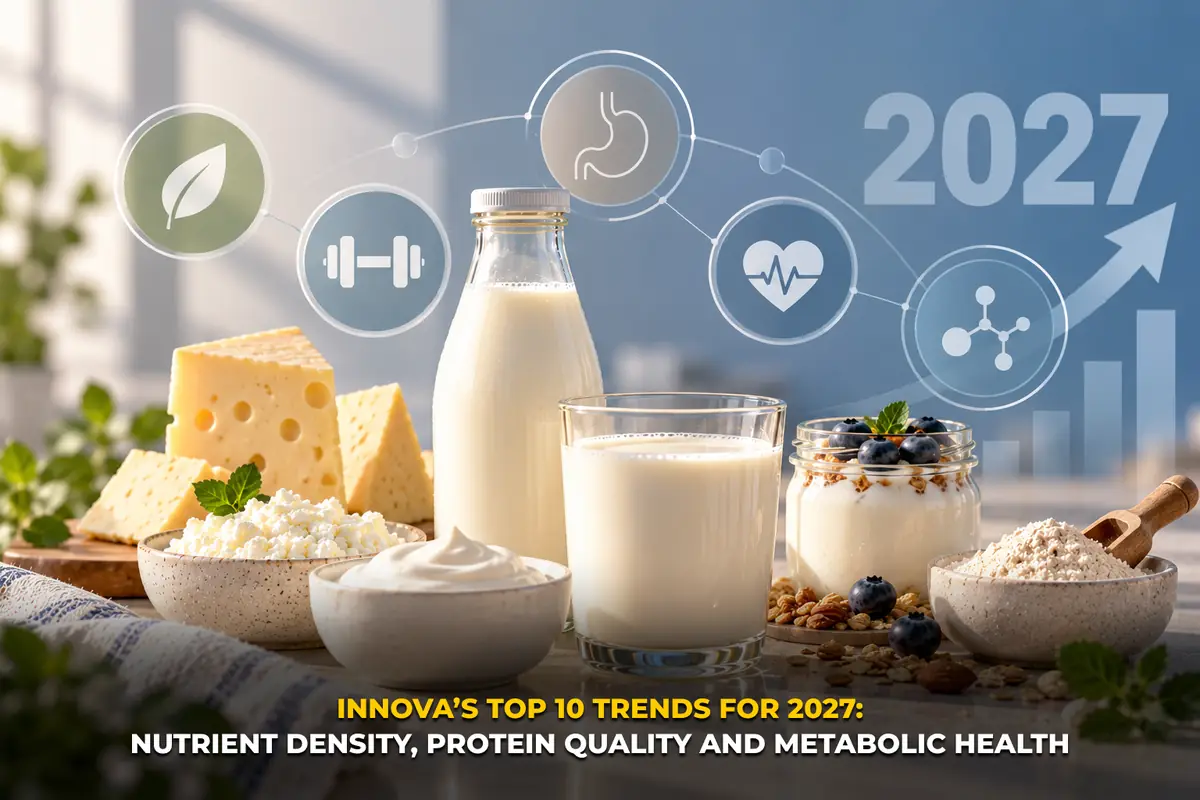
Market research company Innova Market Insights has unveiled its «Top 10 Trends for 2027» in food and beverages, with a clear focus on how much nutrition a product delivers, Food Ingredients First reports.
Key points:
- 59% of consumers globally read all or most of the nutrition information on packs;
- launches positioned around slow and complete protein grew 90%, led by sports nutrition and dairy;
- launches with glucagon-like peptide-1 (GLP-1)-friendly claims grew 190%;
- launches featuring creatine rose 106%, and those with joint health claims 70%.
How the ranking was built
Each year, Innova compiles its top ten food and beverage trends based on its global consumer surveys, tracking of new product launches and on-pack information, and market intelligence.
According to the company, modern consumers read nutrition labels and choose protein by its quality. They also expect food to support their energy, appetite, longevity, lifestyles and sustainability values and goals. Climate concerns, economic pressure and global uncertainty appear to be making consumers more deliberate about what they buy.
Food Ingredients First spoke with Lu Ann Williams, Innova’s president and co-founder, and took a deep dive into the first five of the ten trends presented at the company’s webinar.
Innova’s Top 10 Trends 2027:
- «Nutrient Density Design»
- «Precision Protein»
- «Sensory Playground»
- «Metabolic Edge»
- «Longevity Engineering»
- «Peace of Mind»
- «Ferment Forward»
- «From Soil to Shelf»
- «Radiance Rituals»
- «Prompt to Plate»
Trend #1 — «Nutrient Density Design»
Innova finds that consumers increasingly weigh products by their nutritional return. According to its 2026 packaging survey, 59% of consumers globally read all or most of the nutrition information on packs. Sugar draws the most attention, followed by protein and fat.
In reformulations Innova tracked between July 2025 and June 2026, protein, fibre, and vitamins and minerals were the top additions. Launches carrying both protein and fibre claims grew 15% year-on-year.
«Nutritional value is becoming a key measure of how consumers judge everyday food and drink», Williams says. «Reduction still matters, but it is no longer the whole story».
«Brands are now reformulating familiar products to strengthen their nutritional profile, not just to remove ingredients».
Trend #2 — «Precision Protein»
Consumers are paying closer attention to protein quality. Launches positioned around slow and complete protein grew 90% year-on-year, led by sports nutrition and dairy.
More than a third of consumers seek high-quality protein, 32% value easy digestion and 29% look for complete protein. Collagen is lifting animal-based protein: launches using animal-based collagen rose 28%, compared with 8% for dairy-based and 4% for plant-based.
«For years, protein has been a numbers game», Williams says. «Quantity still matters, but consumers increasingly want to know what kind of protein they’re getting, how well it’s digested, and whether it suits their body and needs».
«Therefore, the next phase is about matching protein to the person and the occasion».
Trend #3 — «Sensory Playground»
Consumers’ appetite for sensory novelty is becoming more nuanced and targeted. Nearly six in ten consumers worldwide are interested in products drawing on other countries’ or regions’ cuisines, with ingredients such as matcha, ube and chai spreading across categories.
Launches in freeze-dried formats grew 46% and mochi launches 24%. Sweet and spicy launches rose 31%, and sour and spicy launches 27%.
«Sensory innovation is moving well beyond taste», says Williams. «Texture is leading the way, with 56% of consumers looking for interesting texture combinations, but aroma and even colour are starting to shape the experience before the first bite».
«The opportunity is to design products consumers experience through several senses at once, and that can make even a familiar format more memorable».
Trend #4 — «Metabolic Edge»
Consumers are looking beyond general healthy eating to manage how food affects their glucose, appetite, energy and internal balance. Some 39% of consumers globally want food and drink that helps keep their energy steady.
Consumers are already eating less sugar and more fibre to support metabolic health. Launches with low, no or reduced glycaemic index positioning grew 30%.
Satiety is another focus: 33% of consumers want products that help them stay full for longer, and launches with satiety or appetite-control positioning rose 34%.
GLP-1 medications complicate the picture. Launches with GLP-1-friendly claims grew 190%.
Among current US GLP-1 users, 56% say they treat themselves to indulgent foods more since starting the medication. As the company notes, a smaller appetite does not remove the desire to indulge.
Trend #5 — «Longevity Engineering»
The focus of healthy ageing is shifting from short-term wellness to a longer health span, with consumers aiming to stay strong, mobile and mentally sharp throughout life. More than a third of consumers globally want help staying strong as they age.
Muscle, bone and joint support are becoming core longevity benefits. Launches with joint health claims grew 70%, followed by ageing well (+55%) and bone health (+24%).
The range of longevity ingredients is also widening: launches featuring creatine rose 106%, collagen 38% and calcium 36%. Launches pairing anti-ageing or ageing-well claims with protein claims grew 94%.
Cognitive positioning is broadening too, as brands move from short-term concentration claims towards memory support and maintaining brain health with age. Launches with brain health claims grew 21%, and those with memory claims 54%.
All year-on-year data compare July 2024 – June 2025 with July 2025 – June 2026.
Source: Food Ingredients First