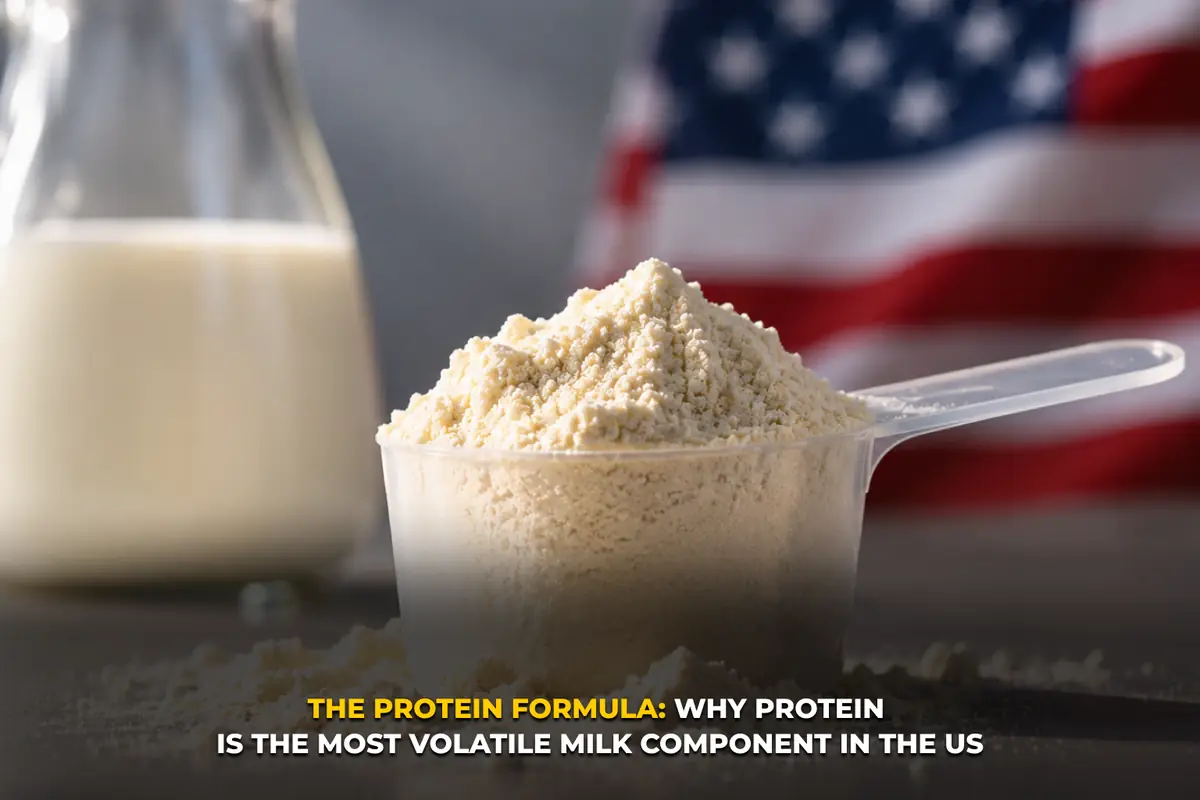
Protein is the most volatile component in US milk pricing because its formula relies on the prices of two commodities at once — Cheddar cheese and butter. Analyst John Geuss has broken down how the formula works and how the 2025 changes affected it, on the MilkPay website.
Key points:
- the protein price formula is based on concepts developed by Dr. Van Slyke in the early 1900s;
- over the past four years, the butterfat price has fallen by 60% and the cheese price by 30%;
- in 2025, the make allowance in the protein formula rose from USD 0.2003 to USD 0.2519 per pound (+26%);
- as a result, the protein price fell by USD 0.16 per pound, a reduction that will continue in all future months.
How the protein price is calculated
The formulas for valuing protein were first developed in the early 1900s by Dr. Van Slyke. Some elements have been modified over time, but they still follow his concepts.
The first line of the formula represents the traditional method of valuing a commodity: the protein value is based only on the Cheddar cheese price less the make allowance.
The second line compares the value of butterfat in cheese with its value in butter. If butterfat is worth more in cheese than in butter, it adds to the protein price; if it is worth less, it reduces it. The formula used in 2025 and 2026 (prices in USD per pound) is:
Protein Price =
((Cheese Price − 0.2519) × 1.383) +
((((Cheese Price − 0.2519) × 1.589) − Butterfat Price × 0.91) × 1.17)
Cheese and butterfat prices are falling
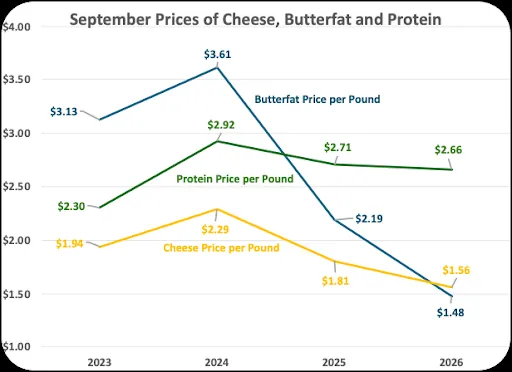
Over the past four years, cheese and butterfat have lost value. Butterfat values are based on the wholesale butter price. The period was chosen to show the impact of varying cheese and butterfat prices: butterfat fell by 60% and cheese by 30%.
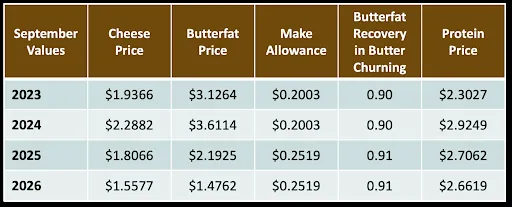
In 2025, the make allowance in the protein formula changed from USD 0.2003 to USD 0.2519, a 26% increase. Butter recovery from butterfat rose from 0.90 to 0.91, a small change. Cheese and butterfat prices, the make allowance and butterfat recovery are all used to calculate the protein value.
When butterfat works in protein’s favour
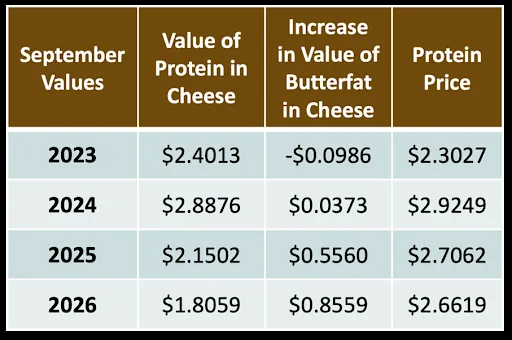
The first part of the formula calculates the protein value based only on the Cheddar price less the make allowance. The second adjusts it depending on where butterfat is more valuable: in butter or in cheese.
In 2023, butter was scarce and butter and butterfat prices were high. Butterfat was worth more when priced by butter than by cheese, so the second part of the formula was negative.
From 2024 through 2026, butterfat was worth more in cheese than in butter, and the «adjustment» turned positive, adding to the protein value.
Summary
The protein formula is complicated, but broken down it is simple. Using two commodity prices in the formula increases volatility. The higher value of butterfat in cheese is positive most of the time, and eliminating it would reduce the average protein price.
How the 2025 changes affected the formula
The 2025 increase in the make allowance lowered the value of both parts of the formula. It reduced the protein price by USD 0.16 per pound in September 2025 and 2026, and this reduction will continue in all future months.
- The first part — the value of protein in cheese — fell by USD 0.07 per pound.
- The second part — the adjustment between butterfat valued by cheese and by butter — fell by USD 0.09 per pound.
The larger drop in the second part results from the change in butter recovery, which increases the butterfat value calculated by the butter formulas. In effect, the make allowance change is counted twice, and the butter recovery change once.
About the author:
John Geuss writes the milk price blog on MilkPay and works as a consultant in dairy and food processing. He holds a B.S. in Engineering and an MBA from Ohio State University. He began his career as a financial analyst at Eastman Kodak. He then spent 22 years at Borden as Vice President of Engineering, Plant and Operations Management, and another 22 years at Adisseo as Director of IT and Marketing. He is a Licensed Professional Engineer and holds securities and IT certifications.
Source: MilkPay