
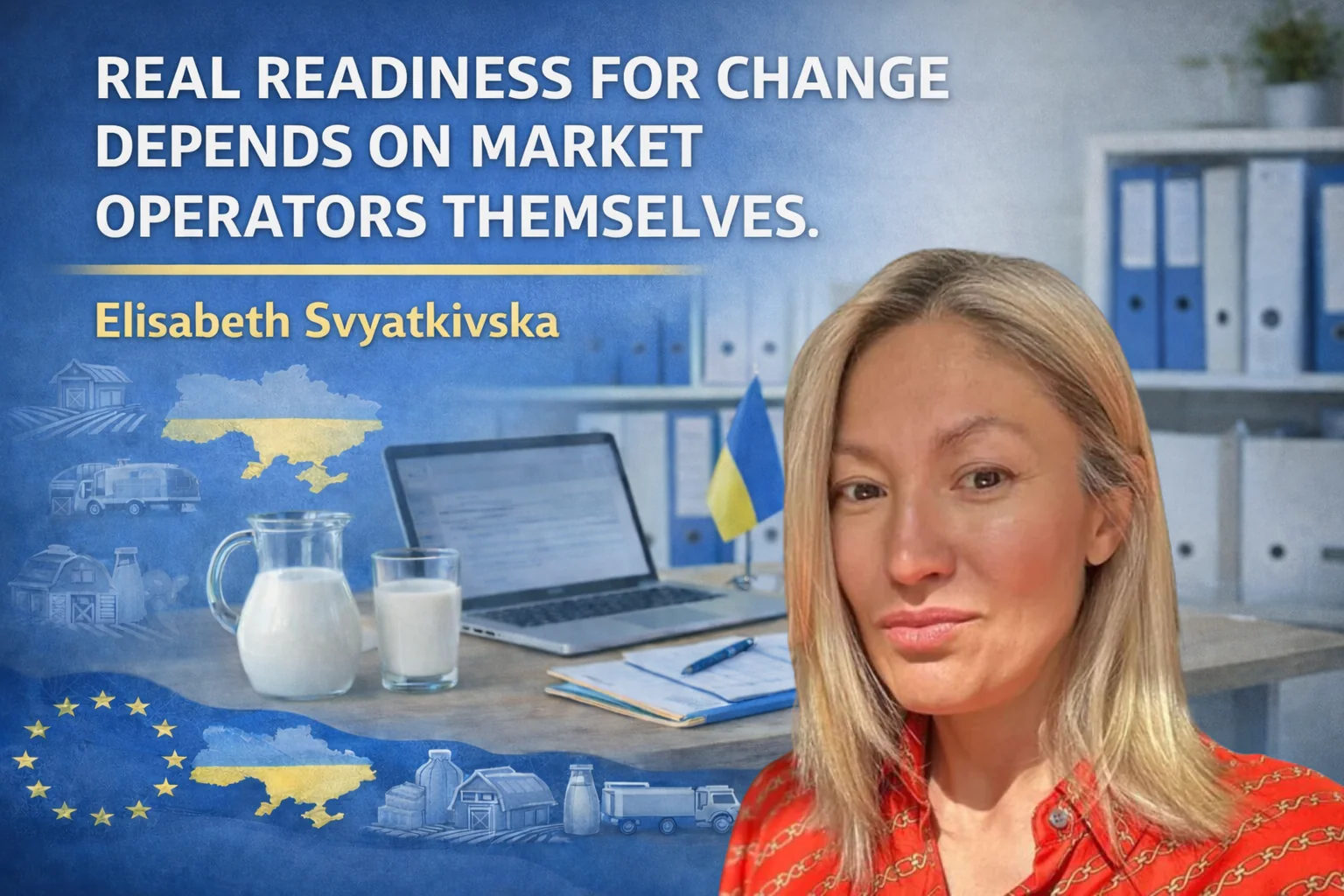
European integration of Ukraine’s dairy sector is moving from declarations to practical solutions. The SMPU Committee on European Integration is finalizing a draft Roadmap that will define the rules for adapting the market to EU requirements. In an interview with Infagro, Yelyzaveta Sviatkivska, Coordinator of the SMPU Committee on European Integration, spoke about key issues in contractual relations, declarations by first buyers, and the business’s readiness for change.
Short-term contracts are the main risk for the sector
According to the expert, the current contract model in the dairy sector does not allow businesses to plan development.
“The main problem is the dominance of short-term contracts. With such agreements, it is difficult to plan development or invest in production or quality,” Sviatkivska notes.
Most contracts lack transparent pricing formulas, risk-sharing mechanisms, or clearly defined responsibilities of the parties, which leads to постоянна instability in the market.
Pressure from retail chains
Relations with retail are another major issue.
“Payment delays effectively mean ‘interest-free lending’ of retail chains at the expense of processors and producers,” the coordinator of the EU Committee emphasizes.
As a result, this puts pressure on farmgate prices and increases risks for farms and processing companies.
Who benefits from the current model
Sviatkivska acknowledges that the existing system can suit both sides, depending on market conditions.
“When raw milk prices rise, this model is less favorable for processors; when prices fall, it is less favorable for producers,” she explains.
Stable and transparent contracts become a real development tool only if businesses are ready to plan several years ahead.
European instruments without classic cooperatives
Despite the absence of a classic cooperative model in Ukraine, European experience can be partially adapted.
“EU Regulation No. 1308/2013 offers instruments such as producer organizations and interbranch organizations, which make it possible to negotiate collectively and make the market more predictable,” Sviatkivska notes.
Why long-term contracts do not work
The reasons are complex: the war, labor shortages, logistics, rising costs, and unstable legislation.
“Short-term contracts often seem more attractive in the short run, and the war has made long-term planning almost impossible for many operators,” the expert says.
Declarations by first buyers: market transparency
The introduction of declarations by first buyers of raw milk is expected to improve the quality of market information.
“First buyers will declare purchase volumes and average prices on a monthly basis. For producers, this means greater transparency; for the state, better analytics,” Sviatkivska explains.
The Roadmap is not coercion
The Roadmap does not force businesses to change but sets a framework for transformation.
“Real readiness for change depends on the operators themselves. Not everyone will be able to meet the new requirements, and not everyone is interested in doing so,” she stresses.
Ukraine is strategically moving toward the EU, but without an industry audit, an assessment of companies’ readiness, and transitional periods, these changes will be difficult to implement in practice.
Source: infagro.com.ua