
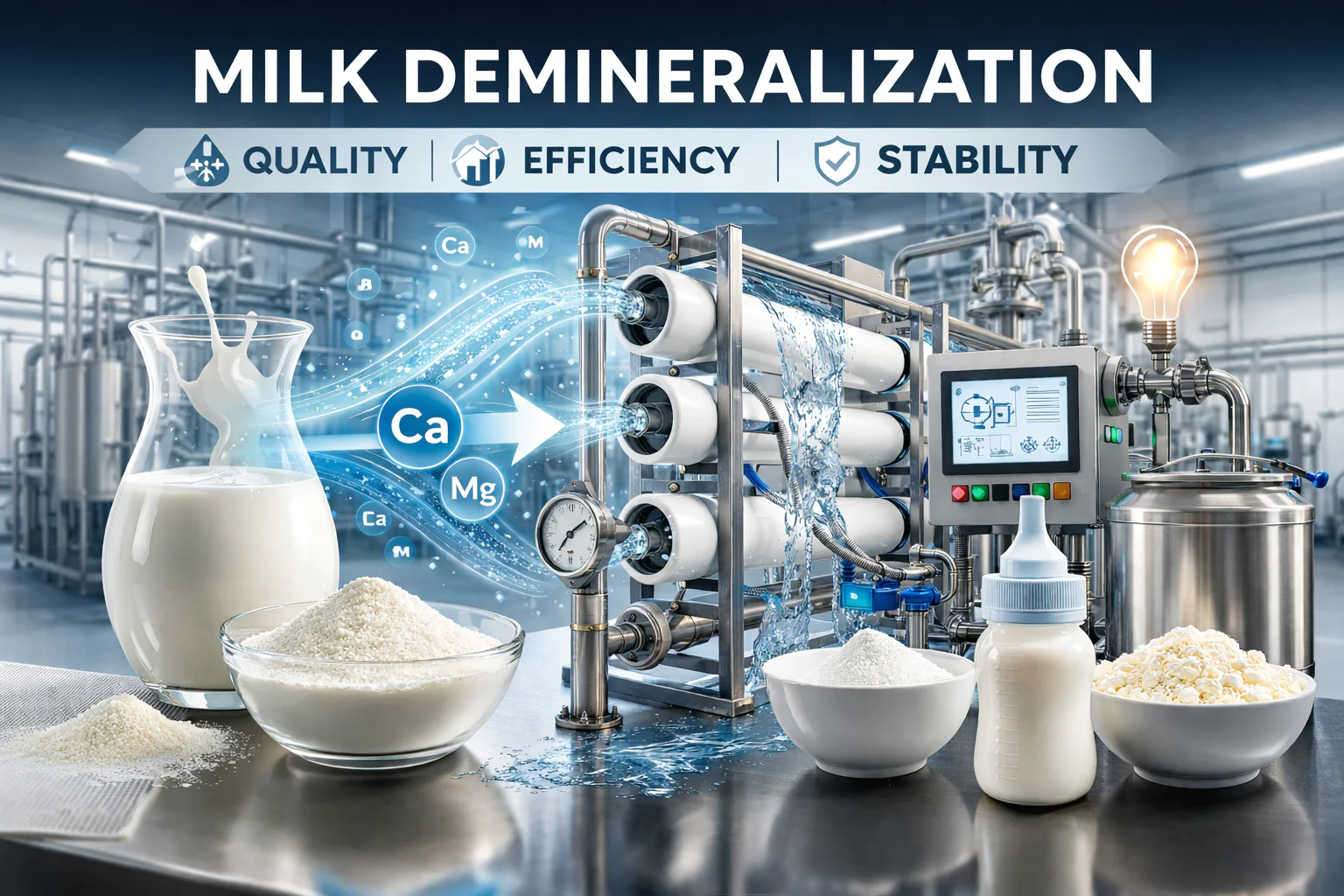
Stricter quality requirements and growing global demand for high value-added ingredients are prompting dairy processors to invest more actively in membrane technologies. Milk demineralization remains a critically important process for the production of infant formula, specialized dry products, and functional ingredients, notes Dairy Foods.
Balancing Productivity and Stability
Membrane demineralization is not merely a matter of adjusting technical parameters. Increasing flux can raise throughput, but it also accelerates membrane fouling and shortens service life. Achieving a high degree of mineral removal increases osmotic pressure and energy consumption, thereby raising operating costs.
As a result, manufacturers must balance four key factors:
- degree of demineralization (product quality);
- productivity;
- energy consumption;
- membrane longevity.
Optimization of pressure, temperature, and flow rate, the use of multi-stage or hybrid configurations (partial membrane demineralization combined with ion exchange), and regular CIP cleaning help maintain process stability.
Focus on Long-Term Efficiency
The industry is gradually shifting from maximizing individual performance indicators to assessing the total cost of ownership of the system. Modern solutions include:
- selection of membranes with the required selectivity;
- optimized hydraulics and uniform flow distribution;
- automated control of pressure, temperature, and conductivity;
- digital monitoring and predictive maintenance.
Automation and inline monitoring enable timely detection of deviations, reduce downtime risks, and support stable production.
Technological Innovations
In 2024–2025, new generations of nanofiltration and ceramic membranes entered the market, offering improved fouling resistance, longer service life, and lower energy consumption. Developers are also actively integrating artificial intelligence systems to optimize processes in real time.
Research projects in Europe are focused on improving demineralization efficiency, enhancing protein recovery, and reducing chemical load during cleaning.
Sustainability Pressure
Energy efficiency, water consumption, use of chemical reagents, and membrane durability have become key criteria in equipment selection. Buchil notes: “As sustainability and efficiency requirements continue to increase, several technical developments and process improvements are expected to significantly impact membrane-based milk demineralization in the coming years.”
Market Demand
Particularly stringent mineral composition control requirements exist in infant formula production. In the functional ingredients and specialized powders segment, the precise mineral profile affects solubility, taste, and subsequent processing performance.
In addition, controlled demineralization reduces fouling risks in evaporation and drying processes, enhancing overall plant stability.
Conclusion
Milk demineralization is increasingly defined not by maximum performance indicators, but by balanced system operation. Innovations in membrane materials, integration of digital solutions, and hybrid configurations enable processors to simultaneously achieve high product quality, energy efficiency, and production stability.
For the dairy industry, this signifies a transition toward strategic process management, where technologies operate in synergy with operational discipline and long-term business objectives.
Source: Dairy Foods