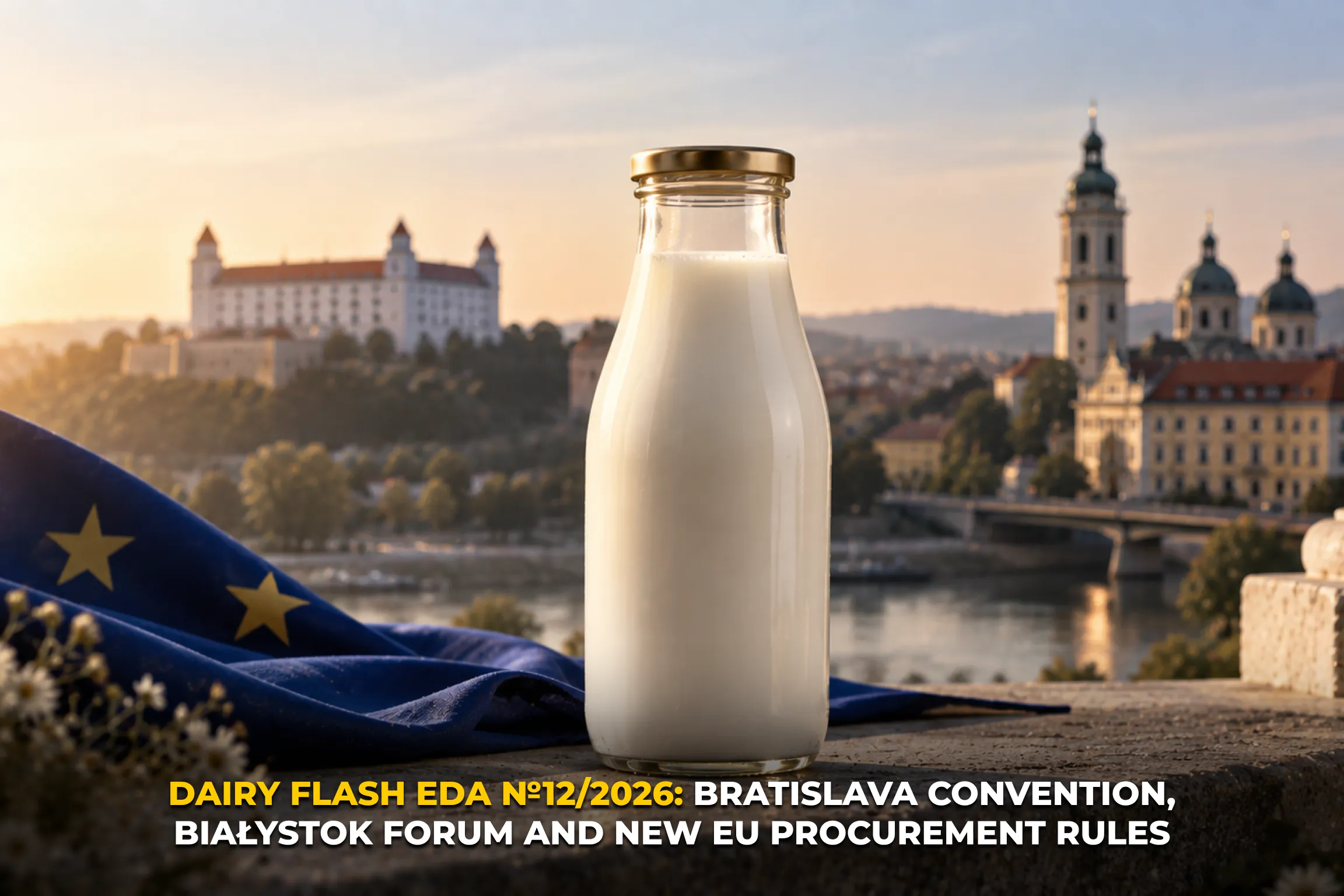

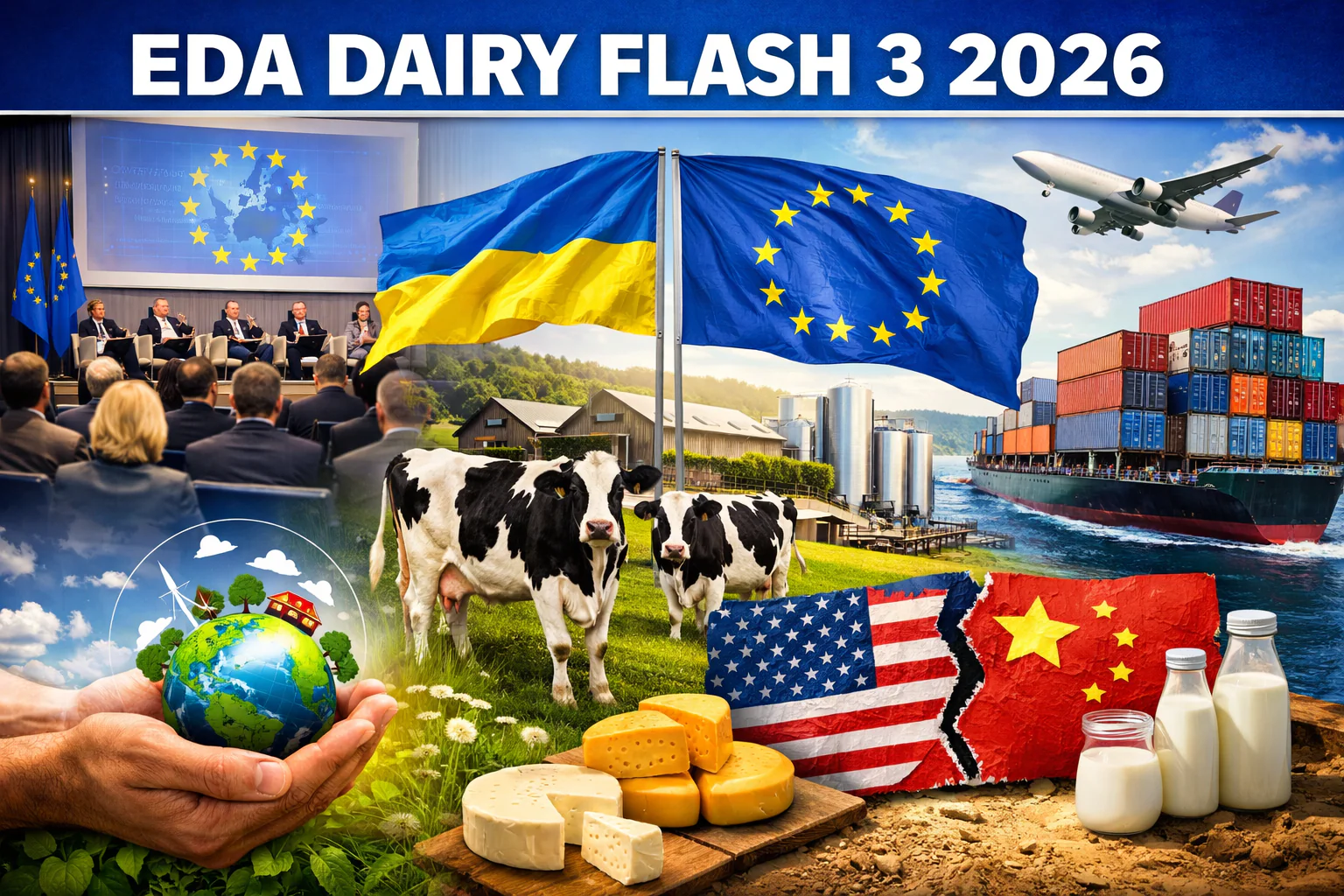
The European Dairy Association (EDA), in its Dairy Flash 3/2026 issue, focused on industry strategy, trade challenges, and support for Ukraine’s integration into the EU.
EDA Conference: Competitiveness and Resilience Strategy
On March 25, Brussels will host the Dairy Policy Conference 2026 under the motto “Competitive, Resilient & Sustainable — our European Dairy Strategy.” Participants will discuss the new EU policy framework for agriculture and the dairy sector, the priorities of the Irish Presidency, and global trade prospects for 2026. Key topics include CAP reform, international trade developments, and regulatory adjustments.
Ukraine: Integration into the EU Single Market
EDA reaffirmed its support for integrating Ukraine’s dairy sector into the EU Single Market and confirmed its participation in the Committee on the Integration of Ukraine’s Dairy Sector. With a population of approximately 40 million and milk production of around 7 million tonnes, Ukraine’s sector — supported by a modern processing base — is viewed as a natural component of Europe’s “lactosphere.” The association emphasized that Ukraine’s swift accession to the EU would strengthen Europe’s food security and resilience.
Crisis Management and New CAP Instruments
Within discussions on agricultural crisis management, EDA highlighted the need to maintain market orientation, uphold the subsidiarity principle, and introduce hedging instruments and dairy futures markets to improve risk management in the sector.
MIV Milk Summit 2026: Focus on Deregulation
The MIV Milk Summit 2026 took place in Brussels with representatives of the German and EU dairy industries.
The central theme was potential “overregulation” of the dairy market. Participants discussed amendments to the sCMO (Articles 148/168), the revision of the Unfair Trading Practices (UTP) Directive, and regulatory simplification.
Norbert Lins called for accelerating bureaucracy reduction, while European Commission representative Fabien Santini confirmed that the Commission would facilitate negotiations between the European Parliament and the Council on updating market rules.
Sustainability: On-Farm Sustainability Compass
EDA presented industry work on measuring environmental impact at farm level under the On-Farm Sustainability Compass initiative. The approach is based on the Dairy PEFCR methodology — an assessment tool approved by the European Commission for calculating the environmental footprint of dairy products across the entire value chain. The association stressed the importance of aligning climate and environmental policies while avoiding excessive administrative burden.
Trade: United States and China
The external trade environment remains challenging. The U.S. Supreme Court ruled previous emergency tariffs unlawful; however, new temporary measures foresee tariff increases on certain cheeses (including Gouda and Italian-type cheeses) from 15% to 25%.
China, in turn, confirmed additional countervailing duties at 11.7% (reduced from 42.7%), to remain in force for five years and applied on top of standard tariffs (approximately 8% on cream and 15% on cheese). The EU exports around 30,000 tonnes of cheese and 100,000 tonnes of cream to China annually, but the new duties will significantly limit the competitiveness of European producers.
Georgia: Expansion of the Dairy Base
In Georgia, the company Sante reported growth in domestic raw milk production as a result of a long-term strategy to develop the local supply base, strengthening the country’s entire dairy value chain.
Conclusion
EDA underlines that ensuring stable development of Europe’s dairy sector requires predictable trade conditions, comprehensive free trade agreements, and consistent agricultural policy.
Source: European Dairy Association (EDA), Dairy Flash 3/2026.