

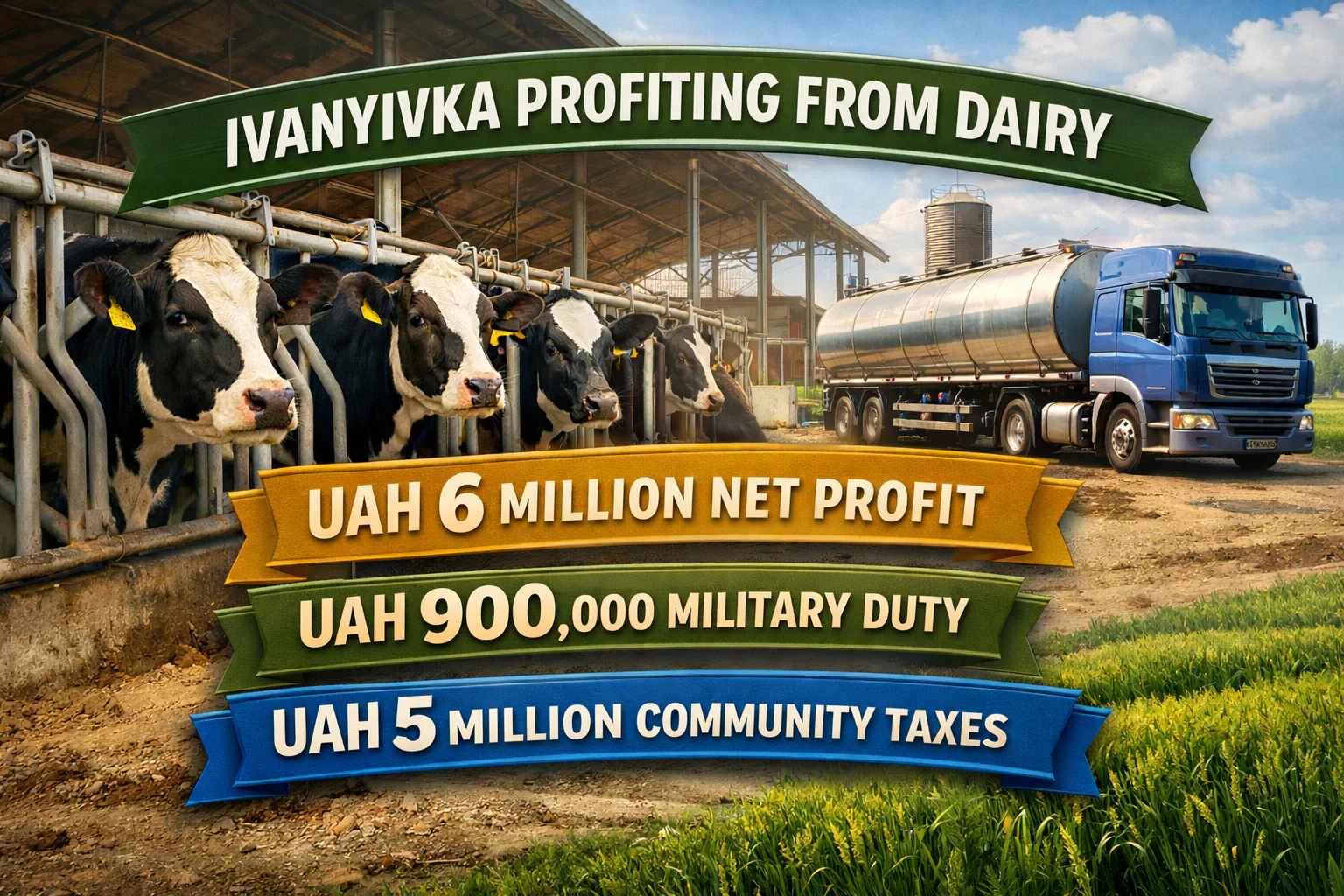
According to the Information Portal of Chernihiv Region, the state enterprise Experimental Farm “Ivanivka” of the Institute of Agriculture of the North-East of the NAAS reported UAH 6 million in net profit from milk production in 2025.
Located in the Borzna community of Nizhyn district, the farm has emerged from multi-million debts and stabilized its financial operations. According to Chief Accountant Valentyna Knyha, in 2025 the enterprise fully repaid long-standing liabilities related to the unified social contribution (USC), totaling nearly UAH 13 million. In addition, it paid approximately UAH 900,000 in military levy and nearly UAH 5 million in local taxes, including UAH 3.5 million in personal income tax and UAH 1.4 million in land tax.
The enterprise employs around 100 people. The average salary in 2025 reached UAH 18,000, increasing to over UAH 19,000 at the beginning of 2026. Due to improved financial performance, the farm obtained the status of a critically important enterprise.
Dairy Farming as the Key Profit Driver
The primary source of profitability has been dairy farming. The enterprise maintains a herd of 300 dairy cows. Annual revenue from milk sales amounted to UAH 28 million (excluding VAT). Milk is purchased by LLC AGROMOLTRANS. The average base price stands at UAH 16,200 per tonne; however, due to favorable protein and fat content, the effective price reaches approximately UAH 18,000 per tonne.
Productivity indicators have more than doubled — from 2,000 liters per cow annually in previous years to 5,000 liters currently. Younger groups obtained through Holsteinization of the Ukrainian Red-and-White dairy breed demonstrate yields of up to 7,500 liters per cow, with potential for further growth.
Livestock operations help maintain liquidity during periods of waiting for more favorable grain prices. In January 2026, milk revenue amounted to UAH 2.2 million, covering electricity expenses of UAH 560,000.
Diversification and Crop Expansion
Beyond dairy production, the farm is developing bull fattening, gradually restoring pig farming, and planning to expand crop acreage, including sugar beet cultivation. Over the past year, 568 hectares of winter wheat and 1,166 hectares of winter rapeseed were sown.