

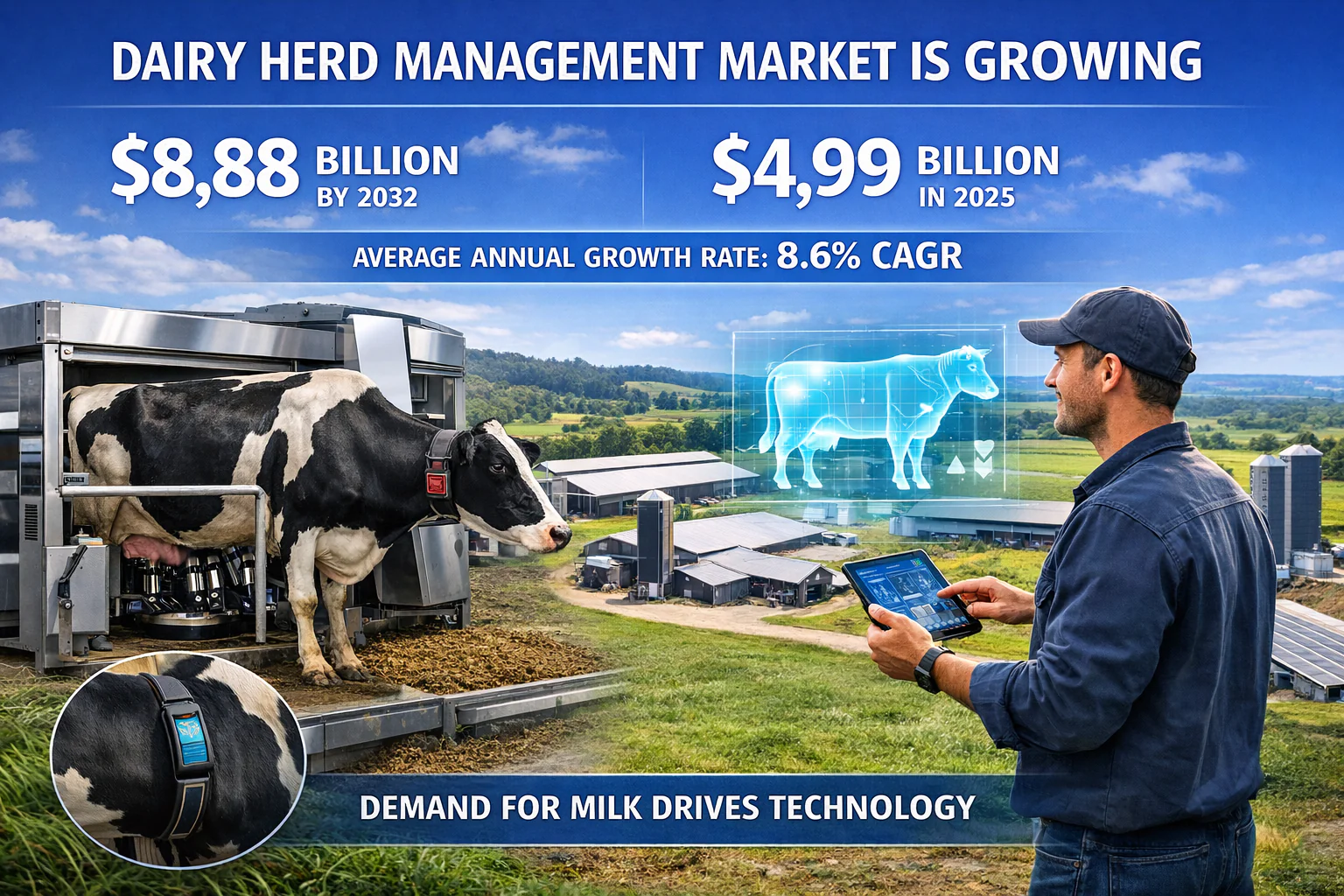
According to information from Dairy Global, the global market for dairy herd management systems is showing steady growth amid rising consumption of dairy products and an increase in the number of cows on farms. According to estimates by the analytical company MarketsandMarkets, by 2032, the market volume could reach $8.88 billion, while in 2025 it will amount to $4.99 billion. The average annual growth rate (CAGR) is projected at 8.6%
The key factors driving market growth are the expansion of dairy herds, increased demand for milk and dairy products, and the active introduction of new technologies in animal husbandry. Investments in dairy farming and the development of digital solutions for farm management provide additional momentum.
Demand for milk stimulates technology
Global consumption of dairy products continues to grow, and in many regions demand already exceeds domestic supply. At the same time, increases in milk production in traditional exporting countries such as Europe and New Zealand are being held back by environmental constraints.
Against this backdrop, the US is seen as the region with the greatest potential for milk production growth, which is driving demand for dairy herd management technologies.
The US dairy sector
According to forecasts by the US Department of Agriculture (USDA), milk production in the US could reach 229.1 billion pounds in 2026. Growth is expected to come mainly from increased cow productivity rather than an increase in herd size.
This highlights the strategic role of dairy herd management systems, which help farmers increase milk yields per cow and meet domestic and international market demand while complying with environmental and regulatory requirements.
In 2024, milk production in the United States amounted to 225.9 billion pounds, which is 3.4% more than the average for the last five years, although there was a slight decrease compared to the previous year.
At the same time:
- The total number of dairy cows in 2024 was 9.35 million, which is 0.4% less than a year earlier.
- The average annual yield per cow has increased to 24,164 pounds, which is more than 1,000 pounds more than five years ago.
In addition, there are 24,810 dairy farms in the US, with an average herd size of 377 cows. This indicates that production growth is increasingly dependent on the productivity of each animal, rather than just herd expansion.
In such conditions, farmers are actively implementing herd management technologies — from automated milking and feeding systems to monitoring the health and reproductive performance of cows.
Investments and prices stimulate the introduction of technologies
Favorable pricing conditions in the dairy market are also stimulating investment in new technologies. According to the USDA, high demand for dairy products is expected to continue in both domestic and export markets in 2025.
For example, at the beginning of July 2025:
- the price of butter in the US was $2.57 per pound;
- in Oceania, it reached $3.59 per pound;
- in Europe — about $3.90 per pound.
This reflects limited supply and stable demand. A similar trend is observed in the market for skimmed milk powder and whey, where prices have risen due to limited supply and active exports.
Such conditions encourage farmers to invest in dairy herd management systems, which allow them to increase productivity and monitor animal health more effectively.
The high cost of technology remains a barrier
Despite the obvious advantages, the widespread implementation of herd management technologies is hampered by the high cost of equipment, especially automated milking systems.
In particular:
- A robotic milking module costs $150,000–275,000.
- One robot can serve 60–70 cows;
- Many farms install 2–4 such systems.
As a result, initial investments can range from $500,000 to $1 million, even for relatively small farms.
According to alternative estimates, the average cost of one robot, including installation and infrastructure, is approximately $220,000.
When calculating the cost per cow, robotic systems can cost between $3,200 and $4,000 per animal, and the payback period is 7–10 years.
In addition, the following costs are added:
- software;
- technical maintenance;
- modernization of premises for automated systems.
As a result, investments often remain unavailable to small and medium-sized farms.
Restrictions in developing countries
The development of the dairy herd management systems market is also hampered by low awareness among farmers and poor infrastructure in rural areas.
In many countries in sub-Saharan Africa, South Asia, and Latin America, traditional farming methods still dominate.
At the same time, modern technologies such as:
- milking management systems,
- monitoring of heat,
- feeding control,
- heat stress management,
- health monitoring,
- automatic sorting and weighing,
can significantly increase milk production efficiency and farm productivity.
Smart sensors for cows
One of the most promising areas of market development is smart wearables for monitoring cows.
Such systems provide real-time data collection, allowing farmers to monitor:
- animal activity,
- dot,
- chewing gum,
- periods of rest,
- state of health.
For example, devices such as MooMonitor+ and AfiCollar allow you to monitor cow behavior and respond to changes in a timely manner, improving reproductive performance and milk yield.
Other solutions, such as the Afimilk Cow Leg Sensor (AfiAct II), analyze animal activity and rest, helping to identify health problems early on.
Wearable technologies also help control heat stress. HerdDogg and CowManager systems track cows’ body temperature, activity, and mobility, allowing farmers to respond quickly during hot weather.
Integration with IoT platforms and cloud services enables data to be obtained via mobile applications and decisions to be made in real time.
Automation of dairy farms
Another important driver of market development is automation of livestock farming.
Modern autonomous feeding and milking systems help:
- increase productivity,
- reduce the need for labor,
- reduce operating costs.
For example:
- In 2023, DeLaval introduced the Opti Wagon robot for automatic feed distribution, integrated with the DelPro farm management system.
- In 2022, GEA Group launched the Dairy Feed F4500 robot, which automatically weighs, mixes, and distributes feed for herds of up to 300 cows.
- In 2024, Lely introduced Juno Max, an autonomous feed pusher robot for large farms.
Such solutions help reduce feed losses, optimize resource use, and increase the efficiency of milk production.
Prospects in developing countries
Despite slow technology adoption, developing countries could become key drivers of market growth.
In particular, the following have significant potential:
- India
- China
- Turkey
Population growth, rising farmer incomes, and government support for livestock farming are driving demand for modern herd management technologies.
According to the UN, India’s population could grow by another 273 million people by 2050, which will increase demand for milk and dairy products.
Governments in many countries already support the introduction of artificial intelligence, robotics, and IoT technologies in dairy farming.
Rapid transformation of the dairy industry
Today, the dairy herd management market is undergoing rapid digital transformation.
The following play a key role:
- herd monitoring sensors,
- automated milking systems,
- accurate feeding systems,
- cloud-based farm management platforms.
There is also growing attention to animal welfare and sustainable milk production, which is stimulating the introduction of technologies that reduce environmental impact and increase resource efficiency.
The integration of IoT, AI-based analytics, and robotic systems enables farmers to make real-time, data-driven decisions and improve the profitability of dairy production.
With the growth in global demand for dairy products, companies are actively developing new digital solutions for herd management that can be used by both large dairy complexes and small farms.
Source: Dairy Global