

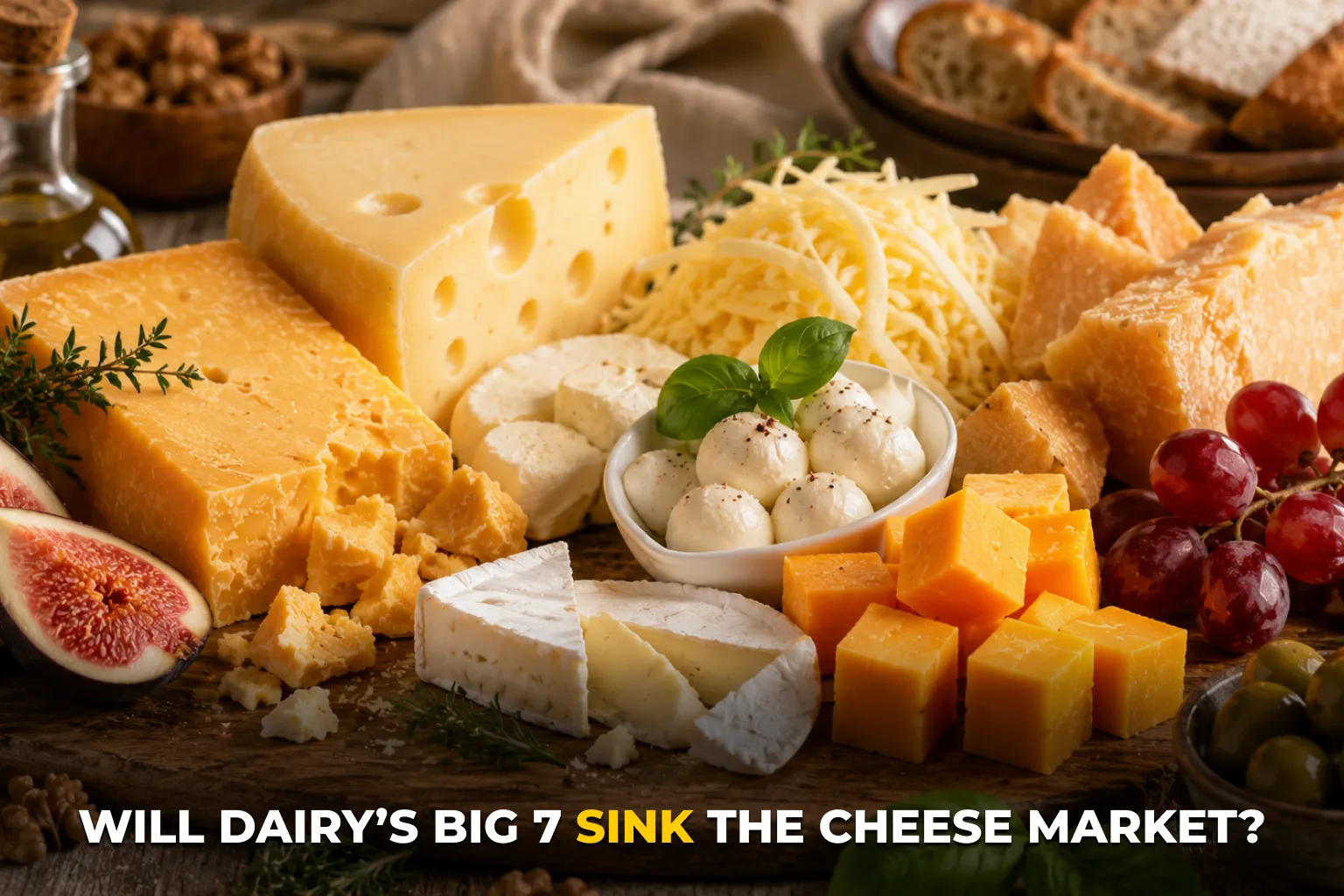
As the world’s biggest dairy players pivot to cheese, the market is growing more polarised — mozzarella prices are climbing while cheddar falls, DairyReporter reports.
Cheese is the new king of dairy, or at least its undisputed growth driver. With volatile milk prices squeezing processors harder than ever, there is a clear shift towards higher-value products like cheese, boosted by rising demand and strategic capacity investment — especially from the big seven global dairies. As a result, global cheese trade is up around 40% since 2017. Yet while one might expect that to flood the market and sink prices, the reality is more nuanced.
Cheddar is following the downward pattern, with prices off 6.5% over the past 12 months according to Global Dairy Trade (GDT), largely because of where it is made. A truly global product spanning the US, the EU and Oceania, cheddar is backed by still-strong milk output in the US (up around 2% year on year) and New Zealand (up around 4%, with a strong next season forecast).
A global market influx of cheese
“On top of that, US manufacturers have invested heavily in adding production capacity, so no shortage of cheddar is expected for the foreseeable future,” explains Tom Booijink, a senior dairy specialist at Rabobank. By contrast, EU-dominated cheeses such as mozzarella are seeing price spikes after recent heatwaves drove rapidly declining milk supplies in countries like France and Germany.
The same is true in the UK, where analysis by the Energy and Climate Intelligence Unit found milk supply suffered an “unprecedented decline” during the June heatwave — a single-day drop of 4.3% and a cumulative shortfall of around 16.5 million pints over the nine-day event.
With supply weak and demand strong, mozzarella is up 1.3% over the year, now at €3,448 per tonne — unusually more expensive than cheddar at €3,138. “Cheddar normally commands a premium over mozzarella, which is now totally opposite,” says Booijink. “The last time this happened — in the EU at least — was in 2019, so the situation is quite extraordinary.”
What will happen to cheese prices?
What comes next hinges on how milk production evolves by region. The US, Australia and New Zealand all expect volumes to rise, while the EU looks set to move the other way — for two reasons, says Booijink. First, EU milk deliveries jumped around 6% in Q4 last year, a mark that will be hard to beat now that there are fewer dairy cows. Second, milk prices are about 30% lower than a year ago, and with diesel and fertiliser costs significantly higher, farm margins have deteriorated to the point where there is little incentive to produce more. The cheese market could therefore become ever more polarised, with EU cheeses like mozzarella growing more expensive while global cheddars get cheaper and cheaper.
Source: DairyReporter