
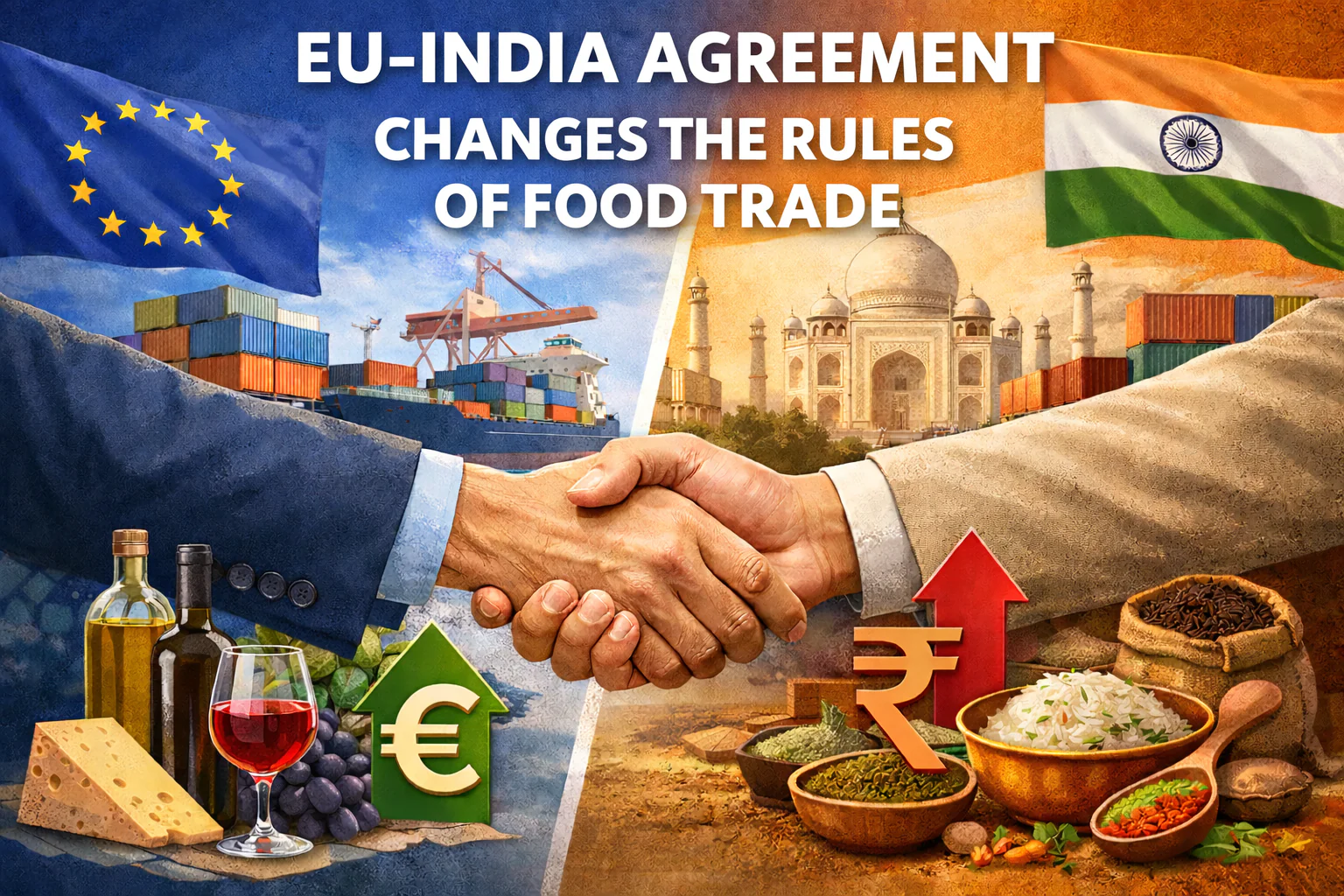
According to Food Ingredients First, the forthcoming free trade agreement between the European Union and India could lead to the abolition or significant reduction of tariffs on food exports worth up to €4 billion per year. At the same time, the document has prompted mixed reactions from different segments of the food industry.
Under the draft agreement, tariffs on a number of European food products that currently exceed 36% will be reduced or eliminated. In particular, duties on wine will be gradually cut from 150% to 75% and eventually to 20%; tariffs on olive oil will be reduced to zero over five years; and duties on processed agri-food products (bread, confectionery) will be fully eliminated. This opens up significant opportunities for European exporters, especially in the wine and spirits segments.
India’s food industry, including producers of spices, tea, and processed foods, also expects expanded access to the EU market. The agreement may simplify labeling requirements and harmonize certain food safety standards, although Indian exporters will need to adapt to stricter European regulations.
At the same time, concerns remain in the EU regarding sensitive agricultural sectors. The dairy, meat, and sugar industries are formally excluded from the agreement, but market representatives warn of long-term risks. Reduced tariffs on ingredients and processed products, including dairy components, could intensify competition and put pressure on European producers. In addition, uncertainty remains about the potential expansion of liberalization in future negotiations.
For India, the dairy sector is politically sensitive, as it provides livelihoods for around 80 million small farmers. Therefore, full liberalization of dairy imports is not currently under consideration, although potential changes could affect the balance of the domestic market and the system of state support.
The agreement has also drawn criticism from animal welfare organizations, which point to significant differences between animal husbandry standards in the EU and India. They warn that imports of products produced under lower standards could undermine sustainability goals and the competitive position of European farmers.
Source: Food Ingredients First