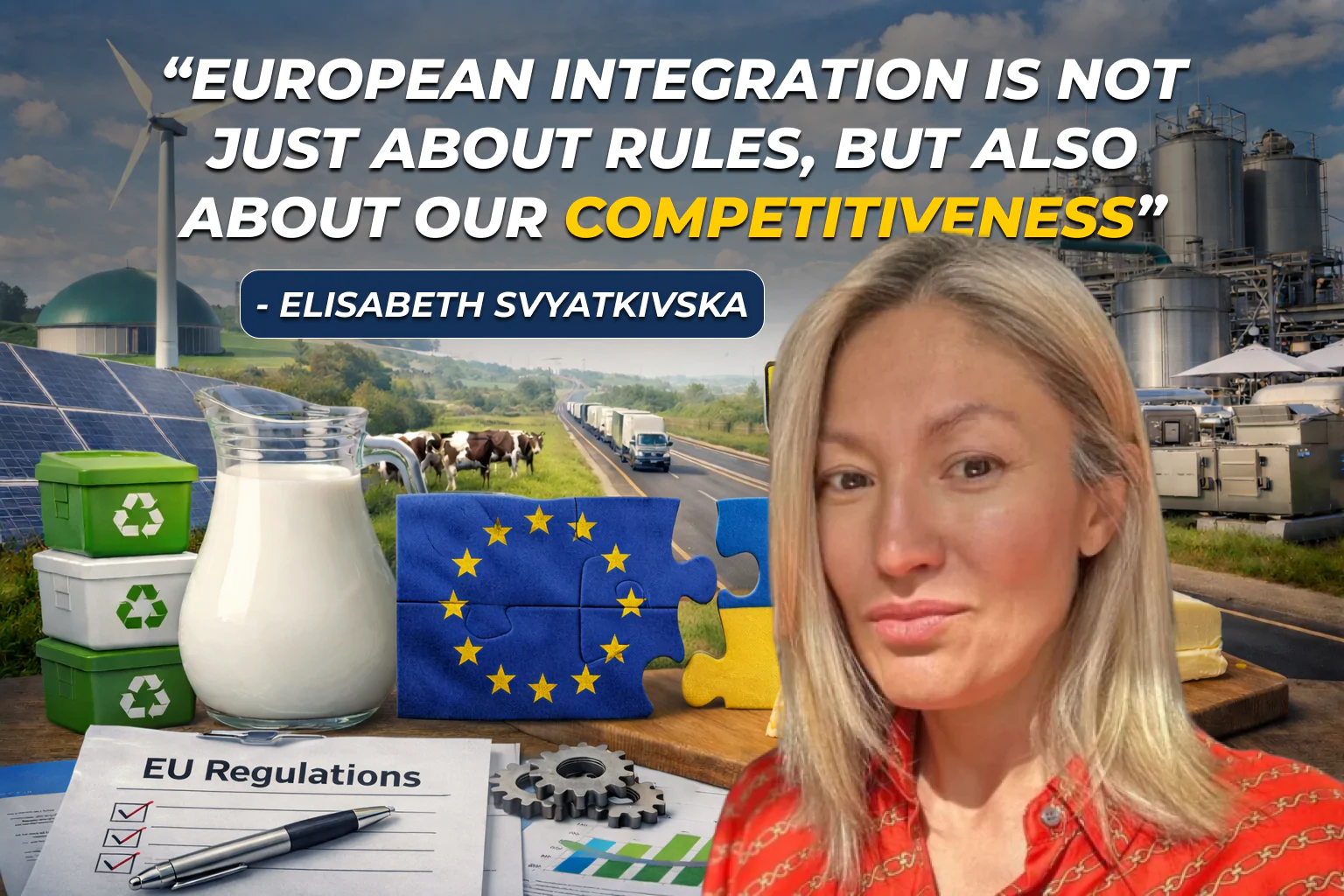
The European integration of Ukraine’s dairy sector is entering the final stage of preparation for a key document — the Roadmap. Elisabeth Svyatkivska, coordinator of the UDEU Committee on European Integration, spoke about the challenges of adapting to EU requirements, investment and the transformation of the sector in a comment for the publication INFAGRO.
A balance between EU requirements and market realities
According to her, the key challenge in drafting the document was striking a balance between the requirements of European legislation (the EU acquis) and the actual conditions under which the Ukrainian dairy industry operates.
The discussion centred on the need to align business interests with EU requirements, as well as with the provisions of the National Programme for the Adaptation of Legislation.
“The main challenge was to create not just a ‘paper’ strategy, but a viable mechanism,” notes Elisabeth.
At the same time, she said, it is important to emphasise that European standards are not merely restrictions, but a means of enhancing investment appeal through transparent operating rules.
Sustainable development in the processing sector: key challenges
The ‘Sustainable Development – Processing’ working group, which she chairs, has focused on issues that had previously been overlooked but are of critical importance from an investment perspective.
Key areas include:
Waste and Packaging Management:
It is necessary to establish a legislative framework for the implementation of Directive 94/62/EC on packaging and waste. A key step will be to create the conditions for the operation of an Extended Producer Responsibility (EPR) scheme, which involves integrating recyclers into the packaging collection and recovery system.
Circular economy:
Regulations are to be drawn up to classify whey and other by-products as valuable resources. This will enable them to be used as raw materials for animal feed or bioenergy.
Energy efficiency:
The roadmap provides for large-scale energy audits – from pasteurisation to cooling systems – and encourages the transition to renewable energy sources in line with the requirements of the EU’s ‘Green Deal’.
Coordination of work
Work on the Roadmap was carried out at several levels, involving 11 working groups, each of which was responsible for specific aspects of the dairy sector’s European integration. Despite this division of tasks, the results were constantly coordinated to ensure the final document formed a coherent whole.
“Eleven working groups operated independently, but at joint meetings we constantly ‘synchronised our watches’ to ensure that key issues were aligned across all areas,” notes Elisabeth Svyatkivska.
The process was coordinated by the consulting firm Prospex, which helped to synchronise the work of all teams and implement the necessary technical tools.
At the same time, there was ongoing engagement with the relevant ministries to ensure that the Roadmap was in line with government policy and aligned with the National Programme for the Adaptation of Legislation.
Practical significance for the dairy industry
According to Elisabeth Svyatkivska, the completion of the Roadmap will mark only the beginning of its practical implementation.
The document is intended to serve as a guide for milk producers and processors — particularly regarding future animal welfare standards, environmental requirements and the modernisation of production.
“Milk producers need to know what standards will be mandatory in 3–5 years’ time. Processors need a clear timeline for the changes,” she explains.
In addition, it is intended to be used as a tool for attracting funding. Industry associations will be able to engage in more effective dialogue with the government and European partners regarding support and financing for sustainable development projects.
“We want European consumers to associate Ukrainian milk not only with quality, but also with a responsible approach to the environment,” she emphasises.
Source: Infagro