
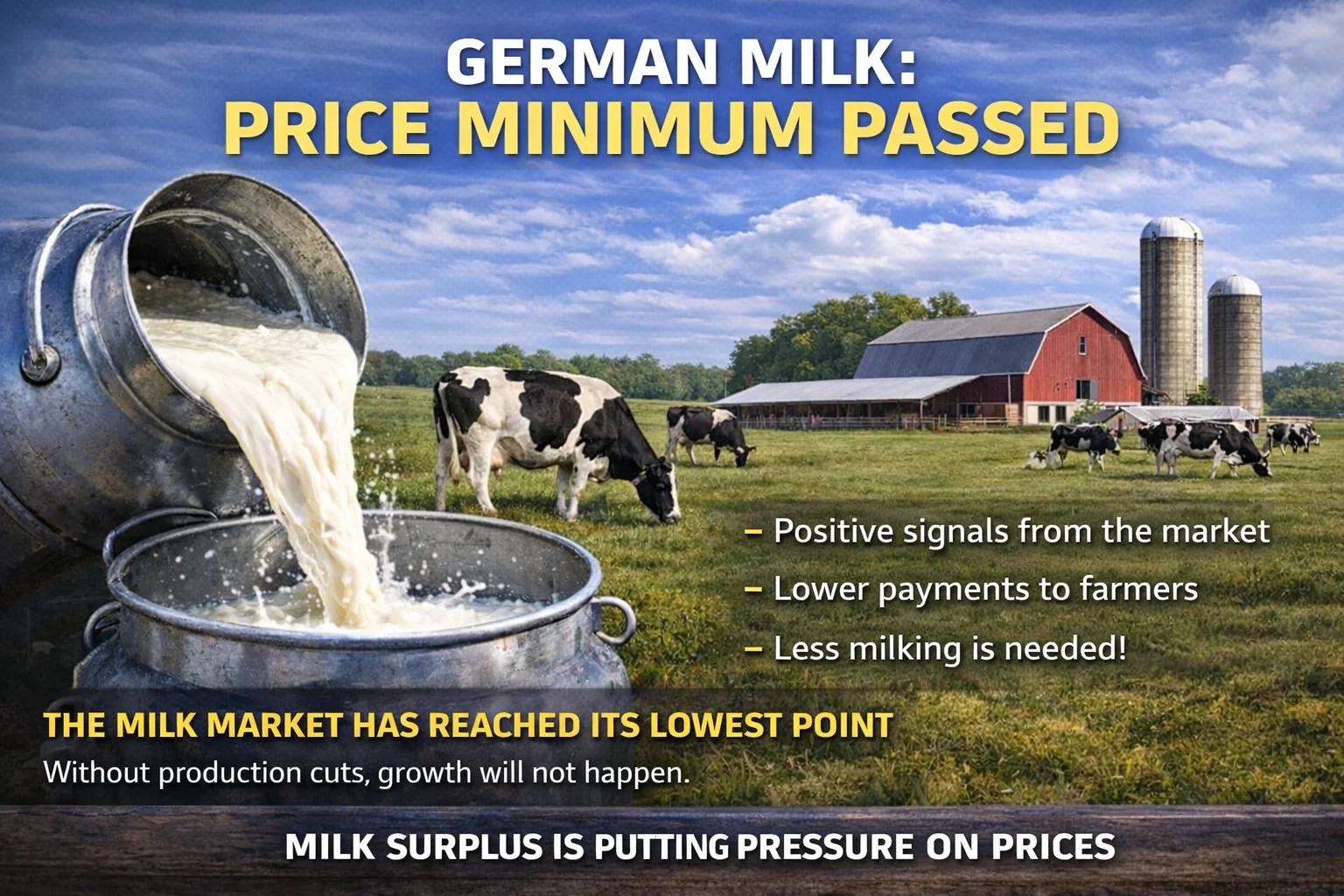
According to agrarheute, the milk market is beginning to show early signs of recovery after a prolonged price decline, but experts stress that without production cuts, sustainable growth will not occur.
Market Has Likely Reached the Bottom
According to Detlef Latka, head of the Milchindustrie-Verband (MIV), the market has likely already passed its lowest point.
- Since autumn 2025, farmgate milk prices dropped to around €0.14/kg
- In February 2026, processor payouts declined again
At the same time, first positive signals are emerging:
- some processors have stopped reducing prices
- certain companies are planning price increases in March
Oversupply Continues to Pressure Prices
The core issue remains excess milk production.
- Since autumn 2025, German milk output has been about 6% higher year-on-year each month
Experts emphasize that market stabilization requires supply adjustment.
Latka states that the industry must “produce less milk”, otherwise volatility will persist.
Global Signals Point to Recovery
Despite current challenges, global indicators are improving:
- rising prices for butter and milk powders
- positive momentum on the Global Dairy Trade (GDT) platform
This suggests that milk prices could start increasing in the second half of 2026.
Farmers Face Financial Pressure
According to Karsten Schmal from the Deutscher Bauernverband (DBV), farms remain under significant financial stress.
Key factors include:
- declining income from milk sales
- high tax burdens following profitable previous years
- rising energy costs
Geopolitical tensions — particularly in the Middle East and Ukraine—are further impacting energy markets. Since dairy processing is energy-intensive, this directly increases production costs.
Demand Expected to Grow Long-Term
Despite short-term difficulties, the long-term outlook remains positive.
According to Food and Agriculture Organization (FAO):
- global consumption of animal protein will increase significantly over the next decade
- demand for milk could grow by around 150 million tonnes
However, experts stress that unlocking this potential will require:
- improved investment conditions
- faster approval processes for modern dairy farms
Source: agrarheute