

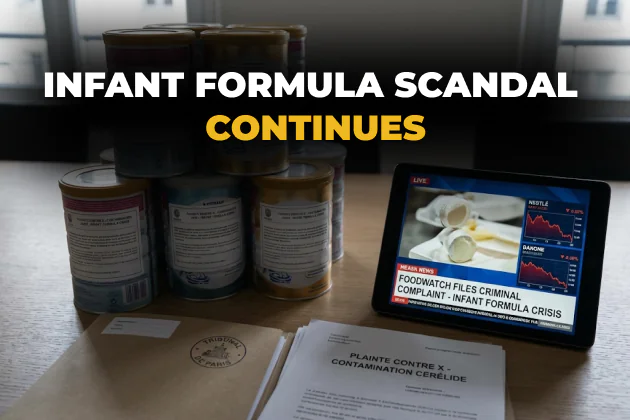
According to Food Ingredients First, a Dutch consumer organization has filed a criminal complaint with a court in Paris in connection with the global contamination of infant milk formula. The filing names seven manufacturers, including Nestlé, Danone, and Lactalis, as well as Vitagermine (Babybio), Hochdorf, La marque en moins, and Granarolo. The complaint was submitted under the “contre X” procedure, which allows investigators to identify all potentially responsible parties, including food safety control authorities.
The lawsuit is based on the companies’ actions during the crisis related to the detection of cereulide — a heat-stable bacterial toxin — in infant formulas. Mass product recalls began in December 2025 and affected more than 60 countries. At least eight affected families have already joined the case.
Foodwatch claims that the recalls were carried out with significant delays and that manufacturers, in the organization’s view, downplayed the risks and denied a link between the use of the recalled milk powders and serious symptoms in infants. The organization is calling for a criminal investigation into potential violations, including endangering children’s health, misleading consumers, and the untimely withdrawal of products from the market.
The consequences of the crisis have already affected the companies’ financial performance. Nestlé shares lost nearly 10% in January, while Danone shares fell by about 4%. Analysts estimate potential risks for Nestlé at up to €1 billion, although the company states that the recalled products account for less than 0.5% of annual sales. For Danone, the risks are more sensitive, as infant nutrition accounts for around 21% of the group’s revenue.
Nestlé denies Foodwatch’s accusations, stating that the company was the first to identify the issue through its own quality control and promptly informed regulators. Danone and Lactalis say they acted in line with recommendations from European authorities and carried out precautionary recalls even in the absence of confirmed contamination in their own tests.
The investigation also addresses the role of national and European control authorities. The European Food Safety Authority has already confirmed receiving reports of illnesses linked to the recalled formulas, and the European Commission has instructed that a maximum permissible level of cereulide for infants be established. Relevant recommendations are expected to be published in early February.
Read the full text on the Food Ingredients First website.