
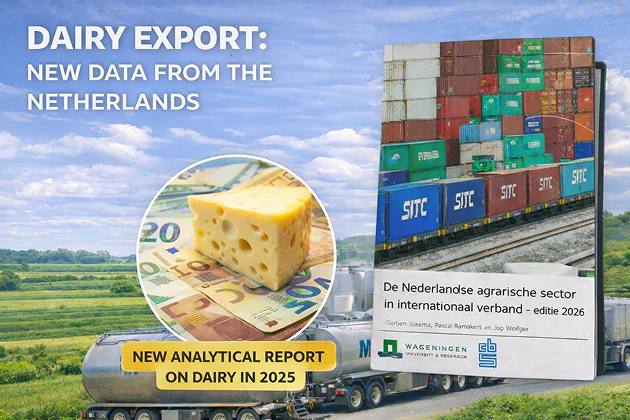
The annual analytical bulletin “De Nederlandse agrarische sector in internationaal verband – editie 2026”, prepared by Wageningen University & Research in cooperation with Statistics Netherlands (CBS) has been published. The document summarizes key trends in the foreign trade of Dutch agricultural products in 2025 and traditionally serves as a benchmark for agribusiness and traders in the EU.
What the report says about the dairy sector
Section 4.2, «Zuivel en eieren: import en export nemen sterk toe 2025» records a further strengthening of the dairy sector’s role in the country’s agricultural trade.
Exports of dairy products and eggs in 2025 reached approximately €13.3 billion, almost 10% more than a year earlier. At the same time, imports grew faster — by 14.5%, to €6.4 billion — indicating high utilization of processing capacity and the active role of the Netherlands in intra-European supply chains.
The main export destinations remain Germany and France. Supplies to Germany increased by 13.5%, and to France by 19.2%. Growth in exports to Poland and Spain was also recorded, while shipments to Belgium showed more moderate dynamics.
Imports and processing: a key clarification
Germany remains the main supplier of dairy products to the Netherlands, accounting for 38% of imports, followed by Belgium and Ireland.
In the continuation of the section, the authors explain in detail the structure of the use of imported dairy products:
- 69% of imports ultimately go to export:
- 43% is re-exported without processing
- 26% is exported after processing in the Netherlands
- 43% is re-exported without processing
- 31% of imports remains within the country:
- 11% goes directly to domestic consumption
- 20% undergoes additional processing for the domestic market
- 11% goes directly to domestic consumption
These data clearly confirm the role of the Netherlands as a European processing and trading hub for dairy products, rather than merely a producer or exporter of raw materials.
Market context in 2025
The first half of 2025 was characterized by declining raw milk prices, which strengthened the competitiveness of Dutch processors. Additional factors influencing the market included:
- high milk supply in Europe;
- environmental and nitrogen restrictions that limit production expansion;
- the impact of avian influenza, which affected the egg segment.
Despite these factors, the overall export value of dairy products increased, driven in particular by cheese, milk powder, and higher value-added products.
Source: Wageningen University & Research / Statistics Netherlands (CBS),
“De Nederlandse agrarische sector in internationaal verband – editie 2026”