
According to Our World in Data, milk consumption remains a staple of diets in many countries. However, dairy products account for a significant share of the food-related carbon footprint. In a typical EU consumption pattern, dairy represents more than one-quarter of total dietary greenhouse gas emissions — and in some cases, up to one-third.
Growing environmental awareness has fueled demand for plant-based beverages, including soy, oat, almond, rice, and coconut drinks. The key question is whether these alternatives truly have a lower environmental impact and which option performs best.
Comparing Environmental Indicators
Assessments are typically conducted per 1 liter of product across four key metrics:
- greenhouse gas emissions;
- land use;
- freshwater use;
- eutrophication (excess nutrient runoff into water bodies).
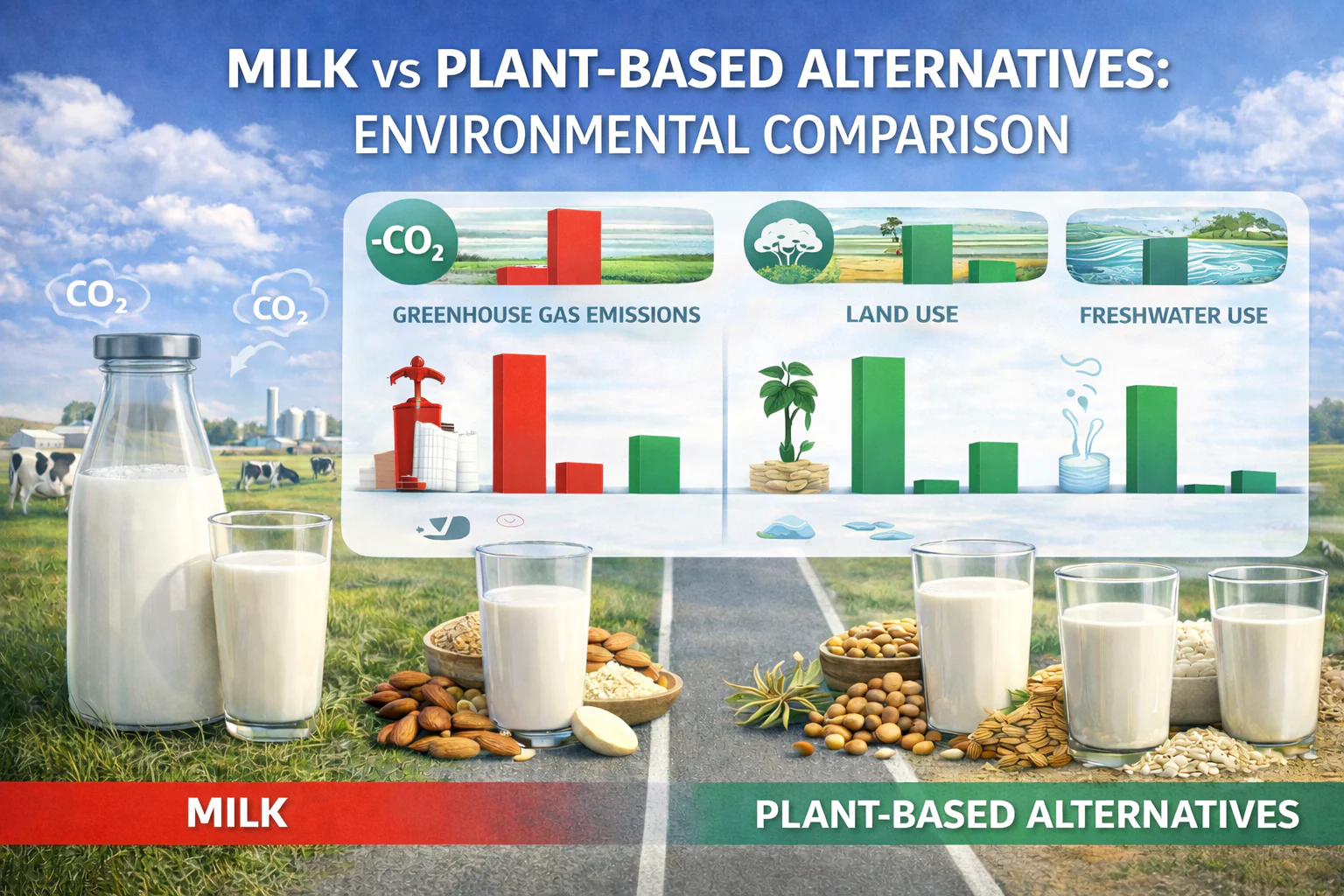
Cow’s milk records the highest impact across all criteria. It generates roughly three times more greenhouse gas emissions, requires about ten times more land, and uses 2–20 times more freshwater compared to most plant-based alternatives. Eutrophication levels are also significantly higher due to the environmental effects of livestock production on soils and water systems.
Switching to plant-based beverages can substantially reduce the environmental footprint of a diet. However, there is no universal “best” option. For example, almond drinks have lower emissions and land use than soy but are associated with higher water consumption and greater eutrophication potential.
Nutritional Considerations
A comparison per liter does not account for nutrient density. Cow’s milk contains approximately 3.4 g of protein per 100 ml, while almond drink contains around 0.5 g. Milk protein is complete in its amino acid profile. Most plant-based beverages achieve comparable calcium levels through fortification and are often enriched with vitamins D and B12.
For consumers with diverse diets in middle- and high-income countries, replacing milk generally does not create a risk of nutrient deficiency. However, in regions with limited dietary diversity, milk may remain an important source of high-quality protein and essential micronutrients.
The Soy and Deforestation Debate
Concerns about soy production and deforestation in South America are primarily linked to animal feed production. More than 75% of global soybean output is used for livestock feed, and in Brazil this share reaches approximately 95%. The portion of soy grown for direct human consumption is relatively small. Moreover, a significant share of soy for the European market is produced within the EU, often with comparable or higher yields.
Conclusion
From an environmental perspective, plant-based alternatives generally have a substantially lower impact than conventional dairy milk. However, decisions about substitution should consider not only emissions and water use but also nutritional value, dietary structure, and the broader socio-economic context.
Source: Our World in Data