
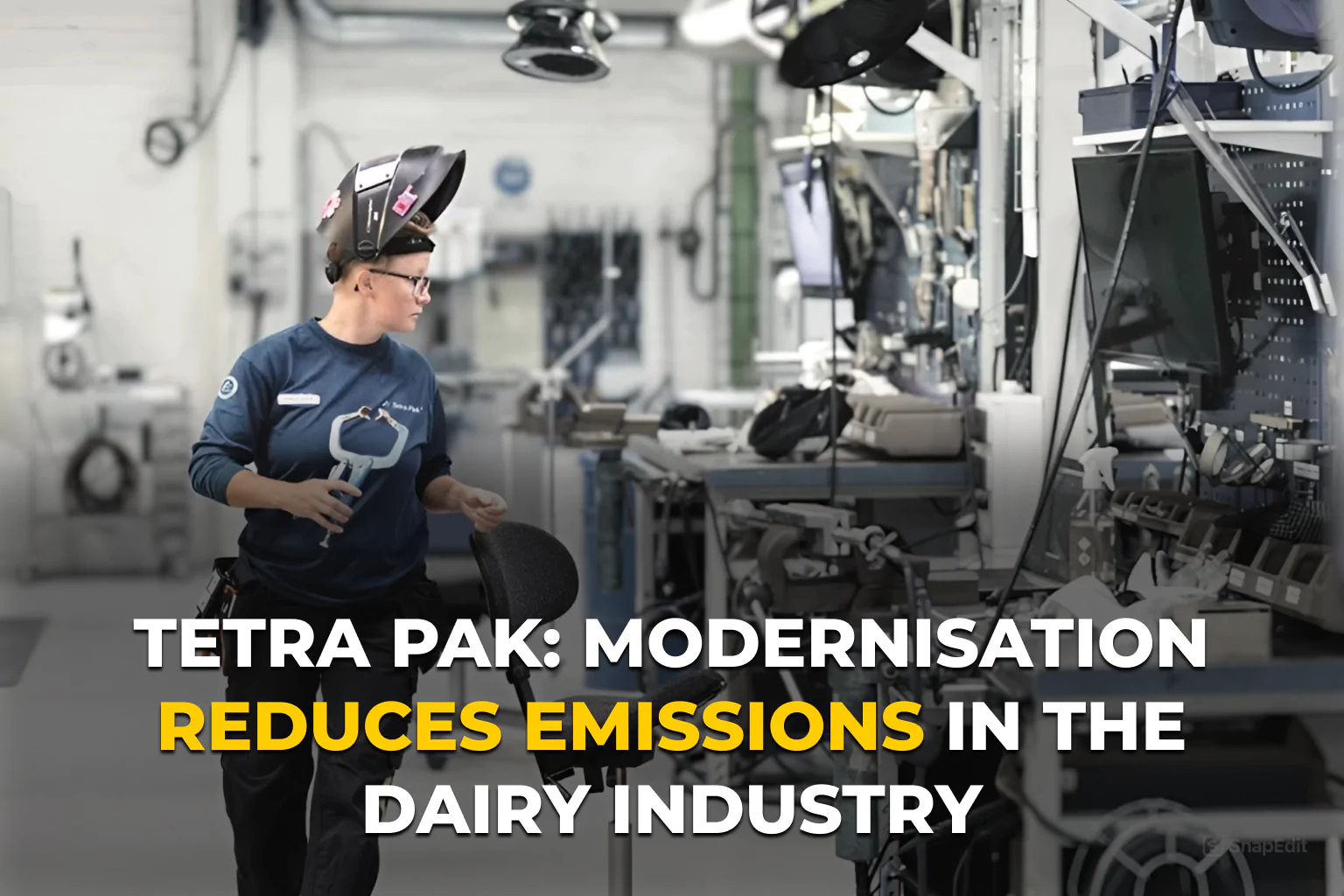
Tetra Pak states that upgrading existing production lines enables dairy companies to significantly reduce emissions and improve efficiency, according to Food Ingredients First. The company estimates that upgrading equipment can reduce GHG emissions by 40–49% without a complete overhaul of production.
Upgrading rather than complete replacement
According to the Dairy Processing Impact Assessment study, modernising existing milk processing lines is a faster and more scalable route to decarbonisation.
This involves the introduction of accessible technologies, specifically:
- heat pumps
- filtration systems
- integration of production processes
This approach enables businesses to improve efficiency without incurring significant capital expenditure on a complete replacement of equipment.
Reducing emissions, water consumption and product losses
A study, independently verified by the Carbon Trust, has shown significant benefits from the modernisation:
- GHG emissions — down by 47% on average
- water consumption — down 45%
- product losses — down 57%
If such solutions were scaled up across the global dairy industry, the potential reduction in emissions could reach 12.7 million tonnes of CO₂ equivalent, which is equivalent to taking around three million cars off the road.
It is also noted that the use of modern water treatment and reuse systems could reduce water consumption by up to 455 million m³ per year.
A practical approach to the dairy industry
According to company representatives, the modernisation addresses several issues at once — reducing costs, increasing efficiency and improving environmental performance.
“Practical improvements to existing production lines make it possible to reduce energy and water consumption and product losses, thereby increasing efficiency without significant changes to production,” said Rodrigo Godoi, Vice President of Tetra Pak.
The company also emphasises that additional support from government policy and financial instruments could accelerate the implementation of such solutions within the industry.
Decarbonisation as a development strategy for the dairy sector
The dairy sector remains a vital part of the global food system, but it is also a major consumer of energy and water. In 2023, it accounted for around 2.7% of global GHG emissions.
In this context, the modernisation of existing facilities is seen as a realistic and rapid way to reduce environmental impact without the need for large-scale investment in new plants.
The Carbon Trust emphasises that measuring ‘emissions avoided’ allows for a clear quantification of the impact of such solutions and provides a basis for scaling them up across the agri-food sector.
Джерело: Food Ingredients First