
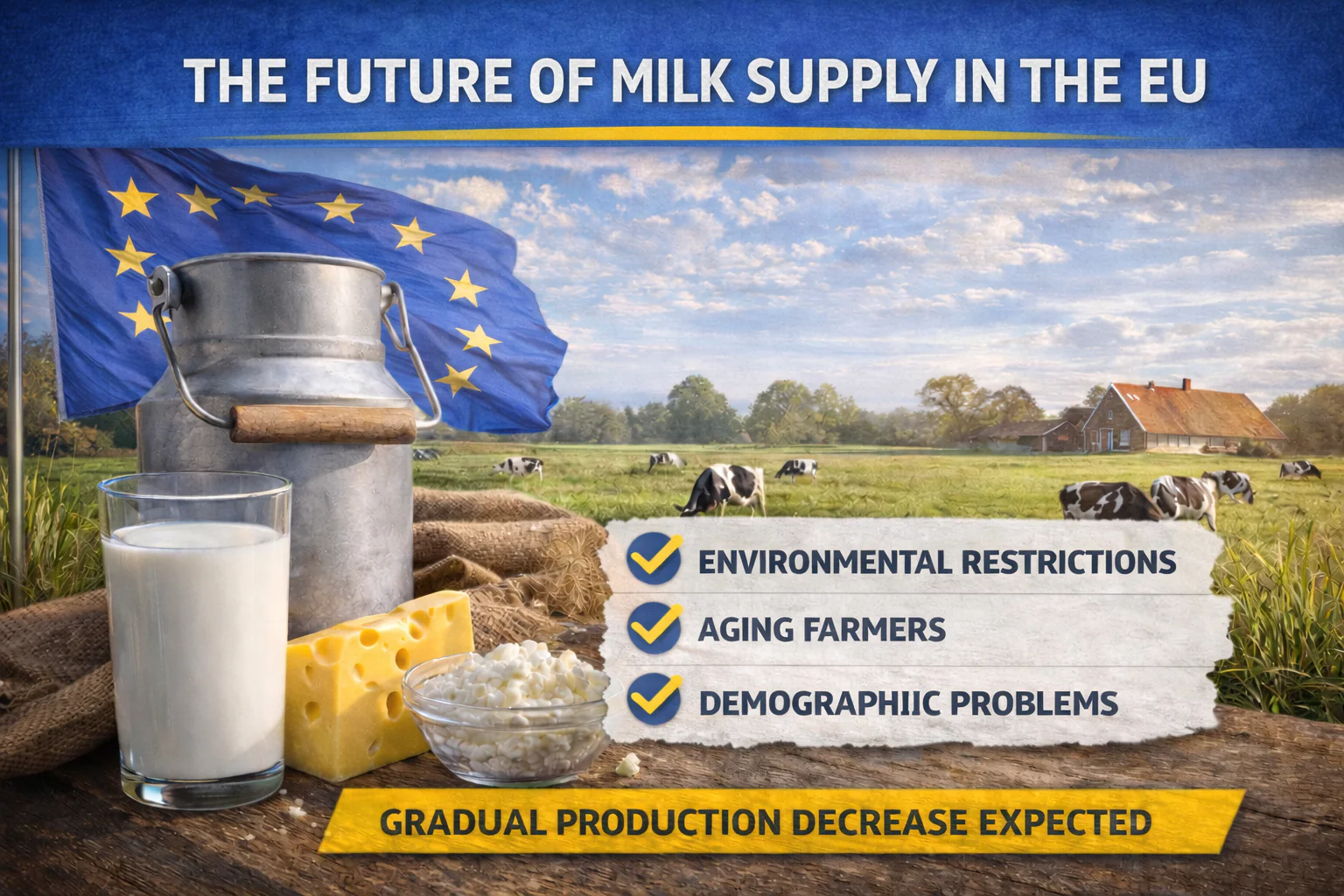
As reported by Dairy Global, citing a recent RaboResearch podcast, the European dairy sector is entering a phase of stabilization and, in the medium term, gradual production decline.
Senior dairy analyst Michael Harvey and European market expert Tom Booijink outlined the key structural changes that will shape supply dynamics over the next 5–10 years.
From Growth to Stabilization
Following the abolition of milk quotas in 2015, EU milk production expanded sharply, particularly in Northwestern Europe. However, 11 years after deregulation, the market is showing signs of stabilization, with slight production declines expected in certain regions.
This presents challenges for processors that invested heavily in capacity expansion between 2015 and 2020, anticipating continued growth in raw milk supply. Under stagnating supply conditions, part of this processing capacity may remain underutilized.
Why Is Europe’s Milk Pool Shrinking?
Analysts highlight several key structural factors behind the expected decline in supply:
- Stricter environmental regulation — tougher requirements on nitrogen, phosphates, and CO₂ emissions, manure management restrictions, and new licensing procedures are increasing production costs and limiting expansion.
- An aging farmer population — in many countries, there is a shortage of younger producers willing to continue dairy operations.
- Demographic shifts in Eastern Europe — labor migration to Western Europe and population decline (notably in Bulgaria) are constraining dairy sector development.
The most significant reductions are expected in countries with the strictest regulatory frameworks — the Netherlands, Belgium, Germany, and Denmark — which together account for up to 40% of EU milk production. France is also projected to see a decline, largely driven by demographic factors.
Implications for Processors
According to experts, dairy processors will need to:
- Strengthen cooperation with farmers by offering competitive milk prices.
- Optimize assets and capacity utilization, as plant load factors directly affect production costs (particularly in cheese manufacturing).
Global Perspective
Booijink expects that global milk supply could decline by 5% over the next decade. While this may appear moderate, for the EU it would translate into a substantial reduction in export potential — approximately 40% in milk equivalent terms.
Given stable global demand, this development could create opportunities for other exporting regions to capture part of the vacated market share.
Analysts emphasize that declining production represents a long-term structural trend that will reshape the European dairy sector and usher in a new phase of global competition.
Source: DairyGlobal