
The dairy market is ever harder to describe with a single figure: milk fat is cheap, while protein and powders are regaining value — which could reshape how dairies value each litre of raw milk.
The dairy market in the second half of 2026 is ever harder to capture with a single indicator: milk fat has risen recently in the EU but remains clearly cheaper than a year ago in international trade, while protein and powders are regaining market value, Tygodnik Rolniczy reports.
A weaker fat segment and a stronger protein segment
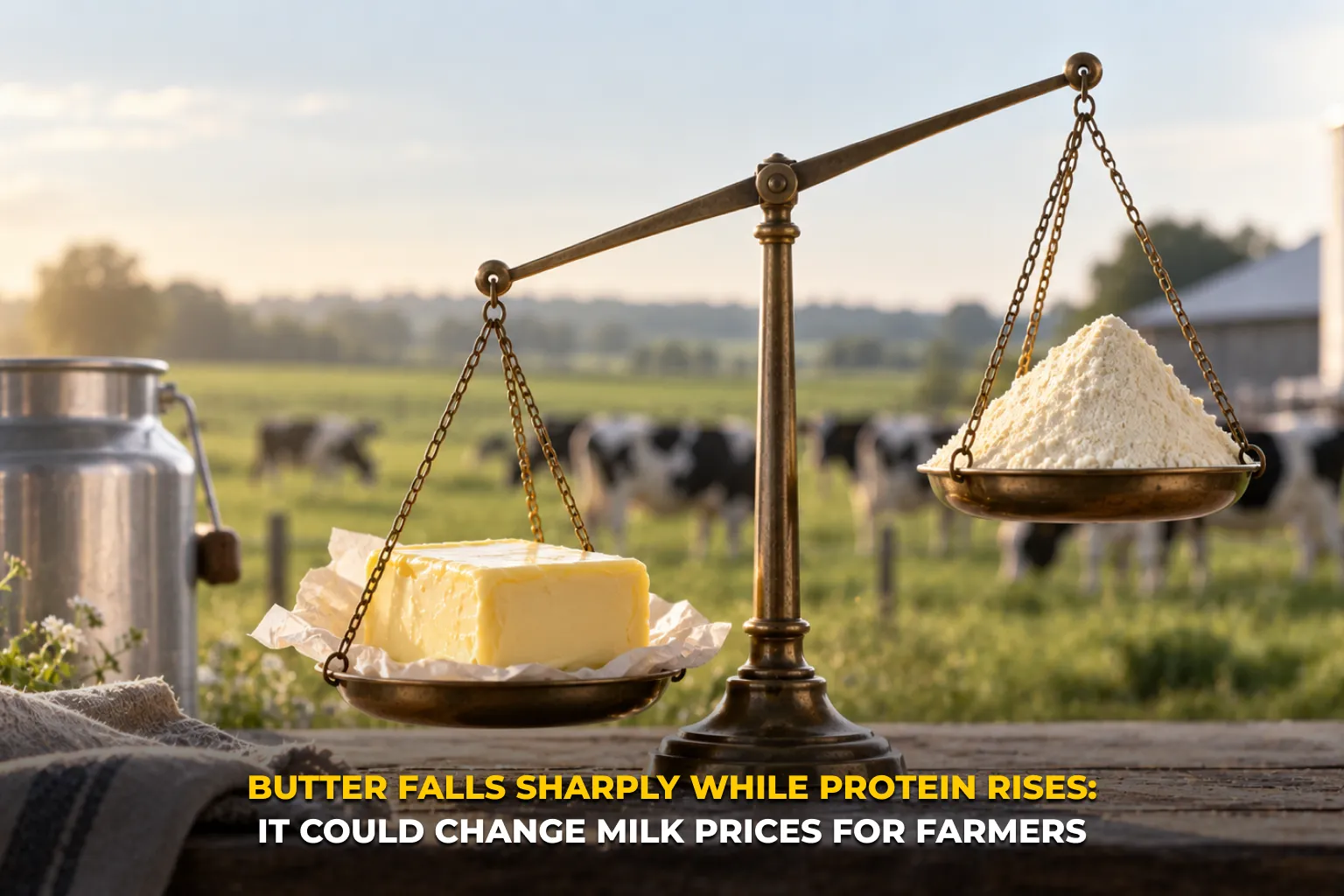
In August, butter in Germany, Oceania and the US was on average 37.9% cheaper than a year earlier, while skimmed milk powder (SMP) rose 21.5% and whey powder as much as 42.5% — so the market is splitting into a weaker fat segment and a stronger protein segment.
At the 18 August GDT auction, SMP rose 6.8% to about €3,012/t and whole milk powder (WMP) 2.8% to €3,093/t, while butter fell 2.4% to about €4,429/t.
In the EU, SMP averaged €2,877/t on 16 August (from €2,689/t on 5 July), up about 7% in six weeks. It was over 20% dearer year on year in France, 18.2% in Poland and about 35% in the US.
EU butter averaged €3,976/t on 16 August — up 0.9% week on week but still far below last year (Poland −40.5%, Germany ~42%, Netherlands 43%+, France ~45%).
Whey, protein premiums and the autumn outlook
Whey prices in Germany and the US were 42.5% higher year on year in late August — important for cheesemakers, as whey has shifted from a by-product to a key source of value via powders, lactose and functional-food ingredients.
A dairy buys not fat and protein separately but one litre of raw milk containing both, so higher powder prices do not automatically improve a plant’s position — what matters is the value extracted from the whole litre and the product portfolio. If protein stays relatively more valuable than fat, its weight in raw-milk premium systems may grow, shifting emphasis from litres and fat to total milk solids. Some co-ops have already taken first steps.
Note that the average milk price in 13 EU countries was 20.7% lower year on year in July, versus only about 1% in the US.
The takeaway: it is increasingly meaningless to say dairy prices are simply «rising» or «falling» — the advantage may go not to the plant that processes the most milk, but to the one that best uses its protein, fat, lactose and whey components.
Source: Tygodnik Rolniczy