
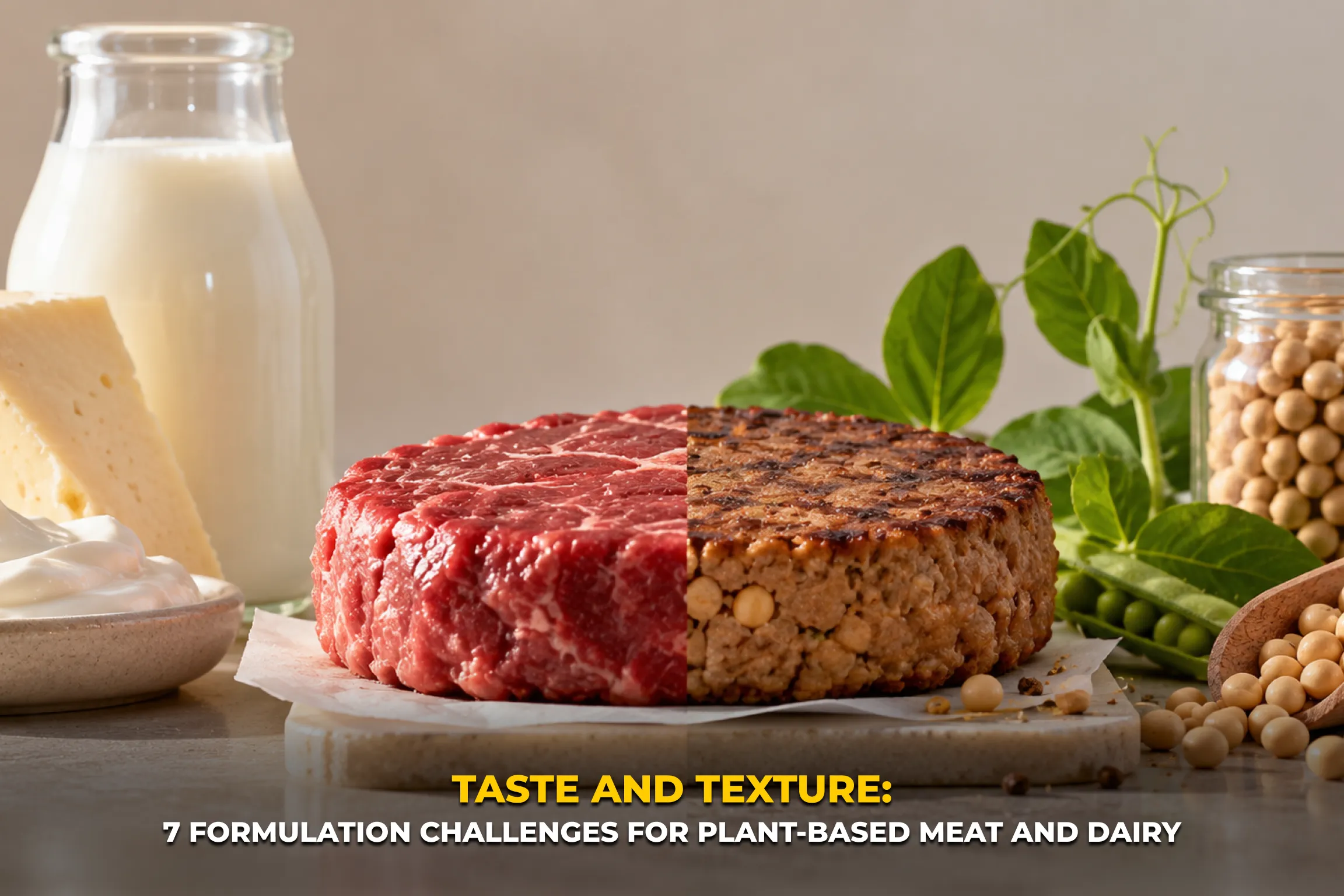
Plant-based meat and dairy have come a long way, but recreating a meat- or dairy-like character without animal ingredients remains hard — and scaling up successes to manufacturing brings its own difficulties.
Plant-based meat and dairy face a number of hurdles to winning consumer acceptance — many shoppers see prices as too high, and the products have also felt the backlash against ultra-processed foods.
Yet taste and texture still matter most, and despite real progress in recent years, plenty of formulation challenges remain, DairyReporter reports.
1. Plant-based meat: plant proteins don’t behave like animal proteins
One of the biggest challenges is that plant proteins do not naturally behave like animal muscle proteins, explains Valentina Gallani, health and nutrition research manager at non-profit ProVeg International.
They must be structured to reproduce meat’s fibrous architecture — and while processing technologies like extrusion have advanced greatly, matching meat’s firmness, chewiness and juiciness remains active research territory, alongside getting colour, flavour, cooking behaviour and nutritional quality right.
2. Plant-based dairy: replicating milk-protein functionality is tricky
Plant-based dairy faces similar bottlenecks, says Devika Suresh, head of the ProVeg Incubator: reproducing the functionality of milk proteins and caseins.
In plant-based drinks, plant ingredients behave very differently from milk proteins or fat, creating stability challenges and making sedimentation, creaming or separation hard to prevent — emulsifiers, stabilisers and homogenisation can help.
3. Plant-based meat: lab success doesn’t always survive the line
A recipe that performs well in a lab or kitchen may not translate to a manufacturing line.
«Recipes that perform well on lab equipment frequently behave differently on a co-manufacturer’s line», Suresh says.
Reformulating around available equipment and keeping quality consistent across batches is a common headache for plant-based meat makers.
4. Plant-based meat: sourcing the right ingredients at the right volumes
Smaller plant-based meat companies especially struggle to secure the protein fractions or functional ingredients they need at the volumes or prices required, Gallani explains — a key bottleneck for firms without deep capital, often forcing them to reformulate.
5. Plant-based dairy: cheese remains the hardest case
«Founders in this category tell us that cheese is where the technical and commercial challenges collide most sharply», Suresh says.
Plant-based cheese has to deliver on melt, stretch, firmness, creaminess and flavour all at once — and the right functionality adds cost.
«The ingredient systems that deliver credible melt, stretch and flavour are frequently the most expensive part of the formulation, and fermentation-based approaches add time and process-control requirements that are difficult for a young company to manage without pilot-scale facilities», she notes.
6. Plant proteins can bring unwanted flavours
Flavour is another problem.
«Plant proteins can bring unwanted beany, bitter or astringent notes, while reproducing the complex savoury flavour of cooked meat requires careful formulation and processing», Suresh says of plant-based meat — though fermentation, extrusion and flavour optimisation are helping.
Off-notes challenge plant-based dairy too, in both beverages and cheese.
7. Nutritional parity is hard to achieve
For both categories, matching animal-based nutrition matters — and is contentious given ongoing debate over how healthy these products are.
For plant-based meat, protein quality, micronutrient content and, depending on the ingredient, digestibility and bioavailability are crucial, Gallani says.
For plant-based dairy, Suresh notes nutritional equivalence matters too, with many drinks relying on fortification.
What plant-based has got right
Despite these lingering challenges, plant-based meat and dairy have made real progress, even if many problems have been eased rather than solved outright.
Advances in protein structuring and extrusion have made fibrous meat textures more convincing, Suresh says, while research has improved meat-like flavour and colour and cut unwanted notes.
For plant-based dairy, better emulsion and suspension stability, fermentation, homogenisation and fortification have lifted nutrition, consistency and sensory quality, with high-pressure and ultrasound-based approaches now being explored.
Infrastructure has improved too: from the ProVeg Incubator’s vantage point, «functional ingredient systems, flavour-masking solutions and contract manufacturers willing to run plant-based lines are all far more accessible than they were five years ago», Suresh says — start-ups now spend less time building capability and more on differentiation.
Plant-based has come a long way in recent years, but formulation challenges remain, and companies will need to keep tackling them to widen consumer appeal.
Source: DairyReporter