
US dairy now produces 76% more milk with fewer cows, as robotics, beef-on-dairy income and component pricing reshape the farmgate.
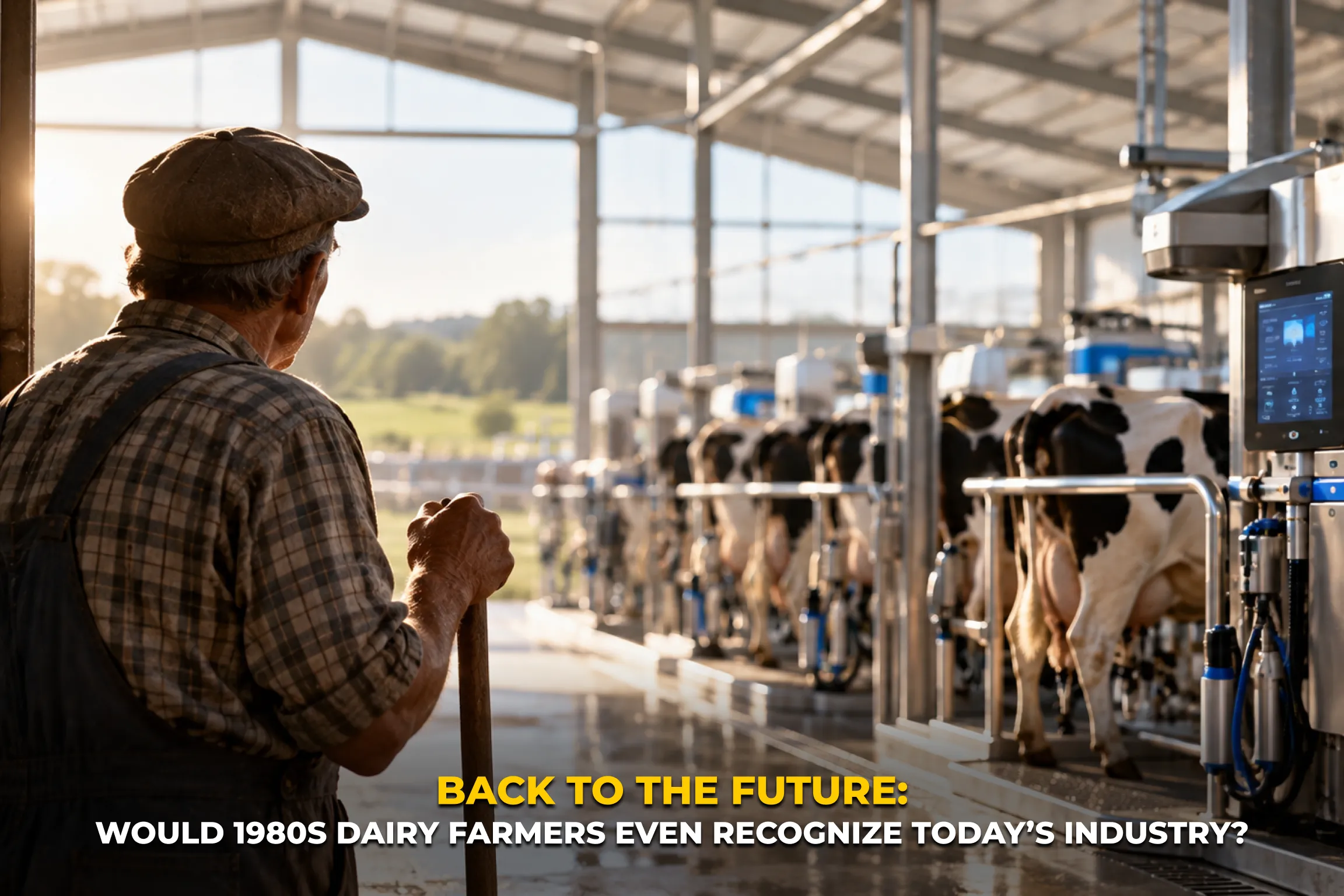
The structural evolution of the US dairy industry over the past four decades has rewritten the fundamentals of milk production, herd genetics and farm revenue models, Dairy Herd Management reports, in a report by Karen Bohnert. Walking a time-travelling 1980s dairy producer through a commercial operation in 2026 would feel like science fiction.
More milk, fewer cows
In 1980, a national herd of 10.8 million cows generated about 128 billion pounds of milk, averaging roughly 11,900 pounds per cow a year. By 2026, a smaller national herd of 9.7 million cows produces about 226 billion pounds — a 76% output surge — yielding more than 24,000 pounds per cow on average, with elite herds surpassing 30,000 to 35,000 pounds.
From volume to components
Beyond sheer volume, the composition and valuation of milk have fundamentally transformed through precision nutrition and genomics. In the 1980s, raw milk was sold largely as simple liquid volume; today, over 90% of US milk is priced via Multiple Component Pricing, rewarding producers specifically for butterfat and protein yields.
National butterfat levels have jumped 15.2% over the past decade alone, raising processing efficiency from 10 pounds of cheese per hundredweight of milk to 11.6 pounds. This component surge has flipped the country’s trade balance, turning the US from an importer of 176 million pounds of butter in 2024 into an active net exporter in 2025.
Robots, genomics and a new second revenue stream
On-farm workflows and genetic strategies bear little resemblance to the labour-intensive stanchion and tie-stall setups of the 1980s. Modern facilities rely heavily on voluntary robotic milking systems, with cows entering stalls unassisted three to four times a day, guided by real-time biometric sensors and computerised ear tags tracking rumination, temperature and somatic-cell indicators.
The arrival of commercial genomics and sexed semen has also created an unprecedented secondary profit centre: beef-on-dairy. By breeding top genomic females to sexed dairy semen for replacement heifers and crossing the rest with beef sires, farmers now sell crossbred calves for $1,500 to $2,000 — replacing the negligible $50 once fetched by Holstein bull calves — adding an average $5.39 per hundredweight to the milk check.
Geographic consolidation
The geographic and commercial footprint of milk production has also consolidated sharply. Where dairy farms were once scattered across nearly every agricultural county, just 10 states now account for 74% of total US milk output, with the top 14 controlling 84%.
The end-market profile has shifted too, from fluid-milk jugs to export-bound manufactured solids and functional nutrition. Dairy exports — a mere 2–3% surplus-dumping mechanism in 1980 — now regularly exceed 140 million pounds of cheese a month, backed by a $13bn wave of domestic processing-plant investment.
At home, traditional white milk has ceded shelf space to multi-billion-dollar Greek yogurts, functional protein shakes and a revitalised cottage-cheese category that grew 14.3% in 2025.
What hasn’t changed
Despite the arrival of digesters generating renewable-energy credits, complex futures hedging and the Dairy Margin Coverage (DMC) safety net, dairy’s human foundation remains unchanged.
Producers still contend with 365-day commitments, unpredictable weather, volatile margins and a Federal Milk Marketing Order (FMMO) system that has struggled to modernise at the pace of technology.
Yet where generational succession was deeply uncertain in 1980, the convergence of robotics, beef-on-dairy income, component premiums and global export access has delivered a more technologically agile, financially resilient outlook for the next generation of American producers.
Source: Dairy Herd Management