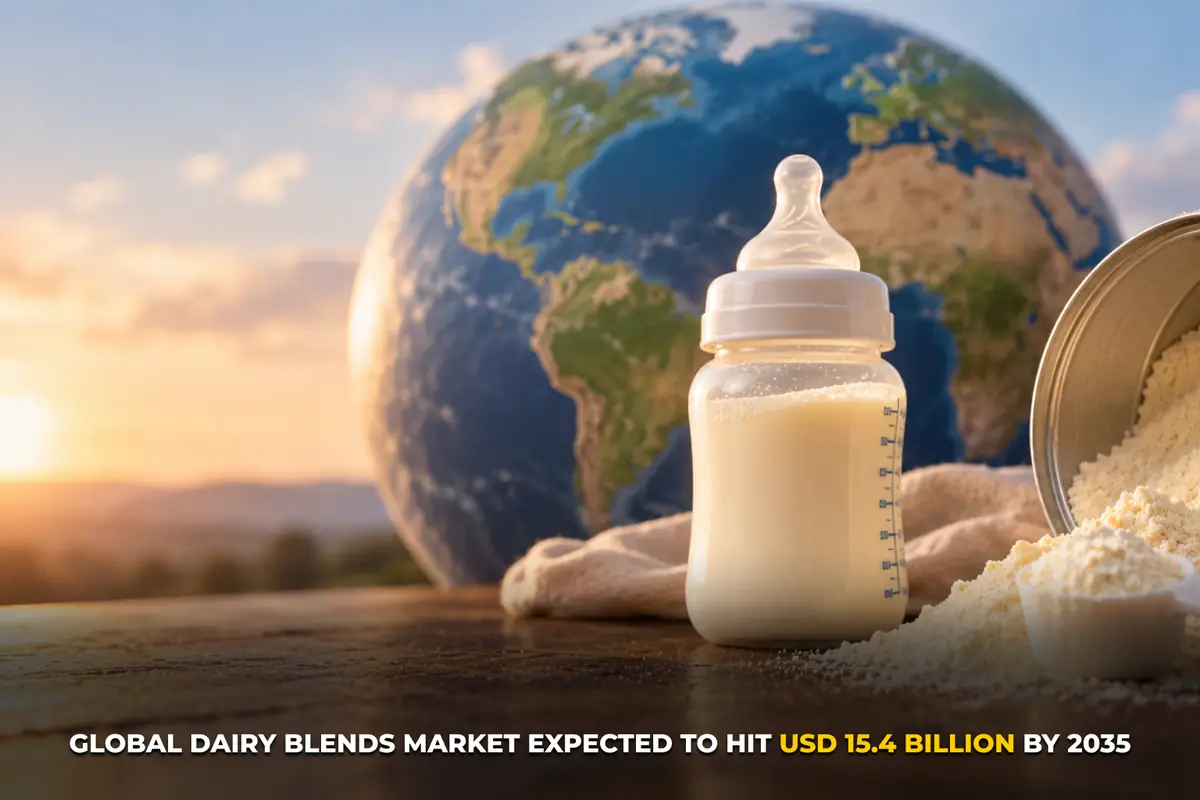
The dairy blends market is set to grow as food manufacturers and price-sensitive households seek affordable, convenient products, DairyReporter reports.
Key points:
- Credence Research forecasts the dairy blends market to reach USD 15.38 billion by 2035, a compound annual growth rate of 4.43%;
- the market was worth USD 9.97 billion in 2025 and is expected to reach USD 10.4 billion in 2026;
- fat-filled milk powders hold the largest share (35.5%), and powders overall account for 61% of the market;
- replacing milk fat with palm or coconut oil can cut the cost of reconstituted milk by nearly half;
- Asia Pacific is the largest region (30.2%), while Africa is growing fastest (5.68% a year).
Credence Research forecast
According to Credence Research, the dairy blends market will reach USD 15.38 billion by 2035, with a compound annual growth rate (CAGR) of 4.43% over 2025–2035.
Valued at USD 9.97 billion in 2025, the market is estimated to grow to USD 10.4 billion in 2026.
Three main buyer groups
Growth is driven by three main customer groups, Credence Research says: households in import-dependent markets buying fat-filled milk powder and filled canned milk as affordable milk; food manufacturers and foodservice chains buying ingredient blends made to their recipes; and shoppers in Northern Europe and Oceania buying spreadable butter blends for convenience.
The firm divides dairy blends into powder, spreadable and liquid formats, including fat-filled milk powders, dairy ingredient blends, spreadable butter blends and filled evaporated or condensed milk.
Powders lead the way
Fat-filled milk powders led the market in 2025 with a 35.5% value share. Powders overall accounted for 61% of 2025 value and grew fastest, at 5.2% a year, because they travel well and keep for a year or more without refrigeration — ideal for import markets with weak cold chains.
The price gap between milk fat and vegetable fats is fuelling substitution: replacing milk fat with palm or coconut oil can cut the cost of reconstituted milk by close to half.
Regions
Asia Pacific held the largest share of the dairy blends market in 2025, at 30.2%, as the Philippines, Indonesia, Malaysia and China buy powder, canned and ingredient blends. Africa was the fastest-growing region, at 5.68% a year.
Cost optimisation and functionality
«With the global dairy blends market projected to grow from USD 9.97 billion in 2025 to USD 15.38 billion by 2035 at a CAGR of 4.43%, the biggest catalyst we are seeing is the need for cost-optimization and functional versatility in food manufacturing», said Priyanka Mor, Senior Consultant at Credence Research.
«As traditional dairy commodity prices remain volatile, food and beverage processors, particularly in bakery, confectionery, and ice cream, are increasingly shifting toward dairy blends and fat-filled milk powders to protect their margins without compromising on texture, mouthfeel, or nutritional profiles».
Beyond cost efficiency, Mor said, custom formulation is driving the next wave of growth.
«Manufacturers in the infant nutrition, clinical nutrition, and functional beverage sectors are actively using specialised dairy blends, combining whey protein, skim milk powder, and vegetable fats or dietary fibers, to achieve precise micronutrient and clean-label targets, especially across fast-growing Asia-Pacific and Middle Eastern markets», Mor said.
Source: DairyReporter