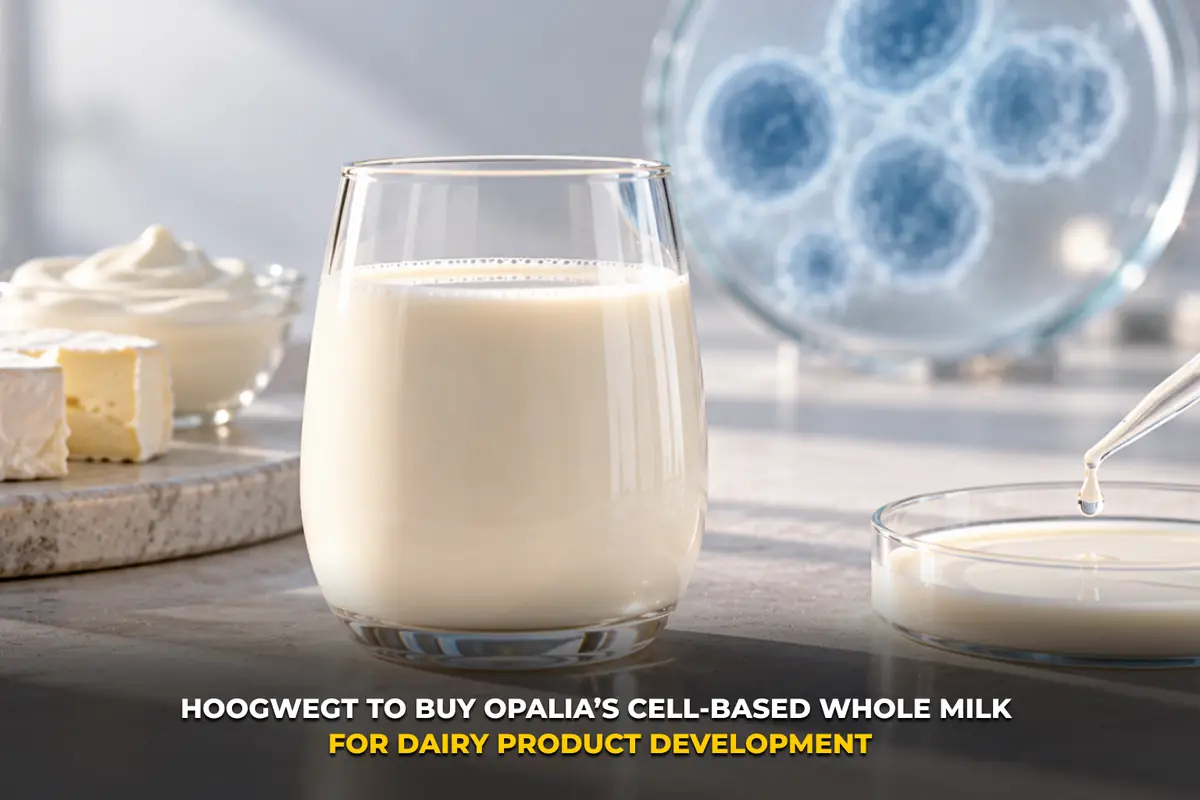
Dairy ingredients supplier Hoogwegt plans to buy the first production batch of cell-based whole milk from Canadian company Opalia for composition testing and product development, and the two will showcase a prototype at Fi Europe 2026, Food Ingredients First reports.
Key points:
- Hoogwegt plans to buy Opalia’s cell-based whole milk for testing and dairy product development;
- Opalia aims to apply for regulatory approval in North America within the coming year and targets «food-grade status» in 2028;
- the companies will show a prototype at Fi Europe to attract development and commercial partners.
A first purchase of cell-based milk
Hoogwegt plans to buy Opalia’s first production material of cell-based whole milk for composition testing and product development, with fresh cheese, yoghurt and butter among potential applications.
The companies describe the planned purchase as a world first for whole milk produced from bovine mammary cells. Opalia has validated its process at laboratory scale, with scale-up and regulatory approval still to come.
«The future of dairy will be a mix of traditional and new production methods, and we want to help shape it», says Roland Wientjes, global technology director at Hoogwegt.
Montreal-based Opalia grows mammary cells in a controlled bioreactor environment to produce milk containing proteins, fats and sugars. Its approach differs from precision fermentation, which typically targets individual dairy proteins.
The company aims to supply milk and milk ingredients and license its technology to food manufacturers, and says its milk can be processed into dairy products using existing methods.
Functionality in focus
Ingredient performance is also central to precision-fermented dairy. At IFT FIRST 2026, Standing Ovation showcased its Advanced Casein in gelato, which it says supports texture and creaminess at a 2–3% inclusion rate. That approach uses a specific dairy protein in a formulated product, whereas Opalia aims to produce whole milk.
The publication’s July coverage of rising whey costs highlighted manufacturers’ efforts to diversify protein supplies through alternative ingredients, blends and new production methods, with suppliers citing tighter availability and higher prices as drivers of reformulation.
Cellular agriculture is also being explored on existing dairy farms. In June, Dutch start-up RespectFarms opened a cultivated meat pilot on a dairy farm in Schipluiden, the Netherlands, to test whether small-scale cell cultivation can give farmers an extra revenue stream alongside conventional farming.
Building toward commercial production
Hoogwegt’s purchase builds on its investment in Opalia and a commercial agreement announced in August 2025 covering 2026 and 2027, which included a purchase order supporting product development.
In April, Opalia raised CAD 3.2 million (USD 2.28 million) in an initial seed funding close to support development of its modular bioreactor and commercialisation plans. The planned system targets 28 litres of milk a day.
The company plans to apply for regulatory approval in North America within the coming year and targets food-grade status in 2028. The announcement gives no purchase volume or value, nor finished-product performance results.
Opalia and Hoogwegt will present a prototype at Fi Europe in Frankfurt, Germany (17–19 November), seeking partners to support development and explore future commercial and offtake agreements.
Source: Food Ingredients First