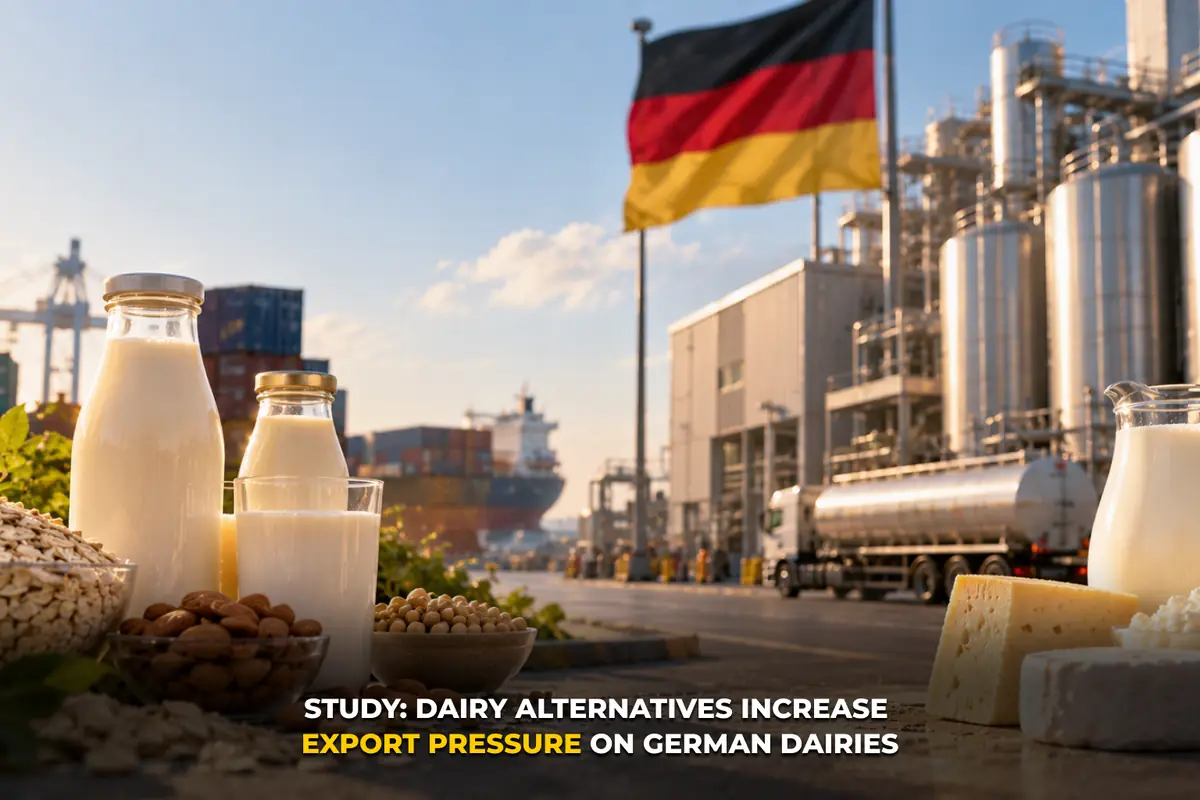
Dairy alternatives could account for up to 25% of consumption in Germany by 2035. That may open opportunities for dairies, but without more exports the German dairy sector will come under pressure, a new study shows, Lebensmittel Praxis reports.
Key points:
- by 2035, alternatives’ share of German dairy consumption could rise from 7.5% (2023) to 12.5–25%;
- if lower domestic demand is not offset by exports, German milk production could fall by 5.5–19.4%;
- dairies already have the plants, product lines and know-how to develop new business areas;
- from the early 2030s, precision fermentation could open up new possibilities.
Dairy alternatives such as oat drinks, soy yoghurt and cheese alternatives could make up between 12.5% and 25% of total dairy consumption in Germany in 2035, up from 7.5% in 2023. If the German dairy industry does not offset this growth with higher exports, domestic milk production could come under pressure and fall by 5.5% to 19.4%.
These are the findings of the study «Alternative dairy products — demand development and possible impact on the dairy market in Germany», produced by agricultural think tank Agora Agrar together with the Centre of Expertise for Agriculture and Food of the German Agricultural Society (Deutsche Landwirtschafts-Gesellschaft, DLG) and the Department of Agricultural Markets at the University of Hohenheim. The assumptions are based on expert interviews and market analysis.
Dairy alternatives have real growth potential
«The debate on the development of alternative dairy products is often shaped by very different perspectives that put their potential either very low or very high», says Christine Chemnitz, Director of Agora Agrar. «Our analysis supports neither extreme — but we do expect significant growth potential for alternative dairy products that could change the market permanently».
The study examines two demand scenarios. In the conservative scenario, the share of alternative dairy products rises from 7.4% in 2023 to 12.5% in 2035; in the dynamic scenario, to 25%. The authors assume constant overall demand for dairy products throughout the period, met by both cow’s milk and alternative products.
Dairy consumption falls — exports would have to rise
This means that the more alternatives are consumed, the fewer cow’s milk products are bought. According to the researchers, the impact on German milk production therefore depends largely on whether dairies and dairy farms can offset lower dairy sales with additional exports.
Both demand scenarios are analysed under two hypothetical trade scenarios. If lower domestic demand is fully offset by exports, domestic production is unaffected. If not, production in Germany falls by 2035, compared with 2023, by 5.5% in the conservative scenario and 19.4% in the dynamic scenario.
Dairies: a chance for new business areas
According to the study, dairies could respond to these possible developments by adapting their offering to changing consumer behaviour.
«Changing demand can open up new options for dairies: the plants, product lines and know-how are there to develop new business areas», says Max Knoll-Rosenberg, livestock topic manager at Agora Agrar. «If dairies remain economically stable as a result, dairy farms in the region benefit too».
Why consumption of alternatives could rise
The study also looks at technological approaches that could shape the development of alternative dairy products over the next ten years. While the short-term focus is on plant-based alternatives, that may change in the longer term.
«We expect technologies such as precision fermentation to open up new possibilities from the early 2030s. They could be used to make products that are functionally comparable to animal dairy products», says Stephanie Wunder, team lead for sustainable nutrition at Agora Agrar.
The authors see particular growth potential in drinking milk, yoghurt, cream and, to some extent, cheese. Alternative ingredients could also be used in processed foods such as bakery products, ready meals, ice cream and confectionery without fundamentally changing the product for consumers.
Other factors affecting the development of alternative dairy products include production costs, European Union (EU) approval procedures and consumer acceptance. How these will evolve is highly uncertain, but the researchers say it is important to discuss possible changes to the dairy market early and objectively.
Source: Lebensmittel Praxis