

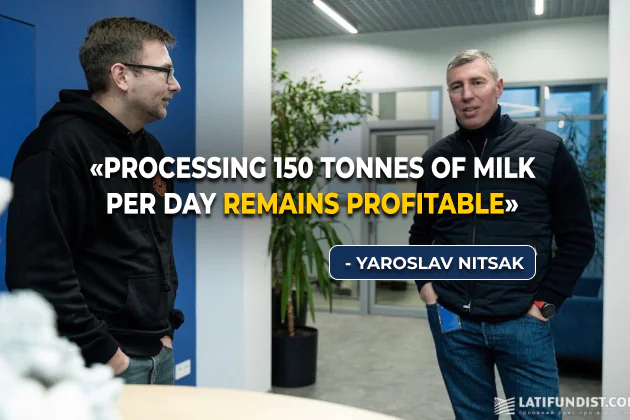
Despite price volatility in the milk market, Ukrainian producers continue investing in farm modernization and milking equipment. In an interview with Latifundist.com, Yaroslav Nitsak, CEO of GEA Group in Ukraine, outlined demand dynamics, processing profitability thresholds, and the outlook for dairy farm automation.
Market Cyclicality and Continued Investment
According to Nitsak, the dairy segment experienced a boom in recent years, and even the current price decline has not halted strategic projects.
“It has indeed experienced a boom in recent years. Now milk prices are declining, and it is not yet entirely clear where the bottom will be,” he noted.
At the same time, the company does not observe widespread cancellations of investment projects. Investors factor in the cyclical nature of the industry and its long-term growth potential.
Profitability Threshold in Processing
One of the key questions concerns the scale at which milk processing becomes economically viable.
“Processing 150 tonnes of milk per day remains profitable for an existing facility,” Nitsak explained.
However, for commodity products such as milk powder, butter, casein, or milk fat, economies of scale are critical. In such segments, profitability typically begins at processing volumes of 400–500 tonnes of milk per day.
From Tie-Stall to Automation
According to the head of GEA in Ukraine, the sector is gradually moving away from tie-stall housing toward mechanized and robotic systems.
“Currently, about half of the herd is kept in tie-stall systems. The industry will definitely move away from that model,” he emphasized.
Key drivers of this transition include labor shortages and rising wage costs, as well as tightening environmental and animal welfare requirements.
Group Robotic Milking: Scaling Efficiency
A particular focus of GEA Group in Ukraine is the implementation of group robotic milking systems for large-scale farms.
“Today, group robotic milking is effectively the most efficient system for farms with large herd sizes,” notes Yaroslav Nitsak.
According to him, this model enables farms to scale operations without proportionally increasing headcount while delivering higher productivity compared to conventional milking parlors, including rotary (“carousel”) systems.
Artificial Intelligence in Dairy Farming
GEA is also deploying artificial intelligence-based solutions. The CattleEye system analyzes cow locomotion and enables earlier detection of health issues.
“The system can identify a problem with 99% accuracy three to four days — and sometimes up to a week — earlier than it can be detected visually,” explains the head of GEA in Ukraine.
Early diagnosis of lameness or body condition issues directly impacts milk yields and overall farm economics, reducing treatment costs and minimizing production losses.
Market Growth Despite Wartime Conditions
The company reports steady demand for new milking parlors and modernization of existing facilities. According to internal estimates, GEA holds approximately 40–45% of Ukraine’s milking parlor market.
“Our team operates across the entire country, and Ukrainian producers continue to invest — sometimes even in regions close to the front line,” Nitsak concludes.
Overall, Ukraine’s dairy industry continues its structural transformation: moving from manual labor to automation, from small-scale farms to large industrial operations where technology, economies of scale, and data-driven management play a decisive role.
Source: Latifundist.com