
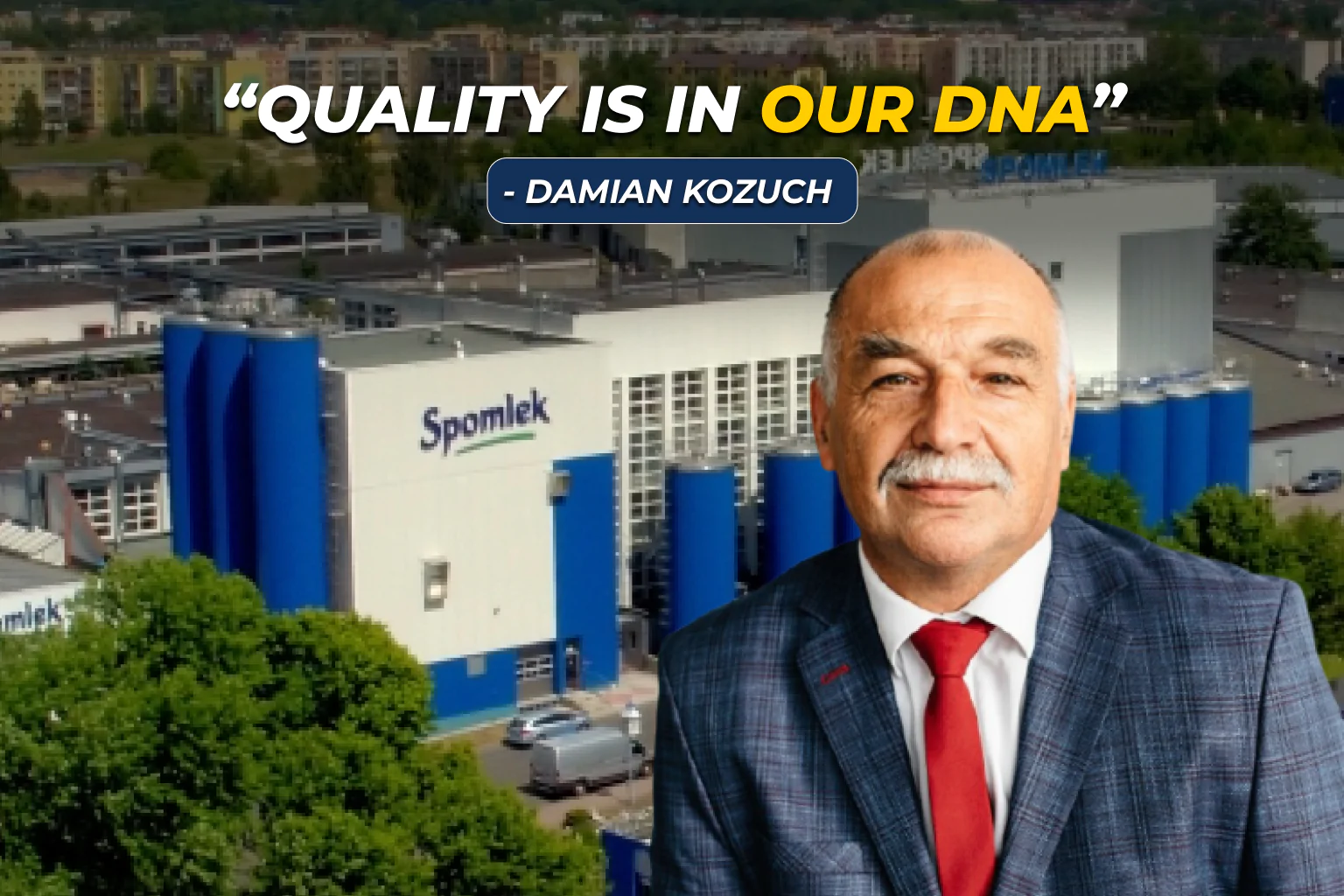
The Polish dairy company Spomlek continues to invest in the modernisation of its cheese production and the automation of its processes. Damian Kożuch, director of the Chojnice branch of Spomlek (SM), spoke about the growth in milk procurement, the efficiency of new production lines, and the importance of stable parameters in cheese production in an interview with Forum Mleczarskie.
Together with the director of Forum Mleczarskie, we delved into the details of cheese production, but began by discussing the growth in procurement in 2025 and milk processing.
We calculate growth in two ways. The first shows total purchases — and here growth was less than 10%. We also calculate growth based on figures from our regular suppliers. Over the last two years, we have also paid additional fees on a quarterly basis to increase supply volumes.
The scheme was progressing well, and suppliers were competing for the funds on offer. This meant that we did not need many new suppliers, as this was how we were covering the closure and winding-up of dairy farms.
How do the new facilities affect productivity? How do you manage to balance the desire to maximise output with the stringent quality requirements for premium cheeses?
We assess every investment in terms of cost-effectiveness per kilogram of product. Let me give you an example from our plant in Chojnicach: we installed a new casomat for producing Swiss-style cheeses. This enabled us to produce more cheese per day than we previously did with salami-style cheese. Crucially, this was achieved by the same team working the same number of hours.
How can we make the most of every gram of nutrients contained in milk?
There is no room for compromise here. Quality is in our DNA. The drive to maximise output is inextricably linked to quality, which at Spomlek always takes precedence over costs and productivity. Our plants produce cheese, around 98.5% of which is classified as first-grade. That is a very high proportion, although there is still 1.5% room for improvement, but cheese is a living organism.
And what is the situation regarding the loss of milk components on modern production lines?
The waste reduction is minimal, as the dairy industry has always sought to utilise as much as possible. We are talking merely about minor details, such as separating the whey to ensure it is free from ‘milk dust’ or grains. This amounts to a difference of just a few parts per thousand.
It is essential to fully optimise parameters such as the temperature at which the milk is curdled. When producing rennet-based cheeses, the stability of the technical parameters is of paramount importance.
What automation and control system solutions have you implemented recently?
Until recently, we were using traditional curd-making vats, where everything depended on the cheesemaker – they had to touch, smell, and check the texture. Now we work with cheese-making vats. The system controls the heating time, cutting, and speed. The cheesemaker only needs to check the stage, and the system signals with a light when it’s time to take a look at the process. This is a huge leap towards automation.
Source: Dairy Forum