
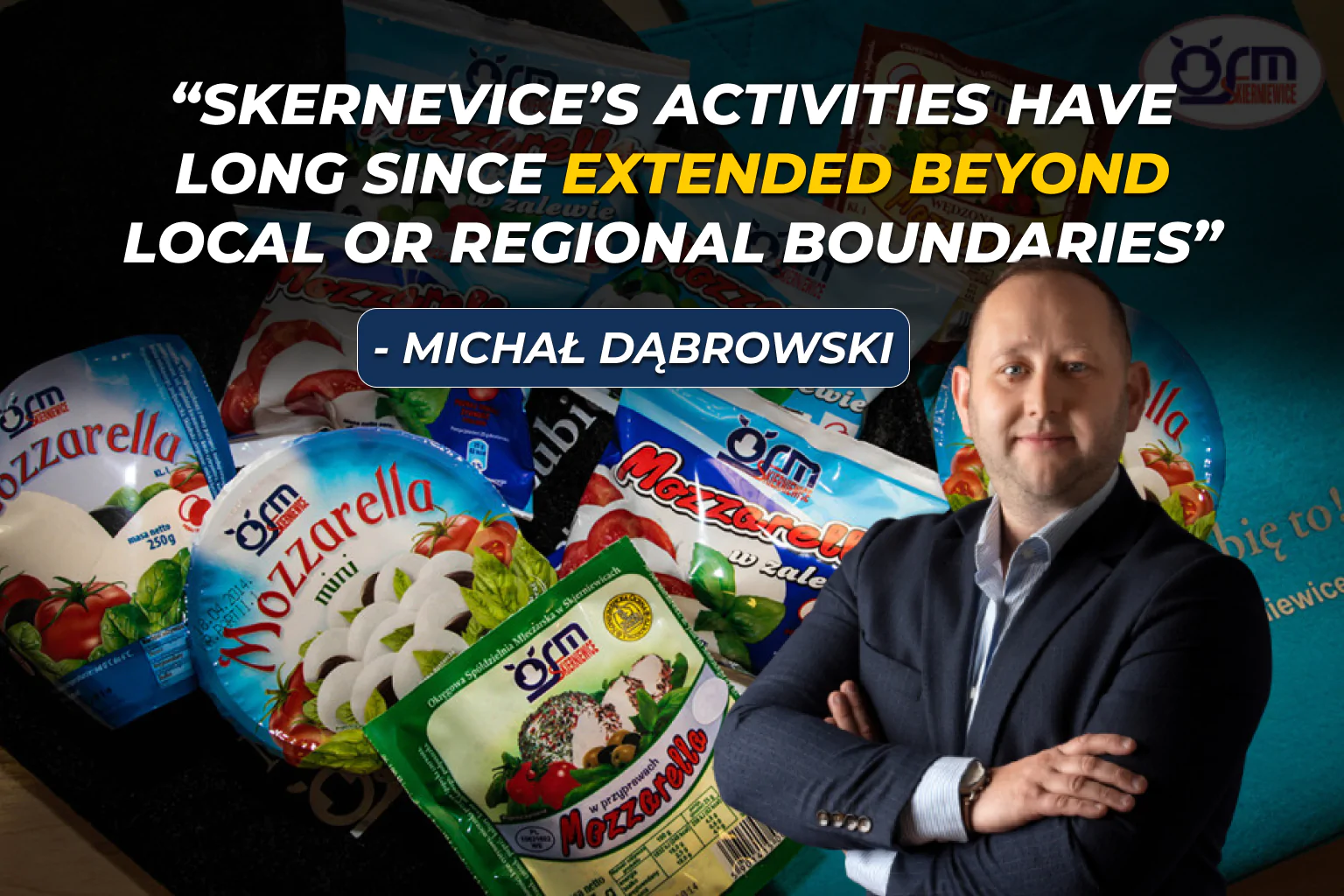
The Polish dairy company Skierniewice (OSM) continues to invest in production, brand development and the value-added products segment, despite the crisis in the European dairy market. In an interview with Forum Mleczarskie, the company’s CEO, Michał Dombrowski, spoke about the rebranding, the dried whey market, the development of mozzarella and the situation regarding milk overproduction.
We’re experiencing the first serious crisis in dairy markets since you took over as CEO of the Skierniewice Dairy (OSM) in April 2025. How do you assess this period, and how did the cooperative navigate it?
I assumed the position of CEO of the District Dairy Cooperative in Skierniewice in April 2025. The first half of the year was a period of relative stability for the dairy industry, during which we reorganised key areas of the company’s operations.
We focused on setting development directions, reviewing our product range, analysing production capacity, and rebuilding relationships with export partners. However, in August, the first signs of the crisis appeared, a crisis that the market continues to face today.
Despite the challenging environment, we are not changing our strategy. We are changing the way we achieve our goal, but the goal itself remains the same.
Recent months have brought the concept of changing the logo and packaging to more modern ones, as well as significant investment decisions to increase production capacity. Please tell us what you’ve implemented.
We decided to refresh the logo without completely overhauling it. Removing the “OSM” designation is consistent with our development direction. Today, our milk and whey powders are sold not only to European markets but also to customers worldwide. We supply mozzarella cheese and butter not only in Poland but also to European markets. We collect milk within a 100-kilometer radius, and our milk purchases – primarily for the production of milk powders – cover the entire country. Our operations have long since expanded beyond local or regional boundaries.
In terms of investments, we launched a new photovoltaic installation and a PFM doypack packaging line. Thanks to this investment, we’ve expanded our product range and increased production of mini mozzarella cheese, and introduced new snack products, such as smoked Ovoletti. We’re also awaiting the launch of a new mozzarella production line, implemented in partnership with GEA. This investment will allow us to increase production capacity to approximately 400 tons per month.
The cooperative’s portfolio includes high-protein, light, and organic mozzarella, as well as doypack and litter packaging. What is the intended sales structure?
Our business today is based on three pillars: milk powders, butter, and mozzarella cheese. In each of these categories, we are seeking new markets and new development opportunities.
We are focusing particular attention on mozzarella, as it is a segment with great potential and excellent prospects. We want to demonstrate that Polish mozzarella can effectively compete with imported products —not only in price, but above all in quality. That’s why we are developing the entire product line, both in terms of recipes and a consistent visual identity.”
The full line of 125g mozzarella in brine is now available: Classic, Light, Lactose-Free, Organic, and High Protein. We’ve also expanded our offerings to include mini mozzarella in doypacks, natural and smoked Ovoletti cheeses, and grilled mozzarella. We’ll soon be introducing 125g Fior di Latte Mozzarella, and this line will be further developed.
We also see great potential in the snack segment, which is why we’re creating the D’Oro line. At the same time, we’re expanding sales across all key channels—from export, through wholesale, to retail chains and HoReCa. The HoReCa channel is particularly important to us , where we continue to see growth.
Our goal is not only to increase production but also to build an increasingly stronger position for the Skierniewice brand in the retail market.
How do you assess the current situation in raw material procurement and the price recovery in the powder category? Are we witnessing a major shift and a reversal of the initially downward trend, then a horizontal one at the price bottom? Is it time for growth, given the recent reports of overproduction?
Since last autumn, we have observed very sharp price declines in virtually all product categories. This has also impacted milk procurement prices – in our case, the average price dropped from PLN 2.25 net to PLN 1.87 net.
Today, the biggest challenge remains the very low price of butter, which still shows no clear rebound.
Mozzarella prices have stabilized after the autumn declines, while skimmed milk powder has maintained the levels achieved after the February increases.
The whey powder market also remains very strong, with demand remaining strong despite high prices. At the same time, all of Europe is grappling with overproduction, making it crucial to actively seek new markets.
We hope that the improvement in the powder segment will eventually translate into other categories, including butter.
Source: Forum Mleczarskie