
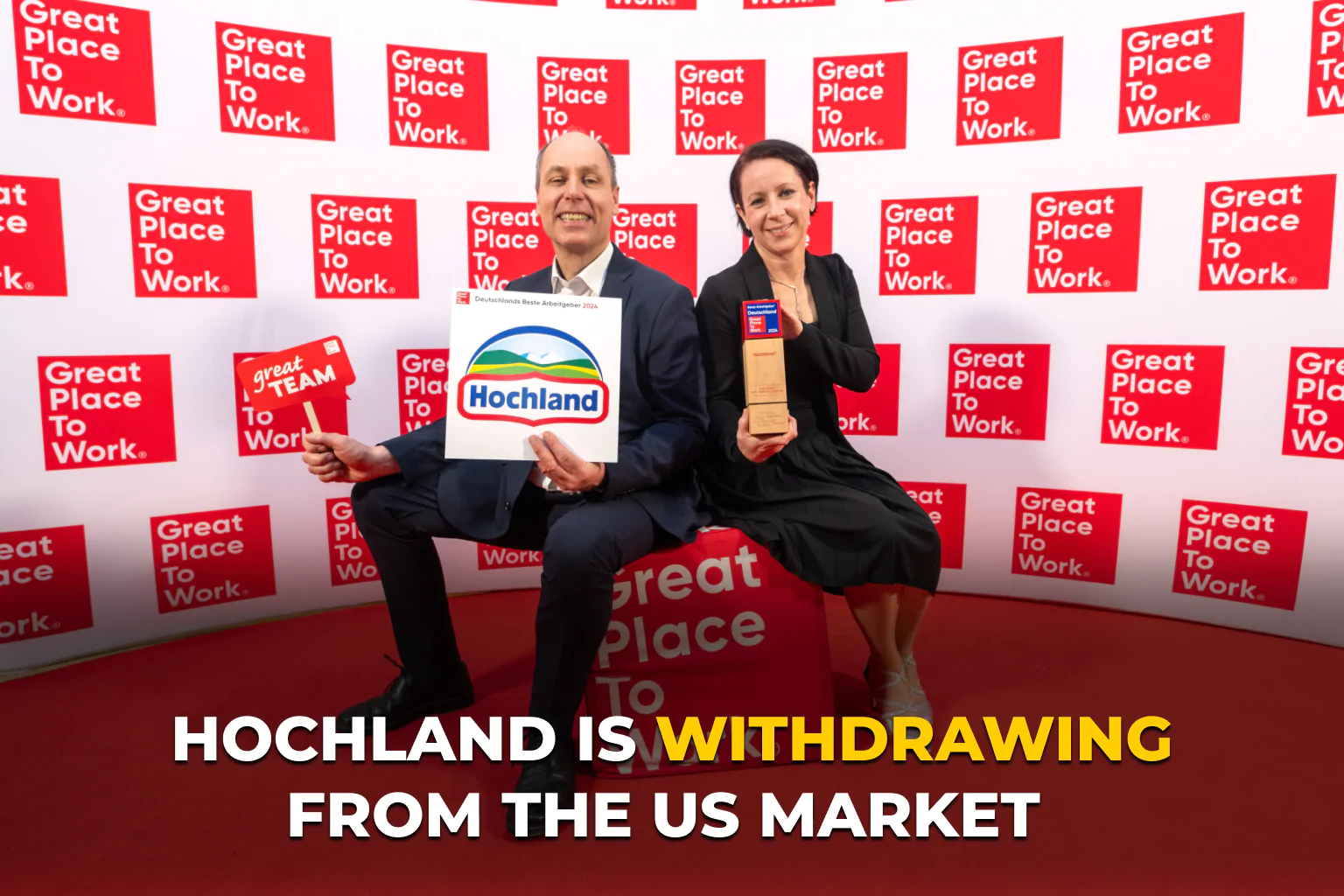
The German cheese group Hochland achieved a turnover of €2.54 billion in 2025 and has decided to focus on key European markets. According to yumda, the company is withdrawing from the US market in order to channel resources towards profitable growth in its core regions of operation.
In 2025, Hochland sold 438,000 tonnes of cheese, and the company’s turnover reached €2.54 billion. Chief Financial Officer Hubert Staub described the year’s results as satisfactory despite the volatile market environment.
“We can look back on an intense year with satisfactory results. In 2025, we took the right decisions – some of them difficult – to continue on our path of profitable growth,” he said.
The company emphasises that the key to stability remains a diversified business model covering the branded segment, Food Service, B2B, and Private Label. The branded segment has delivered stable results in a highly competitive market, whilst Food Service has gained further momentum thanks to innovative solutions for the fast-food sector.
In the B2B sector, Hochland continued to prioritise customer focus and effective solutions, despite rising production and raw material costs. The Private Label division, through its subsidiary Bonifaz Kohler, also maintained its position thanks to flexibility and innovation.
CEO Sebastian Schaeffer noted that combining different business areas gives the company greater resilience.
“Our diversified business model is paying off. Brands, Private Label, Food Service, and B2B complement one another and give us room for manoeuvre. This enables us to seize opportunities and manage risks in different markets,” he emphasised.
In 2025, Hochland maintained a strong position in key European markets. In Romania, the company remains the market leader; in Germany, it ranks second; and in Poland, it continues to operate in a highly competitive environment characterised by high milk prices.
At the same time, the group decided to scale back its presence outside its core markets. In the US, the company did not see sufficient potential for growth and profitability, so it decided to withdraw from the market.
“Focus is part of responsible management. We invest where we can create sustainable value. We see this opportunity clearly in our core markets,” explained Hubert Staub.
Hochland places particular emphasis on sustainability. In 2025, the company continued its efforts to reduce CO₂e emissions through changes to the packaging and recipes of its processed and cream cheeses. The company states that the new recipes enable the carbon footprint of cream cheese to be reduced by up to 40%.
In addition, Hochland continues to work with milk producers to improve the climate efficiency of production.
“As one of the major food manufacturers, we share responsibility for sustainable food production and are proactively shaping change in line with our customers’ wishes,” said Josef Stitzl, Chief Operating Officer.
The company also continues to invest in digitalisation. In 2025, Hochland expanded the rollout of SAP S/4HANA to integrate the group’s international sites. The company expects this to enable it to respond more quickly to market changes, manage costs more effectively, and make greater use of analytics and artificial intelligence tools.
At the end of 2025, Hochland adopted its new Vision 2030 strategy, which is based on the principle ‘We serve our customers better’. The new Hochland Heartbeat concept brings together the company’s key areas of development: people, productivity, profitable growth, sustainability and digitalisation.
“Vision 2025 served as a compass during turbulent years. With Vision 2030, we want to build on this foundation and create new growth impulses. Together with our Winning Culture, we will lead Hochland into the next phase,” said Sebastian Schaeffer.
Source: yumda