
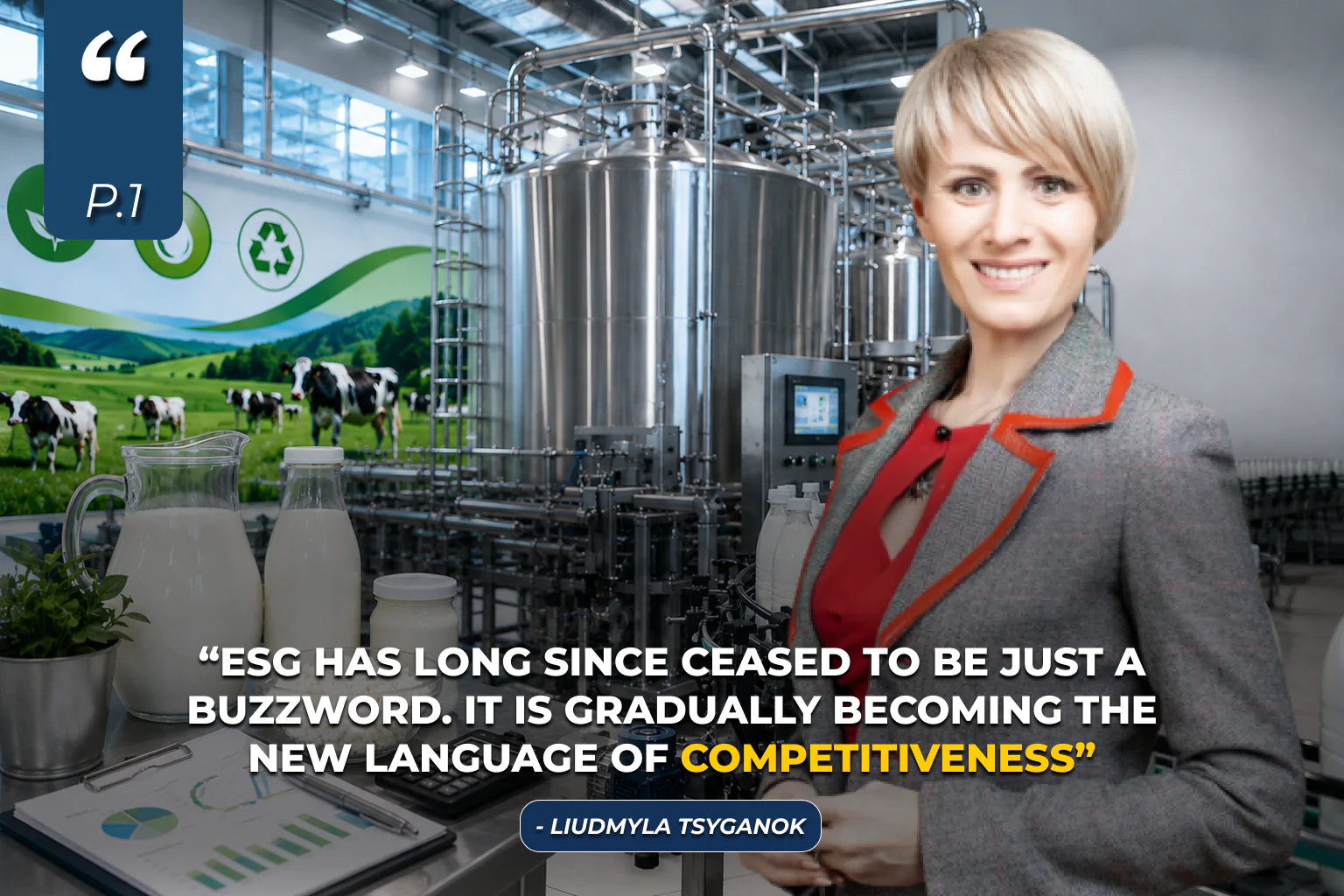
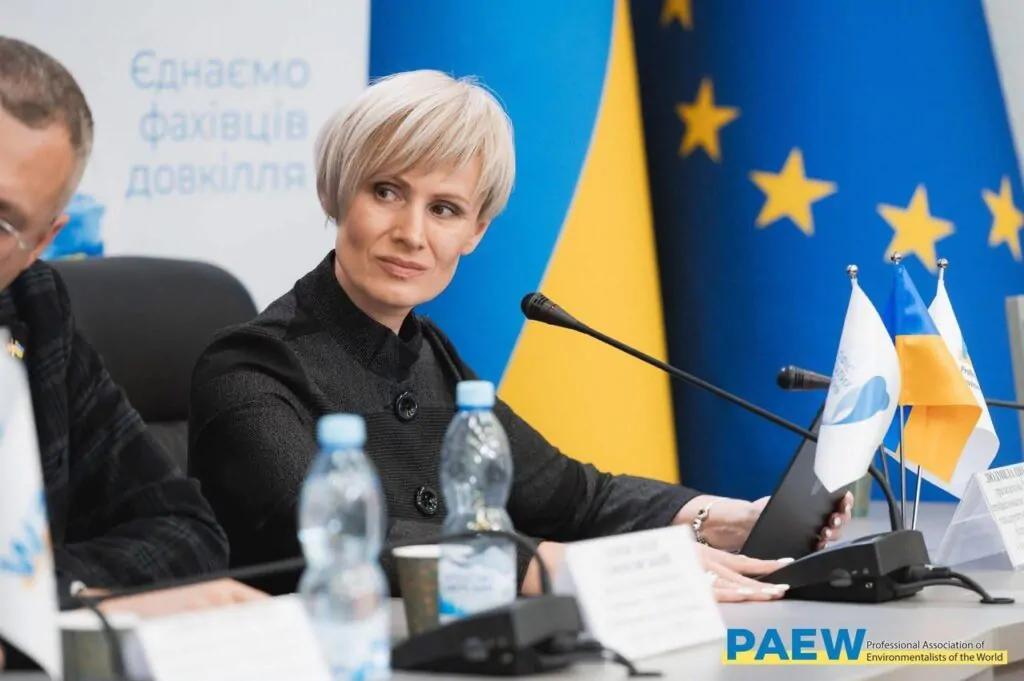
Liudmyla Tsyganok— founder of ESG Liga and president of the Association of Environmental Professionals PAEW — is one of Ukraine’s leading experts in the field of sustainable development. In this interview, she explains why ESG has long been a matter of survival for the dairy industry, which three crises are currently putting pressure on the sector simultaneously, and why EU requirements are being driven not by legislation but by the market — banks, buyers and supply chains.
What does sustainable development mean today for Ukrainian dairy producers and processors? Is it already a business reality or a topic that can be postponed?
Honestly, I would temporarily remove the word ESG from this conversation. When a dairy plant manager hears about sustainability today, they often think about reports or EU requirements.
But the reality of the Ukrainian dairy sector is different — companies have been operating between air raid sirens, staff shortages, an unstable power grid, expensive loans and constant uncertainty.
Everything we call ESG today has long since become a matter of business survival. Installing backup generation to avoid losing production during blackouts — that is resilience. Investing in water conservation — that is resilience. Keeping staff in the community during wartime — that is also resilience.
ESG has long ceased to be a fashionable topic for the Ukrainian dairy sector. It is gradually becoming a new language of competitiveness.
What challenges facing the dairy sector are most critical today?
Three crises are converging simultaneously.
The first is people — a shortage not just of manual workers but of technologists, energy engineers, mechanical engineers and quality specialists. Some have emigrated, some are mobilised, some have changed careers.
The second is energy — the war has shown how vulnerable businesses are when critically dependent on uninterrupted power. The cold chain cannot be paused.
The third, less discussed, is water. After the destruction of the Kakhovka HPP, Ukraine has entered a new water reality.
For dairy, water is a fundamental production resource at every stage. I am convinced that water will become one of the key competitiveness factors for the sector over the next decade.
Which European requirements are already influencing the dairy sector today?
The biggest mistake is waiting for a major regulatory shock. Changes happen much more quietly.
A Ukrainian dairy producer may not yet be hearing about CSRD or ESRS. But tomorrow a bank will begin asking about risks. The day after, an international buyer will request information about raw material origins. Requirements are arriving through the market — and this is probably the most significant change in recent years.
Europe is increasingly evaluating not just the product. It is starting to evaluate the producer.
What can banks or international partners actually check at a dairy processing company?
Paradoxically, they very often check not ecology — they check management quality. Does the company understand its risks? Does it control resource costs? Can it explain where its data comes from? Does it know its key suppliers? Does it have a crisis action plan? Can the company explain where it will be in three years?
That is why the modern conversation about ESG increasingly resembles a conversation about business management quality.
Which EU regulatory instruments are already affecting or will soon affect the Ukrainian dairy sector?
First, CSRD and ESRS — they change the very logic of disclosure for large EU companies, requiring them to report not only how environmental and social issues affect them, but also how their activities affect people and the environment. Requirements often arrive not through law but through supply chains, banks and EU buyers.
Second, the new EU Packaging Regulation — all packaging must be recyclable by 2030, critical for dairy products.
Third, the EU Deforestation Regulation directly covers cattle, with application for large operators deferred to 30 December 2026 and for small operators to 30 June 2027. Traceability of raw materials is becoming increasingly important.
Are there examples of decarbonisation or other ESG parameters becoming a competitive advantage?
Yes, and it is important not to reduce this to carbon alone. For dairy processing, the competitive advantage may not be a decarbonisation headline but very concrete economics: less gas per tonne, less electricity for cooling, water reuse where feasible, utilisation of organic residues, reduction of raw material losses, transition to energy-efficient equipment.
If a company modernises its boiler room and can show energy savings, lower emissions and lower unit costs — that is not a green project, it is a management decision.
What risks arise for Ukrainian dairy producers and processors if they ignore ESG requirements?
Three risks. First: losing access to financing — banks are increasingly treating ESG risks as part of credit risk, not a supplementary questionnaire.
Second: restricted access to contracts with international buyers — if a buyer in the EU reports under CSRD, they will ask their suppliers for data even if the supplier is in Ukraine.
Third: internal losses — the company may think ESG does not concern it, while every day losing money through inefficient use of water, energy, steam, raw materials, packaging or logistics. That is already a question of margin.
What level of investment does an average dairy processor need to align with European sustainability standards?
I would not give a single figure — it would be unprofessional. For one company, the first stage might cost relatively little: a data audit, risk map, basic procedures, energy analysis, water accounting and a 12-month ESG roadmap. For another, it might mean major capital investments in wastewater treatment, energy efficiency, refrigeration, biogas or packaging.
The right logic: first diagnose where the company is losing money or carrying risk, then divide measures into three groups — what can be done organisationally, what needs small investment, and what is a capital project with a payback period.
Are small and medium-sized dairy processors ready for this transformation?
They are often not ready for large-scale reporting, but they may be ready for practical transformation — and that is a crucial difference.
A small company does not need to start with a full ESG report. It needs to start with management order: water, energy, waste, raw materials, staff, suppliers, data, risks. The biggest mistake is thinking ESG is either for corporations or for nobody.
What does working with a consultant cost?
The cost depends on the task. A short ESG diagnostic and roadmap is one budget level. A full report, emissions calculation, bank audit preparation, ESRS mapping, supply chain analysis, policies, procedures and team training is a different level.
I would advise business to evaluate not the consultant’s cost but the cost of the mistake — if a company fails a credit assessment due to weak data, loses a buyer or invests in the wrong project, that costs far more than a quality initial diagnostic.
Does a business need its own ESG specialist in the team?
For a medium or large company, yes — but it does not necessarily have to be a separate person with a fashionable job title. It is often more effective to create an internal ESG group spanning finance, ecology, energy, HR, legal, production, procurement and quality. ESG cannot live in one office because the data is spread across the entire company.
A coordinator is needed to maintain the system. A consultant can help build the methodology, but a mature model is when the external expert supports and the internal team genuinely owns the data and processes.