
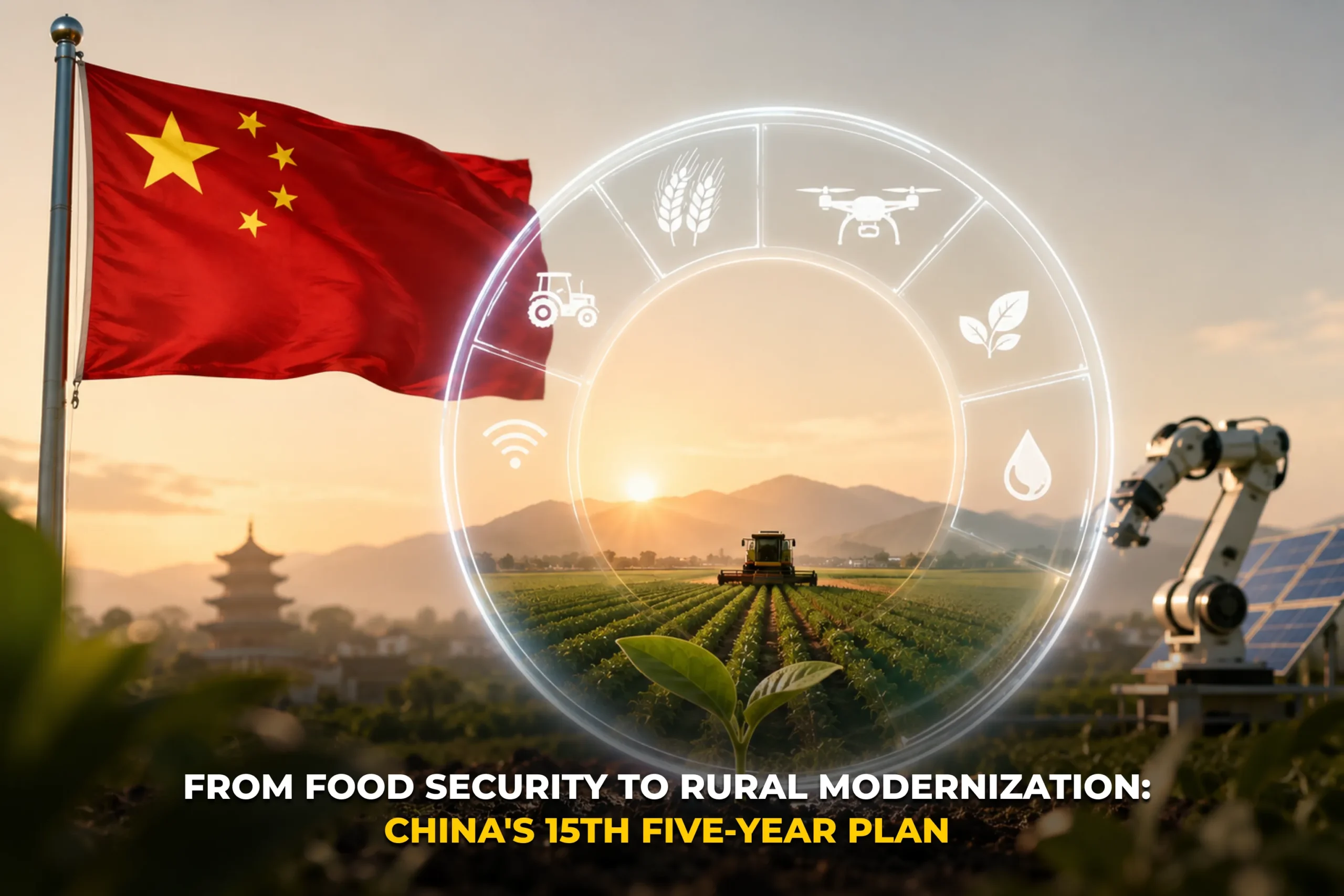
China’s 15th Five-Year Plan (2026–2030) marks a shift toward a more security-driven, technology-oriented model of agricultural development, with agriculture increasingly framed as a strategic sector, a DCZ policy brief by Ahmatjan Rouzi finds, DCZ reports.
Introduction
On 12 March 2026, delegates at the «Two Sessions» — the annual meetings of the National People’s Congress and the Chinese People’s Political Consultative Conference — approved the plan. Drafted amid a slowing economy, a declining population and rising geopolitical and trade tensions, it stresses self-reliance (balanced with continued global integration) and science and technological innovation. The plan sets out 109 major projects across six priority sectors, including five dedicated to integrated urban–rural development and agricultural modernization.
Five key agriculture and rural projects
High-Standard Farmland Construction.
Upgrading farmland in 720 key grain-producing counties and converting eligible basic farmland into high-standard land, in support of the «storing grain in land» strategy, to lift grain production capacity by 50 million tonnes — to around 725 million tonnes by 2030 — and raise crop mechanization above 80%.
Modern Seed Industry Development.
Building a national system for germplasm protection and use — seed innovation bases, breeding centres and multiplication facilities — targeting 85% self-sufficiency in core germplasm.
Animal and Plant Epidemic Prevention and Control.
Strengthening biosecurity through better monitoring and early-warning for pests and livestock diseases, and tighter oversight of pesticides and veterinary drugs.
Agricultural Non-Point Source Pollution Control.
Curbing excessive fertilizer and pesticide use, improving manure recycling and reusing farm waste to support green agriculture.
Rural Living Conditions Improvement.
Part of the «Rural Construction Action»: village roads, water and drainage, toilet upgrades, waste and sewage treatment, and elderly-care facilities.
How the 15th plan differs from the 14th
Where the 14th plan cast agriculture as the «foundation of the national economy», the 15th links it more explicitly to national security and strategic resilience, emphasising a «strong agricultural nation», food security and stable supplies of grain and key commodities.
The focus shifts from maintaining to actively expanding grain production capacity, and from a grain-centred approach toward a broader «big food system».
Technology becomes a central pillar — a comprehensive agricultural science-and-innovation system, commercial breeding and seed enterprises, precision and digital farming, and the principle of «good land, good seeds, good machinery and good farming practices» — under the wider strategy of «new quality productive forces».
Rural development moves from physical infrastructure toward institutional and social measures, and from short-term campaigns to a long-term framework. Key indicators shift accordingly: minimum grain production capacity from 650 to 725 million tonnes (a +50-million-tonne increase); farmland protection maintained at 120 million hectares; high-standard farmland (71.7 million hectares) further expanded; and mechanization from 75% to over 80%.
Key challenges
China’s grain output reached 715 million tonnes in 2025, but rising consumption, water scarcity and land degradation remain sustainability challenges on the path to the 725-million-tonne target.
Despite high grain self-sufficiency, China depends heavily on imported soybeans and feed grains: agri-food imports were USD 207 billion in 2025 (down from a USD 236 billion peak in 2022), still the world’s largest.
Oilseeds — mainly soybeans (USD 54.6 billion) — led imports, alongside grains (USD 7.7 billion), animal products (USD 40.6 billion) and aquatic products (USD 20.6 billion); top suppliers were Brazil (USD 51.4 billion), the EU (USD 16.5 billion), the US (USD 16.1 billion), Australia and Thailand, with US imports down 62% amid trade tensions.
Agri-food exports reached USD 104 billion, led by the EU, the US and Japan.
Geopolitics adds pressure: the 2026 Iran conflict briefly closed the Strait of Hormuz, pushing nitrogen fertilizer to about USD 700 a tonne (from USD 400–490) and lifting China’s NPK price from RMB 3.3 to 3.5/kg.
Food security is increasingly treated as national security, reinforcing self-sufficiency and a pivot in imports toward Belt and Road partners.
Structural risks persist: a fourth straight year of population decline in 2025 (−3.39 million, to 1.404 billion) and possible depopulation of the countryside; per-capita water of just 2,079 m³ against a 6,225 m³ global average, with 60% of groundwater polluted; at least 19.4% of arable land contaminated and fertilizer use of 393.2 kg/ha (versus 166.5 in Germany and 128.8 in the US); and climate models pointing to possible declines in rice, wheat, corn and oilseed output by 2030, especially in the north-eastern grain belt.
Implications
For China, the plan reinforces «greater self-reliance with strategic openness»: grain security stays the top priority, pursued by protecting farmland, expanding high-standard land and investing in seeds, machinery and digital agriculture to raise per-hectare yields rather than expand land use.
For farmers, it accelerates structural change — moderate-scale farming, service providers and smart technologies — which may lift productivity but also speed land consolidation and the exit of smaller, ageing producers.
For agri-business, it signals sustained support for the seed industry, digital standards, biotechnology and smart equipment, benefiting leading domestic firms.
Trade stays pragmatic: soybean and feed-grain imports remain significant but more strategically managed and diversified, while a renewed «Going Global» push (machinery, digital tech, agri-drones, processed foods) intensifies competition abroad.
For foreign agri-businesses, the direction brings both openings — in machinery, smart systems, genetics and sustainable technologies — and hurdles, as a focus on domestic innovation, supply-chain resilience and China-centric standards raises regulatory and localization requirements.
Beijing already requires farm machinery, vehicles and drones to navigate via its own BeiDou satellite system rather than US GPS. Environmental measures feature prominently — non-point pollution control, efficient inputs, water conservation and low-carbon practices aligned with China’s dual-carbon goals.
Overall, the plan points to a technology-driven, resource-efficient and security-focused model aimed at building an «agricultural powerhouse» while narrowing the urban–rural gap.
The full brief, «From food security to rural modernization: China’s 15th Five-Year Plan explained», is available to download on the DCZ website.