
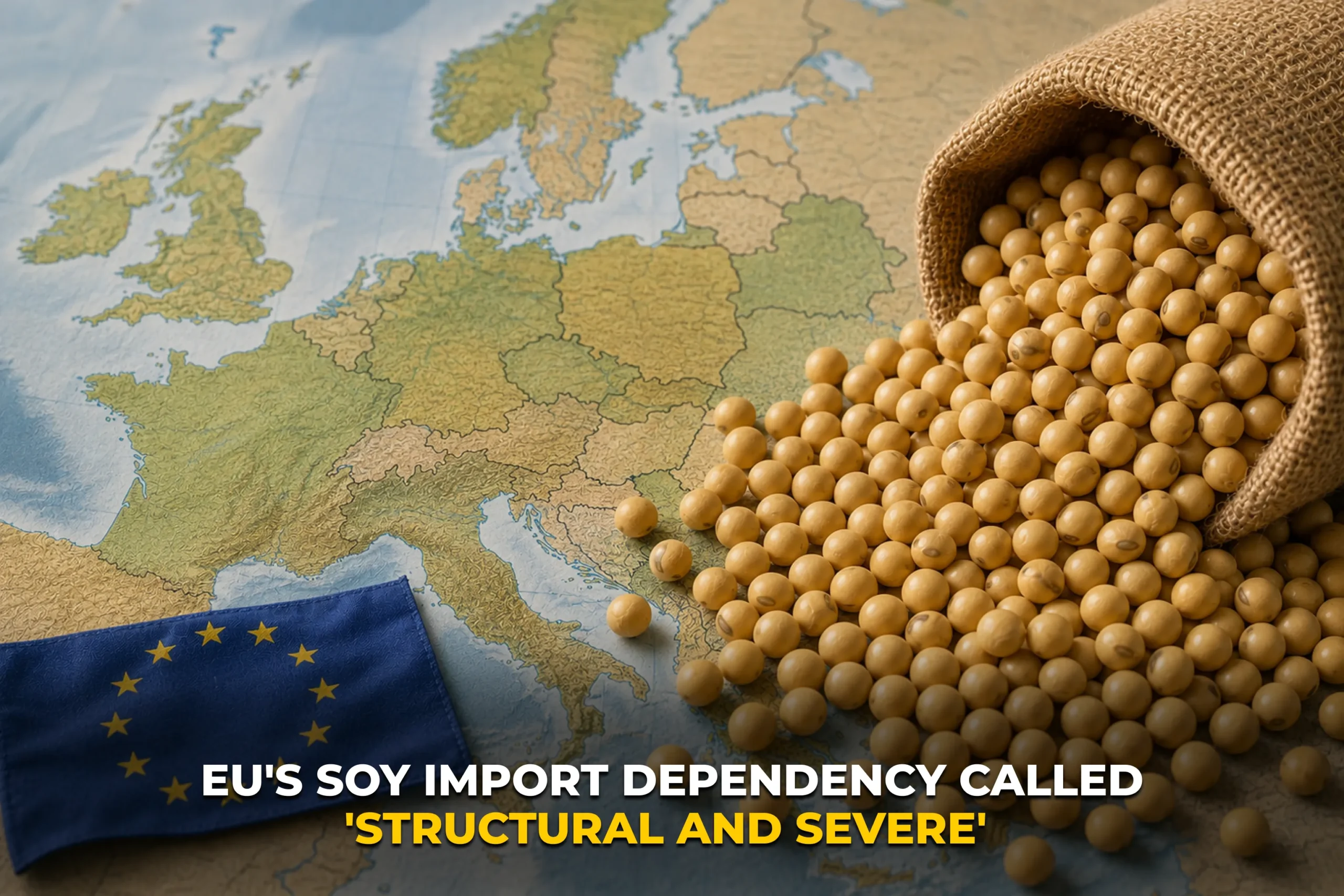
Europe’s reliance on imported soy should be treated as a «strategic vulnerability» and approached with the same seriousness the continent gives to energy and defence, a new report argues, Agriland reports. The study, «From dependency to diversity: a strategic scenario analysis on reducing Europe’s soy import dependency by 2035», was produced by The Protein Project together with a number of researchers. It sets out a scenario analysis of how diversifying protein could improve food security and affordability across the EU.
Using soy as its lead example — the EU draws 91% of the soy protein it consumes from just three countries — the authors model four complementary strategies that span the entire value chain, from farming to consumption, and test their combinations against a shared goal: cutting soy imports by 20% by 2035. That reduction is achievable, the report finds, but only through a balanced combination of the four strategies it sets out.
Strategies
The first strategy expands European protein-crop production, growing more legumes and protein crops for feed and food.
The second optimises the circular use of feedstock, returning safe, protein-rich agri-food side streams to the food and feed system.
The third scales innovative protein production, using biotechnologies such as advanced fermentation to create new, soy-free protein.
The fourth diversifies protein consumption by broadening the range of protein sources in European diets.
Spreading the effort evenly across all four proved the most realistic path, the researchers say, because each strategy relies on levers with real limits — land that can be turned over to protein crops, side streams that can be safely repurposed, realistic growth in innovative-protein capacity, and dietary change that can be sustained over the long term.
EU dependency on imported soy
The report stresses that the EU’s dependence on imported soy is «structural and severe».
Without access to imported high-protein meal, it warns, the EU could lose roughly 15% of its beef and dairy output, about 40% of its pork and up to 60% of its poultry and egg production.
Soy, described as the protein backbone of European livestock farming, reaches the EU food system through two channels: animal feed, which accounts for the vast majority (around 90%) of use, and food products such as tofu, soy drinks and processed goods. Overall the EU produces only 9% of the soy protein it consumes, and the exposure is sharpest in feed: while the bloc is broadly self-sufficient in roughage, it is critically vulnerable in high-protein feed materials.
Brazil, Argentina and the US together supply 86% of all EU soy imports, and the average EU citizen consumes 60.6 kg of soy a year — around 55 kg of it indirectly, through the meat, dairy and eggs on their plate.
Food security
Food security, the report argues, should be a cross-cutting EU priority, warning that the livestock sector rests on a supply chain that is «both structurally vulnerable and highly concentrated». A disruption to these flows would ripple through the feed and food systems, destabilise supply chains and could cost the EU up to 40% of its current livestock capacity — a risk the authors call not hypothetical, but a pattern history has repeatedly shown and recent geopolitical events continue to sharpen.
Protein diversification is a «compelling and measurable» part of the answer, the researchers say.
A balanced approach delivers more than the sum of its parts, distributing effort in a way that is realistic, effective and fair — keeping each strategy within proven reach while generating positive outcomes for farmers, consumers, rural communities and the environment.
The report also highlights a «unique policy window» now opening: a comprehensive EU protein plan is expected soon, alongside the post-2027 Common Agricultural Policy (CAP) reform and the EU Livestock Strategy.
Source: Agriland