
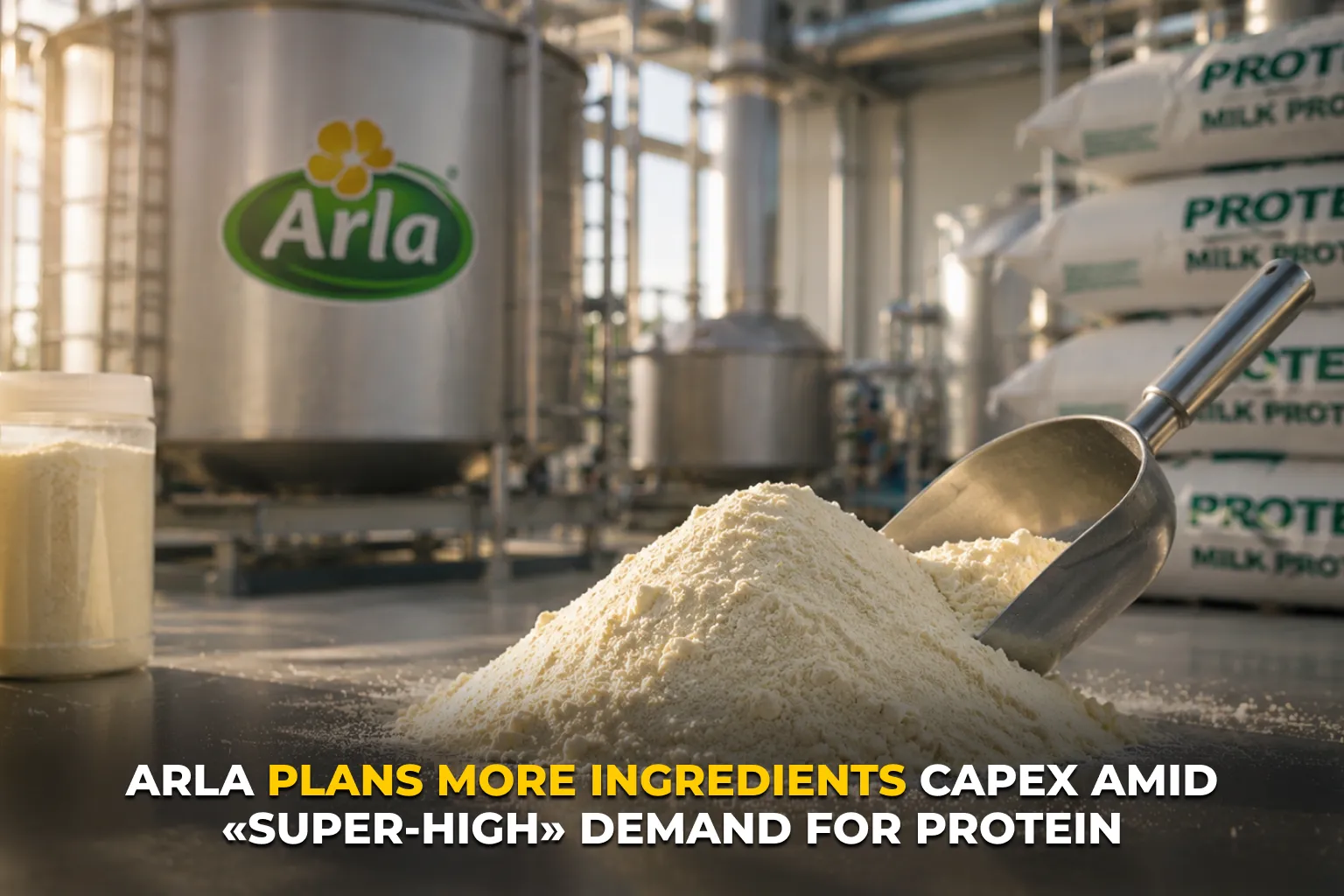
The dairy giant’s CEO said prices for protein ingredients «have really taken off» as demand rises.
Arla Foods will «invest significantly» in its ingredients business, the dairy giant’s CEO has said, as demand for — and the prices of — protein ingredients surges, Just Food reports. The Denmark-based group, home to brands including Castello cheese and Lurpak butter, is also an ingredients supplier to food and drinks manufacturers; its B2B arm, Arla Foods Ingredients, saw sales jump more than 19% in the first half and accounted for over 11% of group revenue.
Protein as a competitive edge
Arla has expanded its B2B operations through this year’s merger with German dairy co-op DMK, which brought Wheyco, a supplier of whey protein ingredients; two years ago Arla also acquired a whey-nutrition business from UK firm Volac.
Speaking on 27 August after first-half results, CEO Peder Tuborgh said the company was seeing «super-high» demand for «advanced milk proteins».
«What we’ve seen in the first half of 2026 is that demand has now reached a level where prices have really taken off — price levels that are twice as high as last year», he said. «That’s our real competitive edge, our protein assortment», both in B2B (Arla Foods Ingredients and Wheyco) and retail.
Investment to continue
Asked if Arla would step up capital investment, Tuborgh said the co-op had projects in the pipeline and spending would continue.
«Since 2008, when Arla Foods Ingredients was created, we’ve invested significantly and over-proportionally in this segment», he said, adding that technologies from Arla Food Ingredients would be applied to the former Wheyco business over the coming years.
He declined to name a target share of group revenue for the ingredients arm.
First-half results
Arla’s «strategic branded volume-driven revenue growth» — revenue growth from higher volumes at constant prices — rose 6.7% to €3.4bn ($3.95bn) in the first half, excluding DMK; the co-op called the result «exceeded expectations» and raised its 2026 forecast for the metric to 4–6% (from 1–3%).
Overall first-half group revenue reached €7.6bn, up 1.3% year on year, including one month of DMK sales. Excluding DMK, group revenue fell 3.6% to €7.18bn as lower commodity prices dampened retail and trading prices, with exchange rates also a factor. Net profit rose to €213m, up from €158m a year earlier.
Source: Just Food (Dean Best)