
The US shift away from synthetic dyes could raise demand for natural colours by up to 500%, exposing supply, cost and reformulation challenges — relevant to dairy, too.
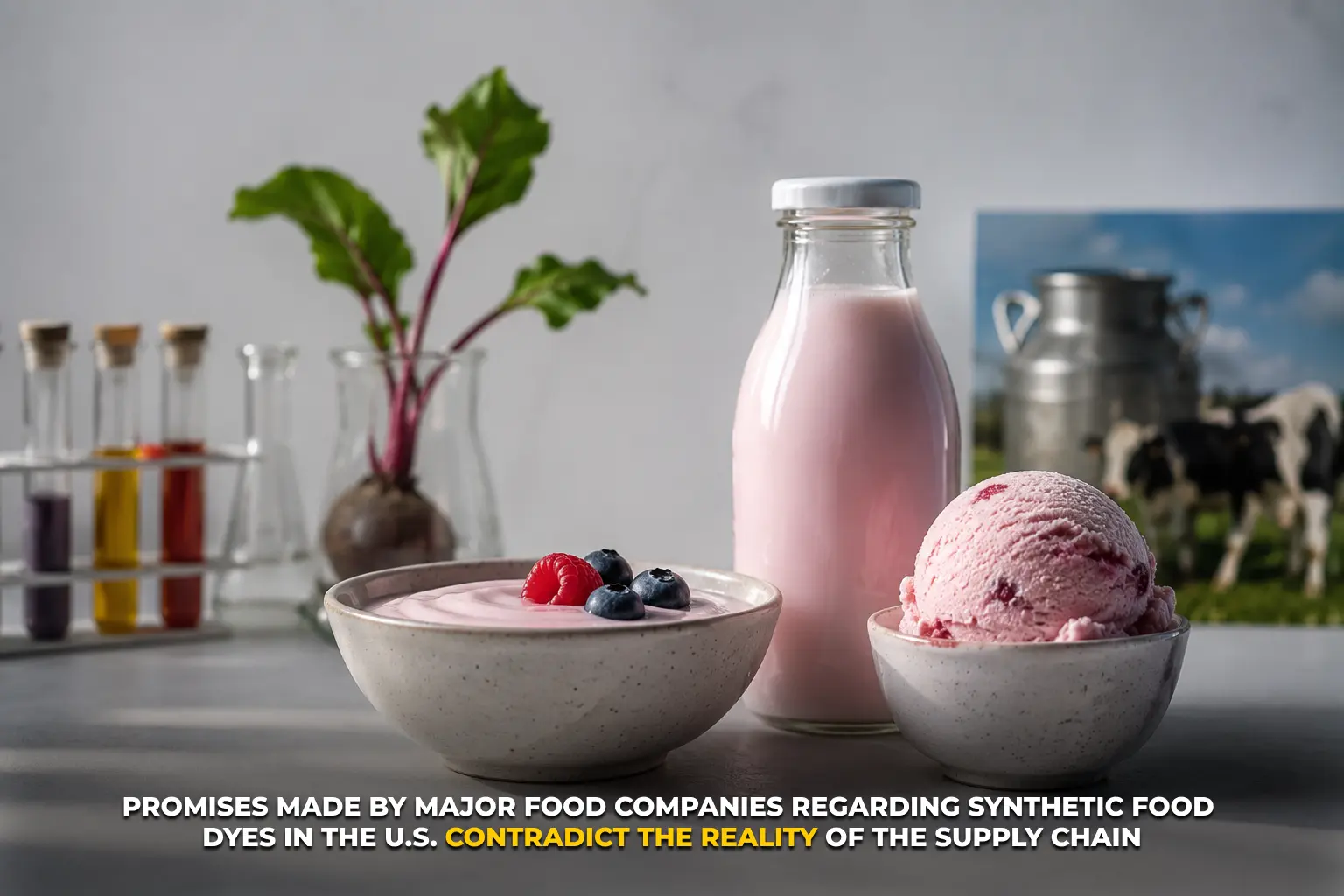
The US move away from synthetic food dyes is a supply-chain transformation, not just a reformulation exercise: demand for non-FD&C colourants could rise 400–500%, outstripping current agricultural and processing capacity. For dairy it matters, as colour reformulation directly affects yogurts, ice cream, desserts and flavoured milk, DairyReporter reports.
A $57.8bn market chasing the same alternatives
General Mills has removed petroleum-based dyes from every US cereal (90% of its retail portfolio converted), with fruit snacks and baking to follow by end-2027.
Per an NCA report by RTI International, FD&C colours appeared in about 4% of US retail products in 2025, generating $57.8bn (7.1% of food & beverage sales). The US certified about 21.4 million pounds (~9,700 tonnes) of FD&C dyes in 2025, versus a non-FD&C market of ~12 million pounds (~5,400 tonnes) — yet matching one FD&C dye can need ten times as much non-FD&C colourant.
Sensient Technologies is investing up to $250m in natural-colour capacity. CEO Paul Manning calls it «the single largest opportunity in the company’s history».
«Replacing synthetic dyes is far more than a reformulation challenge — it’s a supply-chain transformation», said NCA president John Downs.
Import dependence, price shocks and reformulation
«Naturally sourced» is not «locally sourced»: the US is 98.2% import-dependent for annatto, 99.1% for butterfly pea and 99.7% for saffron, with China supplying 76% of capsanthin and India ~86% of curcumin.
RTI modelled three demand scenarios to 2028: baseline colourant prices would need to rise 53%, the accelerated scenario 516% on average, and a fourfold stress test over 1,000%. Curcumin is the extreme case — up to 3,200%.
Non-FD&C colours are not drop-in replacements (turmeric and spirulina are especially tricky for stability), and reformulation costs $50,000–$500,000 per SKU.
Oterra has partnered with biotech firm Debut on a precision-fermented Red 40 alternative, targeting commercial scale within three years.
Consumer signals are encouraging: sales of «natural colours» products rose 24.4% in 2024-25 versus 0.1% for artificial-colour products.
Source: DairyReporter