
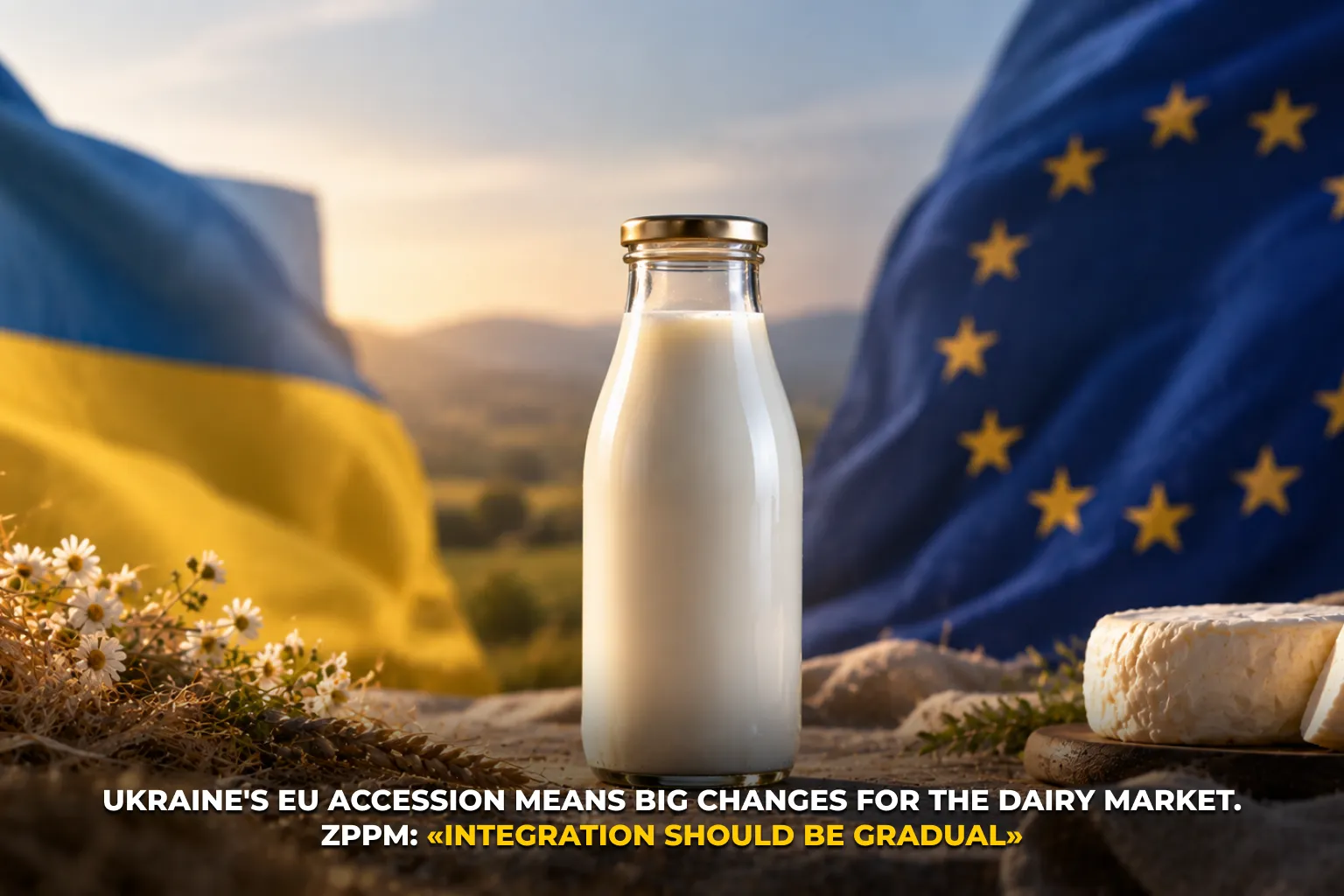
Poland’s dairy sector backs talks with Ukraine on geopolitical grounds but insists on gradual integration — on common standards, equal competition and effective market-disruption mechanisms.
«Talks with Ukraine should be held for geopolitical reasons, but the integration itself should be gradual — based on ultimately common standards, equal rules of competition and effective mechanisms for responding to market disruptions», said Marcin Hydzik, president of the Association of Polish Dairy Processors (ZPPM), Portal Spożywczy reports.
One carbon-footprint methodology
At the Dairy Community Forum in Białystok, Hydzik said dairy must build a partnership-based, realistic decarbonisation model with a fair distribution of costs.
«We created and work in the Dairy Group at the ESG Round Table… so that a milk producer does not have to fill in many different questionnaires from each retail chain separately», he said, calling for a single carbon-footprint methodology and a minimum dataset from farms.
He stressed the role of the Agriculture Ministry amid EU-level work under the Livestock Strategy on harmonised on-farm emissions calculation and a new «low-emission cattle» eco-scheme, plus dairy electrification funded via the Modernisation Fund.
How Ukraine’s EU future is seen
Hydzik cited a report by the Warsaw School of Economics (SGH) and Forum Ekonomiczne 2026 on the consequences of Ukraine’s EU accession for food security in Central and Eastern Europe.
Using a Delphi survey of 64 experts (25 Ukrainian, 23 Polish, 16 from Bulgaria, Czechia, Romania and Hungary), the most likely outcome was a WIN-WIN scenario — benefits for both Ukraine and the region — with an average probability of 46% (about 55% among Ukrainian experts, 39% among Polish ones, who rated a WIN-LOSE scenario slightly higher at ~42%).
The report stresses that accession is not seen as a threat to food security as such. The risk concerns market mechanisms and how costs and benefits are shared.
«Success will not be automatic», it warns — a positive EU-wide effect could coexist with serious regional tensions without adequate Common Agricultural Policy (CAP) instruments and market-stabilising mechanisms.
It recommends gradual alignment of Ukrainian agriculture with EU standards, equal competition, quality advantages for CEE producers, and support for exports beyond the EU.
For dairy, Hydzik said, the key is to track the terms of Ukraine’s single-market entry, CAP instruments and standards harmonisation.
Source: Portal Spożywczy