Ukraine’s foreign trade in dairy products deteriorated in October 2026 compared with September: exports fell for most product groups, while imports rose across all groups and reached peak levels. A further deterioration is expected in November, the official website of the Union of Dairy Enterprises of Ukraine reports.
The analysis was prepared by the UDEU Expert and Analytical Service for product groups 0401–0406 of the Ukrainian Classification of Goods for Foreign Economic Activity (UKTZED).
Key points:
- dairy exports fell 2.1% month on month in October to $26.17 million, while imports rose 3.0% to $34.15 million;
- the trade deficit widened to −$8.0 million from −$6.4 million in September;
- exports of skimmed milk powder (SMP) and whey fell by 15%, and butter by more than 9%;
- cheese exports reached a record for the period of martial law at 1.62 thousand tonnes;
- raw milk purchase prices rose by more than 16% in August – October, reducing the competitiveness of Ukrainian dairy products.
Overall foreign trade in October
Ukraine’s dairy trade totalled $60.32 million in October 2026, up 0.7% on September ($59.88 million) and 10.6% above August ($54.55 million). Specifically:
- exports ($26.17 million) fell 2.1% from September ($26.73 million) but were 24% above August ($21.11 million);
- imports ($34.15 million) rose 3.0% from September ($33.15 million) and were 2.1% above August ($33.44 million);
- the trade deficit widened to −$8.0 million from −$6.4 million in September;
- the export-to-import ratio fell to 0.77 from 0.81 in September, with imports exceeding exports by more than 1.3 times, versus 1.24 times in September.
Dairy trade therefore deteriorated in October compared with September, and September’s positive trend did not continue. A further deterioration is expected in November.
Exports by product group
Dairy exports in October 2026:
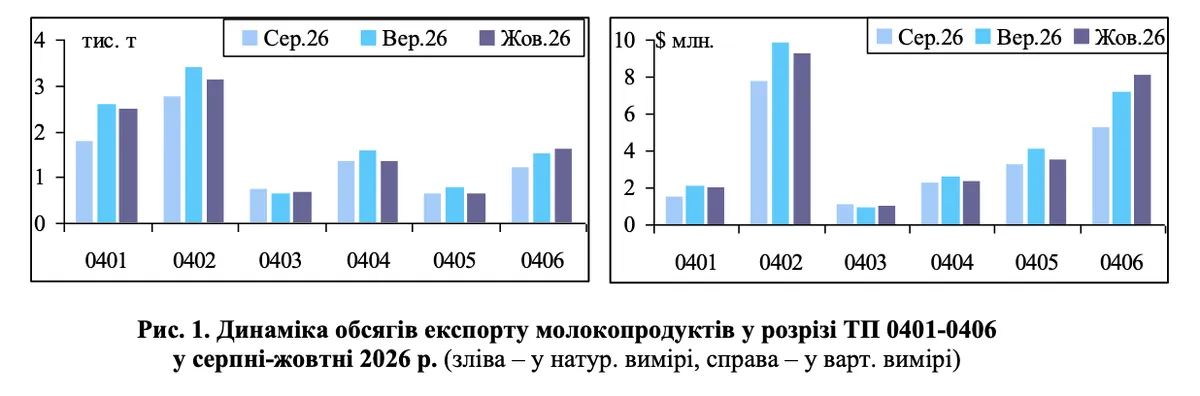
- 0401 — drinking milk and liquid cream: slightly down (−3.7%) to 2.48 thousand tonnes, remaining at the highest level since December 2025 (exports had been growing since May);
- 0402 — milk powder and condensed milk: down to 3.13 thousand tonnes (−7.7%), retreating from peak levels; SMP exports fell by more than 15%, from 2.33 thousand tonnes in September to less than 2.0 thousand tonnes in October;
- 0403 — fermented dairy products: slightly recovered to 0.68 thousand tonnes (+5.4%);
- 0404 — whey: down by more than 15% to 1.34 thousand tonnes;
- 0405 — butter and milk fats: down by more than 9% to 0.63 thousand tonnes;
- 0406 — cheese of all kinds: continued to grow to 1.62 thousand tonnes (+7.5%), a record for the period of martial law.
Why exports fell
September’s sharp export growth proved temporary and did not continue in October. The decline in exports of most dairy products, at least milk commodities, was driven by:
- weaker conditions on global dairy markets in October after relatively favourable conditions in September;
- a significant rise in raw milk purchase prices in Ukraine (+16% in August – October), which reduced the competitiveness of Ukrainian dairy products on global markets.
Against the background of sharply higher raw milk prices in Ukraine, especially in late September and October, milk commodity prices either fell (milk fats) or remained stable (whey). Only SMP prices rose, but:
- first, the increase was small;
- second, by October Ukrainian dairy processors had virtually exhausted their SMP stocks and production capacity, given the seasonality of this product.
As a result, the biggest export declines in October were in milk commodities: SMP (−15%), whey (−15%) and butter (−9%).
Comparison with October 2025
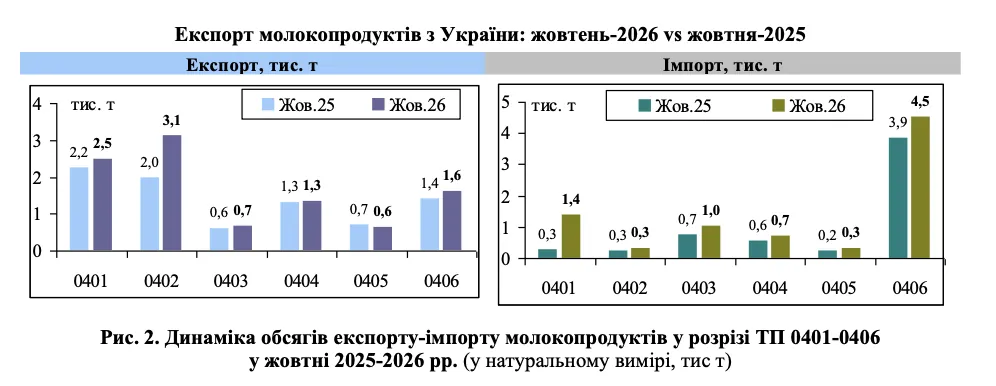
Despite the deterioration compared with September, October 2026 exports were mostly higher than in October 2025, especially for:
- 0401 — drinking milk and liquid cream: +13.5%;
- 0402 — milk powder and condensed milk: +55%;
- 0403 — fermented dairy products: +16.5%;
- 0406 — cheese of all kinds: +14.5%.
Whey exports were virtually unchanged, and only butter declined (−12.5%).
However, conditions in October 2025 differed significantly: the SMP quota for the European Union (EU) had already been exhausted (it is still open now), and butter prices had fallen sharply, making butter exports to the EU uneconomic. A direct comparison between October 2026 and October 2025 is therefore not correct.
Export structure
Compared with October 2025, the value structure of exports changed significantly: the shares of milk powder and condensed milk (from 24% to 35%) and whey (from 7% to 9%) rose, while the share of butter and other milk fats fell sharply (from 25% to 13%).
The value structure of exports in October 2026:
- 35% — milk powder and condensed milk;
- 31% — cheese of all kinds;
- 13% — butter and other milk fats;
- 9% — whey.
Compared with June 2026, the share of milk powder and condensed milk fell from 41% to 35% and butter from 16% to 13%, while the share of cheese rose from 23% to 31%.
Export destinations
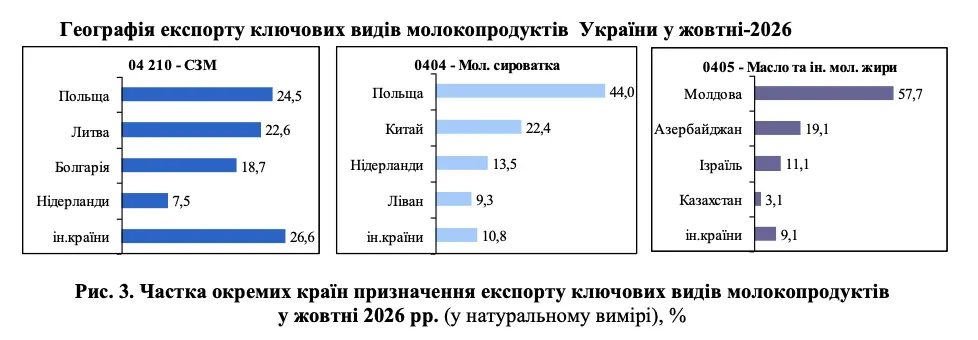
In October 2026, most SMP exports went to the EU, which accounted for almost 77% of the total: Poland 24.5%, Lithuania 22.6%, Bulgaria 18.7% and the Netherlands 7.5%.
Whey was traditionally exported mainly to Poland (44%) and China (22.4%), with significant shares also going to the Netherlands (13.5%) and Lebanon (9.3%).
Butter and milk fats traditionally went mainly to Moldova (almost 58%) and Azerbaijan (over 19%), with Israel also accounting for a significant share (over 11%).
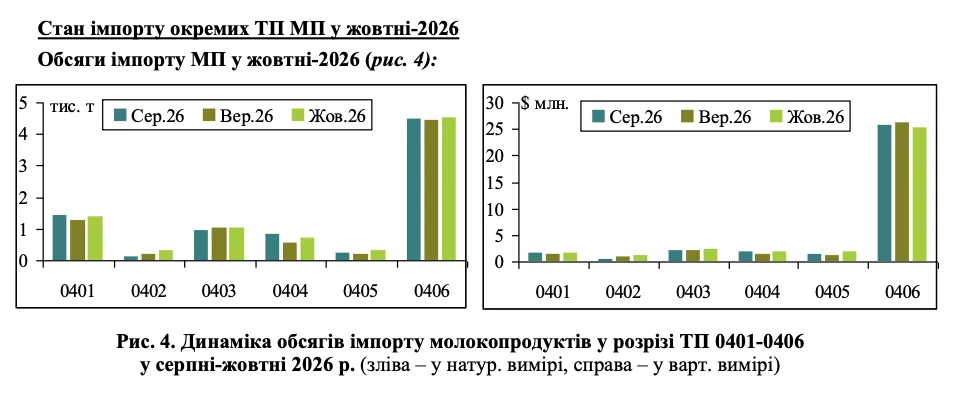
Imports by product group
Dairy imports in October 2026:
- 0401 — drinking milk and liquid cream: back at peak levels at 1.4 thousand tonnes;
- 0402 — milk powder and condensed milk: up to 0.3 thousand tonnes, but still insignificant;
- 0403 — fermented dairy products: steady at 1.0 thousand tonnes, at peak levels;
- 0404 — whey: slightly recovered to 0.7 thousand tonnes after declines in previous months;
- 0405 — butter and milk fats: rose significantly to 0.3 thousand tonnes, back at peak levels;
- 0406 — cheese of all kinds: virtually unchanged from August – September at 4.5 thousand tonnes.
Dairy imports rose across all product groups in October, reaching peak levels (except whey). Butter imports rose particularly sharply, despite large stocks of butter in Ukraine and the resulting low prices.
In the value structure of imports, the share of cheese fell significantly to 74%, a record low. The shares of fermented dairy products (6.7%), butter (5.4%), whey (5.3%) and milk powder (4.6%) increased.
Export-to-import ratio in October
- 0401 — drinking milk and liquid cream: exports exceeded imports by 1.8 times;
- 0402 — milk powder and condensed milk: exports exceeded imports by more than 10.4 times;
- 0403 — fermented dairy products: imports exceeded exports by 1.5 times;
- 0404 — whey: exports exceeded imports by 1.9 times;
- 0405 — butter and milk fats: exports exceeded imports by almost 2.1 times;
- 0406 — cheese of all kinds: imports exceeded exports by 2.8 times.
Conclusions
Ukraine’s dairy trade deteriorated in October 2026. Exports fell month on month for most product groups, except fermented dairy products (+5.4%) and cheese (+7.5%, mostly fresh). Exports of key milk commodities fell sharply: SMP and whey by 15%, and butter by more than 9%.
September’s sharp export growth proved temporary. Exports are likely to keep falling in November, due both to the price situation on milk commodity markets and to the loss of price competitiveness caused by the significant rise in raw milk purchase prices in August – October.
Unlike exports, dairy imports rose across all product groups in October. Butter imports rose particularly sharply, and cheese imports remain significant, putting pressure on the profitability of Ukrainian cheesemakers.
According to UDEU analysts, claims of «substantial earnings» by Ukrainian dairy processors thanks to high milk protein prices do not reflect reality, as their capacity in this area is virtually exhausted. Instead, low milk fat prices and the dominance of imported cheese on Ukrainian store shelves make profitable operations virtually impossible at the new level of raw milk prices (up more than 16% in August – October).
The current state of foreign trade therefore calls for caution when setting raw milk purchase prices in November.
Source: Union of Dairy Enterprises of Ukraine (UDEU Analytics)