
Global dairy markets remain divided by product rather than direction. With Algeria absorbing substantial whole milk powder volumes, US dairy entering New Zealand and fat-filled milk powder following skim milk powder higher, the next shift in dairy availability may be driven by processors’ response to current price signals, CZ App reports.
Key points:
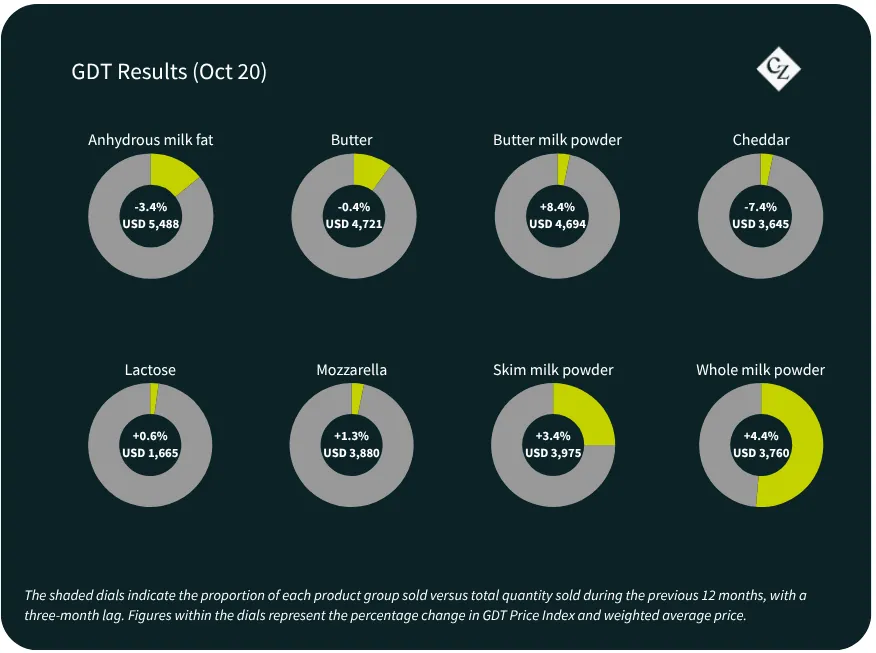
- at the 20 October GDT event, whole milk powder rose 4.4% while Cheddar fell 7.4%;
- in New Zealand, whole milk powder returns are back at parity with the Cheddar and whey protein concentrate stream;
- Algeria’s state buying agency ONIL purchased around 25,000 tonnes of whole milk powder;
- New Zealand buyers are booking US cheese and butter, but US cheese prices are rising sharply.
The global dairy market is not short of milk in aggregate. Production has expanded across several major exporting regions, including New Zealand and the US. Yet individual dairy products continue to move in sharply different directions.
That divergence was evident at the 20 October Global Dairy Trade (GDT) event. Whole milk powder (WMP) rose 4.4% and skim milk powder (SMP) 3.4%, while Cheddar fell 7.4%, butter 0.4% and anhydrous milk fat (AMF) 3.4%. The overall index increased, but the result was a rotation between products rather than a broad dairy rally.
Recent developments in New Zealand help explain why that distinction matters. The country reportedly reached peak milk day earlier this season, particularly in Waikato. At the same time, lower Cheddar and whey protein concentrate (WPC) returns, combined with firmer WMP, have brought the NZ Cheddar/WPC stream back to parity with WMP.
WMP has not necessarily overtaken every alternative use for milk; its return relative to the SMP and milkfat stream remains uncertain. However, parity with Cheddar/WPC removes one competing incentive for milk and may alter the product mix in the post-peak part of the season.
Strong opening, earlier peak
New Zealand milk production began the season strongly. However, an early national peak changes the shape of the production curve and places more importance on the rate of the subsequent decline.
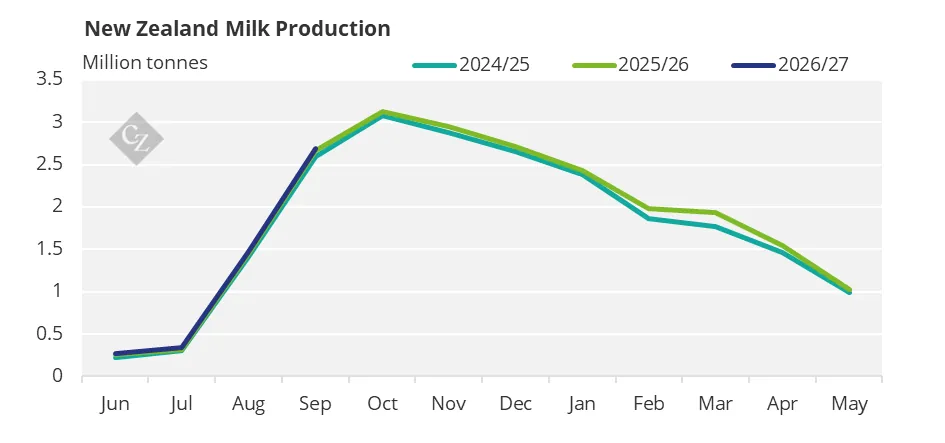
The season may still produce strong overall collections; an earlier peak alone does not imply weaker full-season output. But it makes projecting the strong opening pace across the rest of the season less reliable, especially if North Island conditions deteriorate.
This matters because processors are making product-allocation decisions with progressively less peak-season milk available. The question is no longer simply how much milk New Zealand produces, but how much remains after the seasonal peak and which product stream offers the best return at that point.
WMP regains ground against Cheddar and WPC
Until recently, stronger Cheddar and WPC economics encouraged directing milk solids towards the combined cheese and whey protein stream. Declines in both product values have now reportedly brought that stream back to parity with WMP.
This does not establish that WMP is New Zealand’s highest-returning stream, as WMP economics against SMP and milkfat also need to be considered. Nevertheless, WMP no longer appears to carry the same return disadvantage against Cheddar/WPC.
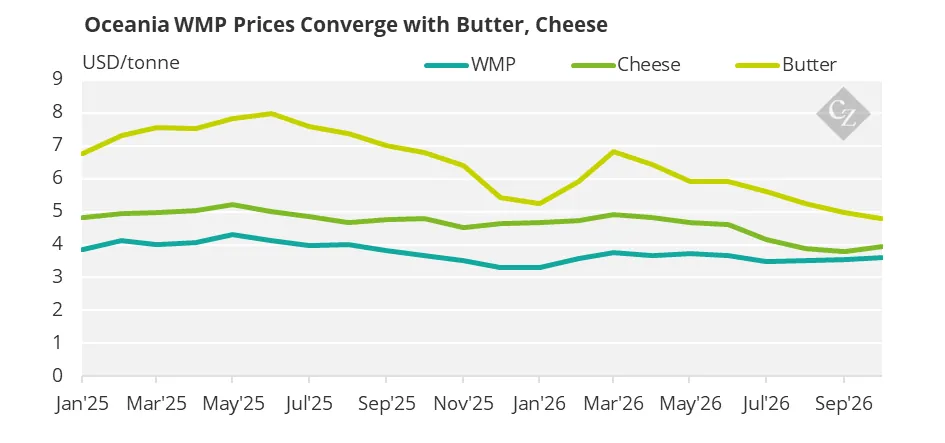
If current relationships persist, processors may produce more WMP and less Cheddar and WPC than they otherwise would have. That would be a supply response to firmer WMP pricing, but it could also shift some availability pressure into cheese and whey proteins.
That is an important distinction. More WMP production would not mean New Zealand had produced more milk; it would mean the same pool of milk solids had been allocated differently.
Algerian demand gives WMP a firm anchor
The change in relative returns follows a significant purchase by Algeria’s state buying agency, the National Interprofessional Office for Milk and Dairy Products (Office National Interprofessionnel du Lait et des Produits Laitiers, ONIL).
Market reports indicate that ONIL bought approximately 25,000 tonnes of WMP at its latest tender. Around 21,000 tonnes were reportedly awarded to NZ-origin suppliers, with the balance divided between Adecoagro and other suppliers.
The result turns anticipated Algerian demand into a substantial physical purchase. It also appears to have required product from several suppliers and origins, rather than revealing abundant nearby availability from any one source.
Some producers were reportedly reluctant to offer substantial discounts in this tender because of perceived market tightness. South American suppliers also reportedly offered SMP into the tender, which is unusual. This came against an already firm international SMP market and suggests North African demand is influencing a broader range of milk powders, not WMP alone.
FFMP is providing less price relief
Fat-filled milk powder (FFMP) would normally offer buyers a lower-cost substitute when WMP prices rise. However, that option is also becoming more expensive.
Expana has raised its European FFMP assessment to approximately EUR 3,300/tonne, saying stronger demand and tight supply caused FFMP to follow SMP higher. It also attributed SMP firmness to demand from Africa and Asia-Pacific, alongside limited participation by US and South American sellers.
FFMP remains cheaper than WMP, and formulations and applications differ between buyers. Nevertheless, the price of the substitute is no longer standing still while WMP rises.
This reinforces the significance of the ONIL purchase. Algerian demand is supporting WMP at the same time as stronger demand and limited supply lift the price of an important alternative.
US dairy is reaching New Zealand
At the opposite end of the market, lower US prices have reportedly encouraged major New Zealand buyers to book increasing volumes of US-origin cheese and butter, with some agreements extending through the first half of 2027.
That is a notable trade flow. New Zealand is one of the world’s major dairy exporters, but domestic buyers will still import when international price relationships make landed product competitive.
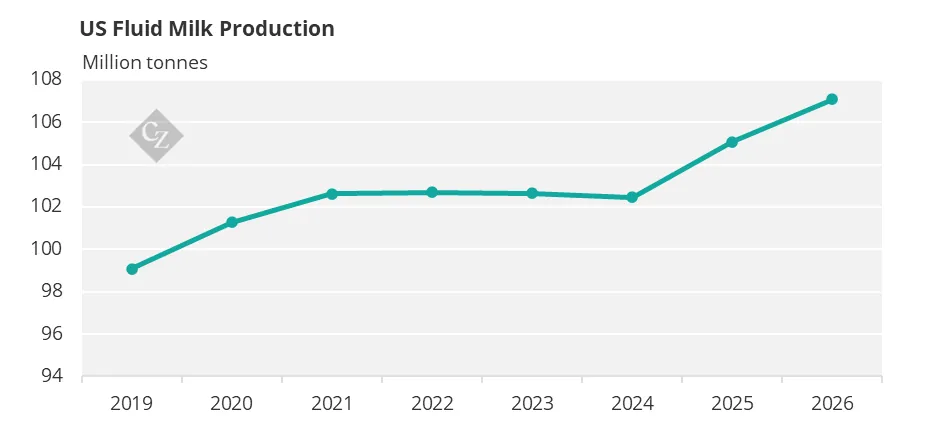
Strong US milk production and substantial cheese availability created that opportunity. US milk production rose 3% year on year in September, and an expanding herd added to supply. The US market consequently became increasingly dependent on exports to absorb its additional production.
However, the economics may already be changing. Chicago Mercantile Exchange (CME) spot cheese has risen sharply over the past two weeks, with Trigona’s converted US cheese series rising from EUR 2,529/tonne on 9 October to EUR 3,543/tonne on 23 October.
Market participants have linked part of the move to disruption at a major US producer, although the scale and duration of the impact remain unclear. Broader market evidence also points to plant downtime and quality issues affecting Cheddar production in parts of the US.
This is an example of dairy arbitrage beginning to correct itself. Discounted US cheese attracted additional export demand, including unusual flows into New Zealand. The subsequent price rally is now narrowing the gap that made those flows attractive.
If New Zealand processors allocate less milk to Cheddar/WPC at the margin, those imports could remain strategically relevant. But higher CME prices may make future US coverage increasingly expensive.
Butter prices hold while commercial terms soften
Butter presents a different version of the same regional divergence.
Fonterra continues to defend NZ butter premiums to GDT, citing Chinese demand. The latest GDT result offered some support for that position: butter declined only 0.4%, despite weaker AMF results.
At the same time, butter tonnage has been added to upcoming GDT events, and NZ suppliers are reportedly offering more flexible payment terms to butter buyers in markets previously seen as riskier.
These signals are not necessarily contradictory. Chinese demand may be enough to support the GDT benchmark, while placing additional product in other destinations requires greater commercial flexibility.
«The price is firm, but the terms are softening».
This suggests the NZ butter premium remains defensible in some channels but is not uniformly supported across all buyers and destinations.
Demand diverging by urgency and affordability
Algeria is buying because physical stock requirements create urgency. The Philippines offers the opposite case.
Philippine dairy demand is currently quiet, with the weaker peso affecting purchasing decisions. Buyers are evaluating offers for January and February departure rather than rushing to cover prompt needs. Cheese interest remains possible, but buyers are seeking sharper prices after the decline at the latest GDT event.
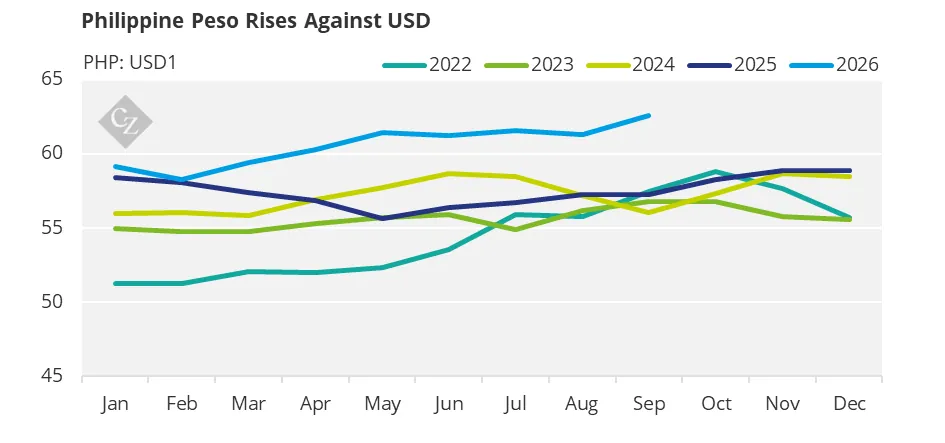
The contrast is instructive. Algeria’s inventory requirements have forced demand into the market despite firm pricing. In the Philippines, currency pressure is allowing or requiring buyers to delay decisions.
This is not evidence of one global demand cycle. Demand is being shaped by local inventory, foreign exchange and buyers’ ability to postpone coverage.
Allocation, not aggregate milk, remains the key
The latest evidence does not point to a broad dairy rally, nor does it indicate that the world is running out of milk. Instead, it shows dairy availability being reshaped by product economics:
- WMP has regained competitiveness against the NZ Cheddar/WPC stream;
- ONIL has absorbed a substantial volume of WMP;
- FFMP is following SMP higher, making substitution more expensive;
- US cheese and butter have reached New Zealand, but the US cheese discount is narrowing;
- NZ butter premiums are holding in some channels while payment terms become more flexible in others;
- New Zealand passed peak milk day earlier, leaving product allocation increasingly dependent on the post-peak milk curve.
If WMP remains competitive against Cheddar/WPC, New Zealand processors may direct more milk towards WMP than they otherwise would have. This could help satisfy powder demand, but it may also mean less cheese and whey protein.
Source: CZ App