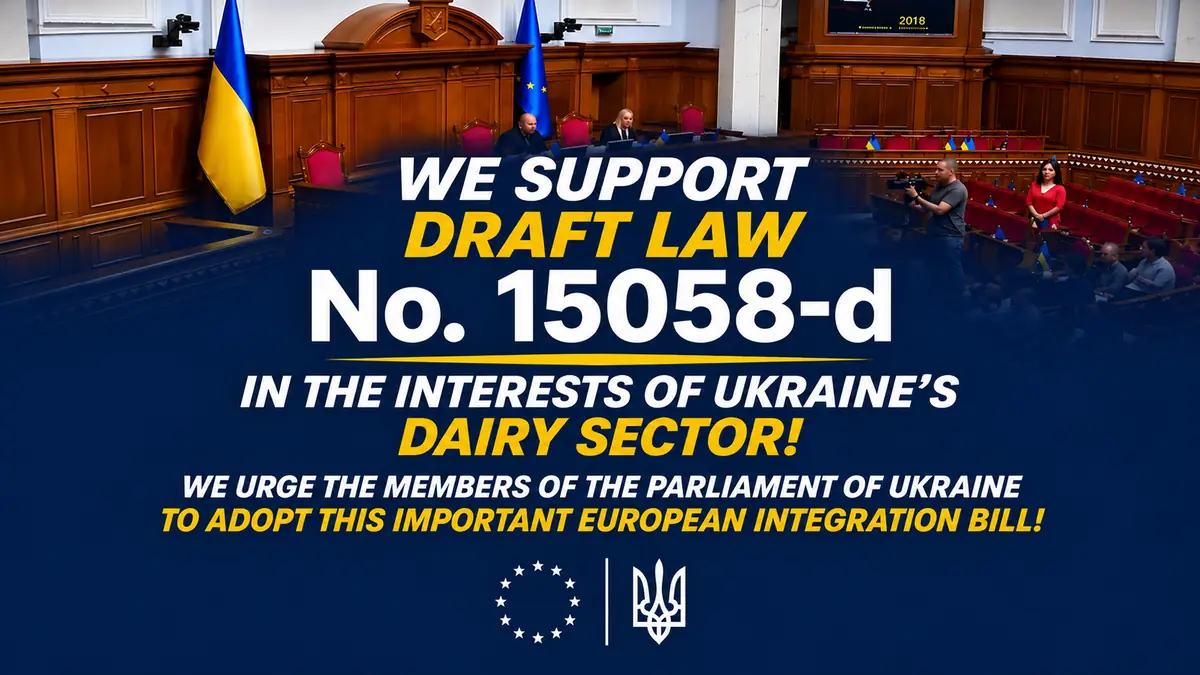
The Union of Dairy Enterprises of Ukraine (UDEU) supports the adoption of draft law No. 15058-d, which would bring 17 Ukrainian laws into line with European requirements. In particular, it provides for the Law of Ukraine «On Milk and Dairy Products» to cease to have effect from 1 January 2029, the Union of Dairy Enterprises of Ukraine reports.
UDEU believes this is a necessary step towards harmonising Ukrainian legislation with European Union (EU) law, removing regulatory contradictions and creating better conditions for the development of the dairy industry and its access to the European market.
Key points:
- draft law No. 15058-d provides for the Law «On Milk and Dairy Products» to cease to have effect from 1 January 2029;
- the current law does not meet European requirements and, in particular, restricts the production of kefir with added ingredients;
- claims that all inspections will become paid once the law is repealed are incorrect, as unscheduled inspections are already paid for;
- requirements for product safety, veterinary and sanitary rules and consumer protection remain in other legislation.
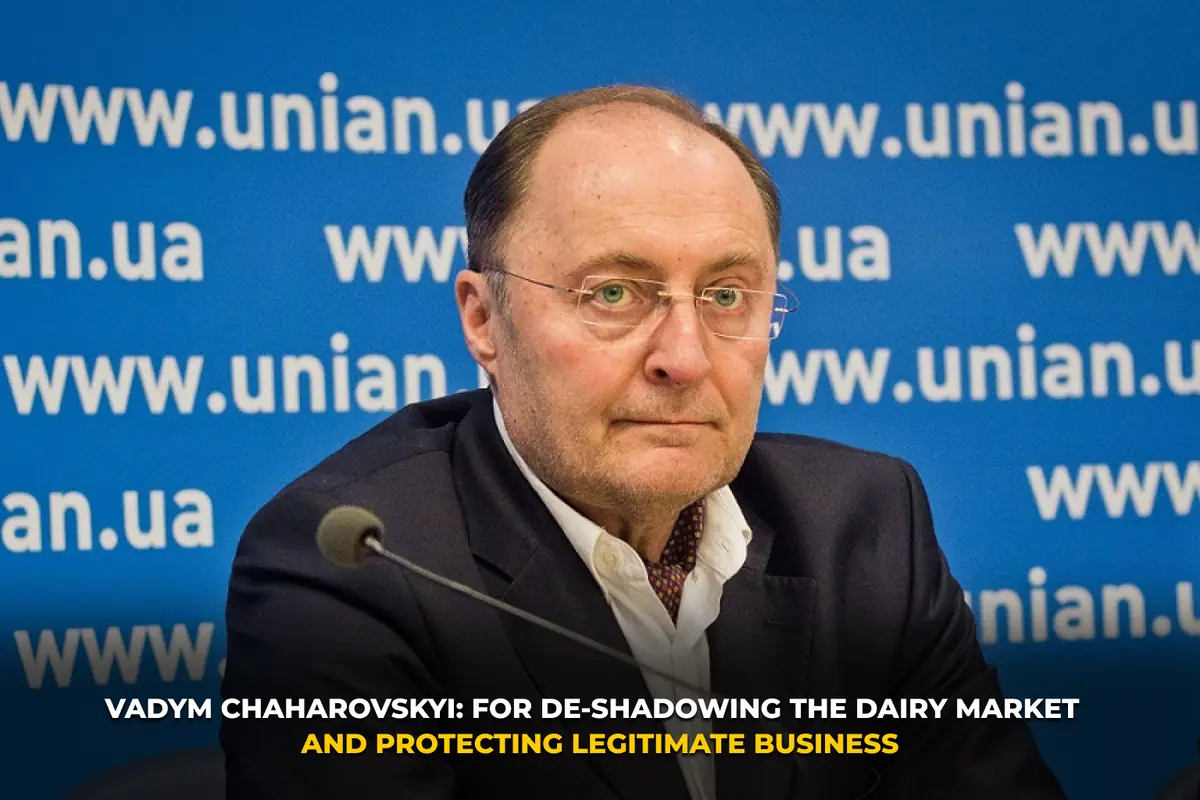
«We support draft law No. 15058-d, especially the part on terminating the Law «On Milk and Dairy Products». This law does not meet European requirements and is creating difficulties for the dairy industry today», stresses UDEU Head Vadym Chaharovskyi.
The current law creates regulatory restrictions for producers
One example of Ukrainian legislation falling short of modern European approaches is its provisions on traditional dairy products.
As Vadym Chaharovskyi explains, the current Law «On Milk and Dairy Products» contains restrictions that do not take into account the development of product ranges and current consumer trends in the European market.
This applies in particular to kefir. Under the current provisions, its definition and composition requirements effectively limit the use of additional ingredients and fillings.
Meanwhile, the segment of kefir with various added ingredients has been growing rapidly in the European market in recent years. Such products meet current consumer trends and open up additional opportunities for producers.
«In Europe, kefir with added ingredients is now a trend; for the past two years there has simply been a boom. But our law effectively restricts producers’ ability to develop this segment», the UDEU Head notes.
Keeping outdated sector-specific rules therefore does not help the competitiveness of Ukrainian producers and may instead limit their ability to introduce new products and operate under European rules.
Will repealing the law lead to paid inspections of dairy enterprises?
One of the main arguments of the draft law’s opponents is that terminating the Law «On Milk and Dairy Products» would supposedly introduce fees for state inspections of dairy enterprises.
This position is based on Article 14 of the current law, which provides for free state control in the areas it specifies. In UDEU’s view, however, this argument ignores both actual control practice and the European approach to regulating this area.
First, it is important to distinguish between the sector-specific state control provided for by Article 14 of the Law «On Milk and Dairy Products» and other types of state supervision and control over enterprises. Article 14 covers specific areas of control, including:
- compliance with veterinary and sanitary rules;
- milk production;
- the safety of milk and dairy products;
- consumer protection.
Terminating this law does not automatically introduce fees for all state inspections of dairy enterprises. It removes a special sector-specific provision on free control in certain areas, not the general procedure for state supervision.
Moreover, as Vadym Chaharovskyi stresses, unscheduled inspections of dairy enterprises are already paid for today.
«Repealing this law will not harm the dairy business. Why? Because even today all unscheduled inspections are carried out for a fee», the UDEU Head emphasises.
The claim that all inspections will become paid after the law is terminated is therefore incorrect and does not reflect the actual situation.
European practice also provides for fees for certain types of state control
EU practice is an important argument in favour of harmonisation. Regulation (EU) 2017/625 on official controls for food and feed provides for mechanisms to collect mandatory fees for certain types of official control.
In other words, the European model is not based on unconditional free-of-charge control procedures. It sets out clearly defined rules, grounds and mechanisms for financing official controls.
Keeping a separate sector-specific provision on free control in Ukrainian legislation therefore cannot be an end in itself, especially if it is inconsistent with general European approaches.
At the same time, terminating the Law «On Milk and Dairy Products» does not remove requirements for product safety, veterinary and sanitary rules or consumer protection, which will continue to be regulated by other Ukrainian legislation.
There is time to adapt until 2029
It is also important to note that draft law No. 15058-d provides for the Law «On Milk and Dairy Products» to cease to have effect not immediately upon adoption, but only from 1 January 2029.
This means the state, control authorities and businesses will have time to prepare for the changes, adapt the regulatory framework and ensure a proper transition to the updated system.
In addition, for the duration of martial law, Cabinet of Ministers of Ukraine Resolution No. 303 restricts scheduled state supervision (control) measures, except those specified by law.
There are therefore insufficient grounds to claim, without specific calculations, that terminating the law will inevitably increase the financial burden on dairy enterprises.
The dairy industry’s interests lie in European harmonisation
UDEU is convinced that modernising legislation and bringing it closer to EU standards is a prerequisite for the development of Ukraine’s dairy industry.
Outdated sector-specific provisions that create regulatory restrictions and do not match European approaches should not hold producers back, limit innovation or complicate access for Ukrainian products to EU markets.
Terminating the Law «On Milk and Dairy Products» from 1 January 2029 does not mean abolishing quality and safety requirements for dairy products or abandoning state control. It means moving to a more modern regulatory system aligned with European legislation.
The Union of Dairy Enterprises of Ukraine supports the adoption of draft law No. 15058-d and calls on members of parliament to back it. The interests of Ukraine’s dairy industry lie in clear, modern rules harmonised with European ones that do not create unnecessary barriers to business development, investment and the competitiveness of Ukrainian products.