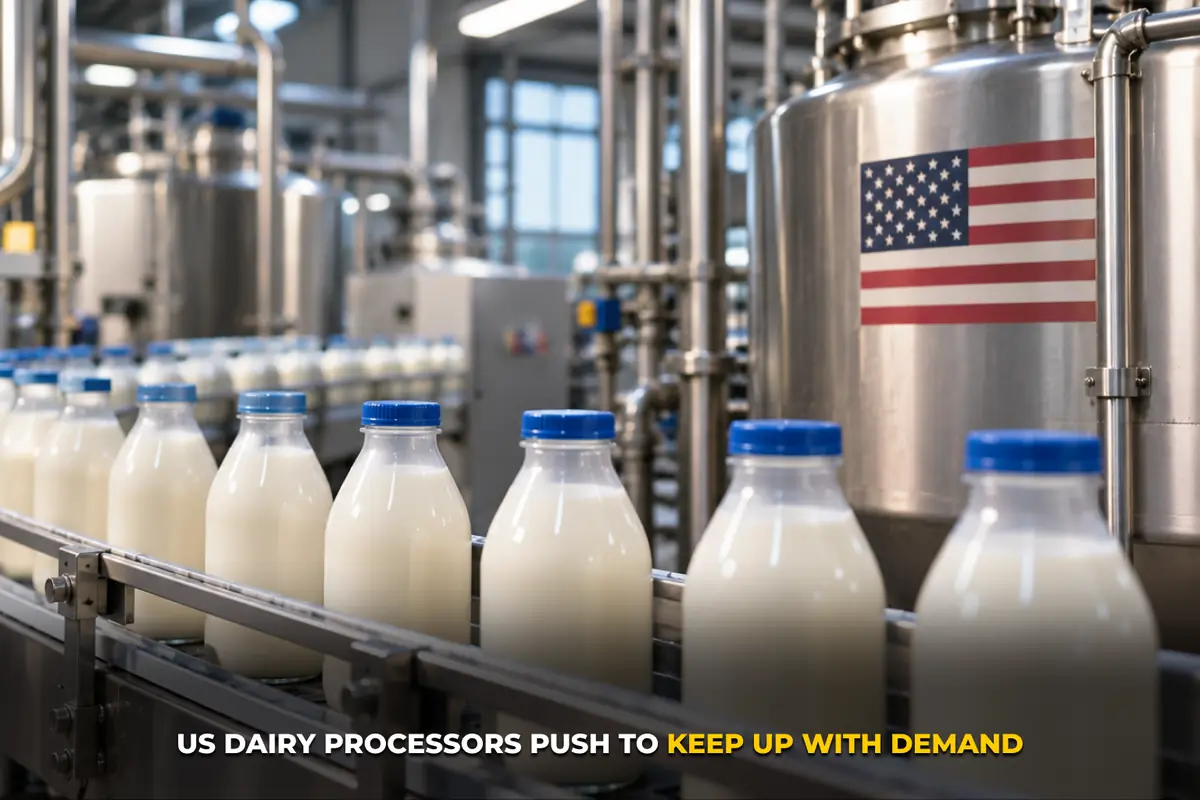
As US consumers increasingly seek out dairy foods, processors are building new plants, expansions and lines, with more than USD 15 billion in investment planned through 2030, Food Processing reports.
Key points:
- dairy is benefiting from renewed consumer interest in real, nutritious foods, including whole milk, high-protein and ultra-filtered products;
- sales of ultra-filtered lactose-free milk grew more than 20% over the 13 weeks ending in early September;
- US dairy processors are investing more than USD 15 billion in new and expanded capacity across 23 states, with more than 85 projects through 2030;
- Chobani has committed between USD 3.5 billion and USD 4 billion to new projects.
Back to simple foods
Dairy demand is being driven by consumers who pay closer attention to what their food contains. According to Heather Anfang, executive vice president of Land O’Lakes and president of its Dairy Foods division, consumers today dig much deeper into ingredients and their health outcomes than in the past.
«It feels like we’re having a real different conversation around health and nutrition and wellness in our country right now, and dairy has always been a terrific, nutritious, healthy product for people», she says. «I think they’re either learning or re-learning that, and it’s coming into the spotlight for many».
For many consumers, rising interest in dairy means a return to basics, to the benefit of milk, says Al Dejewski, senior vice president of marketing at the Milk Processor Education Program (MilkPEP).
«We are seeing consumer preferences shift back toward real, simple foods, and dairy is benefiting directly from that momentum», he explains. «One of the clearest signs of the shift toward real foods is the resurgence of whole milk; as perceptions of dairy fat continue to evolve, whole milk sales are growing».
Dejewski also highlights a trend among milk buyers, who are seeking versatility rather than a one-size-fits-all approach. Circana data show that nearly half of white milk buyers purchase two or more fat types, and those households account for about 60% of white milk volume.
«Whole milk leads for cooking and baking, while 2% is the everyday go-to», he says. «That flexibility is part of milk’s appeal: it works across occasions and budgets».
Pushing production
With demand surging, processors have been ramping up production over the past few years, and many of the food and beverage industry’s big-ticket capital projects involve milk, cheese, butter, yogurt, ice cream and other dairy products.
Ferrero Group’s Wells Enterprises opened the first two phases of its transformed and expanded ice cream plant in Dunkirk, New York, in August. Once all four phases are complete, the plant will produce five times more product annually than before.
In the same month, Coca-Cola subsidiary Fairlife opened a new facility in Webster, New York, expected to process 5 to 6 million pounds of milk per day once fully operational. Fairlife also broke ground on a USD 650 million expansion in Coopersville, Michigan, in August.
«What we can see from the retail side is innovation reaching the shelf», Dejewski says. «Ultra-filtered lactose-free milk, which offers more protein than regular milk and no lactose, is one example. According to Circana, it has grown more than 20% over the 13 weeks ending in early September».
Other completed projects include Hiland Dairy’s 96,000-sq.-ft. expansion of its Tyler, Texas, facility. About a month later, Good Culture and the Michigan Milk Producers Association (MMPA) opened a cottage cheese plant in Remus, Michigan.
More than USD 15 billion in investment
In late October 2026, the International Dairy Foods Association (IDFA) announced that dairy manufacturing is projected to outpace the broader manufacturing sector in both employment and output growth over the next decade.
«America’s dairy processors are investing more than $15 billion in new and expanded manufacturing capacity across 23 states, with more than 85 projects planned or underway through 2030», IDFA said.
Perhaps the biggest recent headline-maker is Chobani, the New York-based maker of Greek yogurt and coffee creamers. By the publication’s rough count, the company has committed between USD 3.5 billion and USD 4 billion to projects in Twin Falls, Idaho; Rome, New York; Allentown, Pennsylvania; and a coffee creamer facility in Norton Shores, Michigan.
Land O’Lakes bets on ultra-filtered milk
In July 2026, Land O’Lakes announced it would expand its high-value dairy protein production capabilities at its Tulare, California, plant. The investment will enable production of ultra-filtered milk, adding value to the milk supplied by its cooperative member farmers.
«This is about more than a single upgrade. It’s about building the future of dairy», Heather Anfang said at the time.
She says the expansion is under way and the first phase is expected to open in the first quarter of 2027. Across Land O’Lakes’ 11 processing facilities, there are many opportunities to advance operations, from additional automation and robotics to address the challenges of recruiting and retaining workers, to maintaining facilities, lines and equipment.
«It’s really looking at how we leverage new technology to meet the needs of the customers and consumers in the most efficient way», Anfang says, «and there’s just tons of opportunity for that right now».
Source: Food Processing