
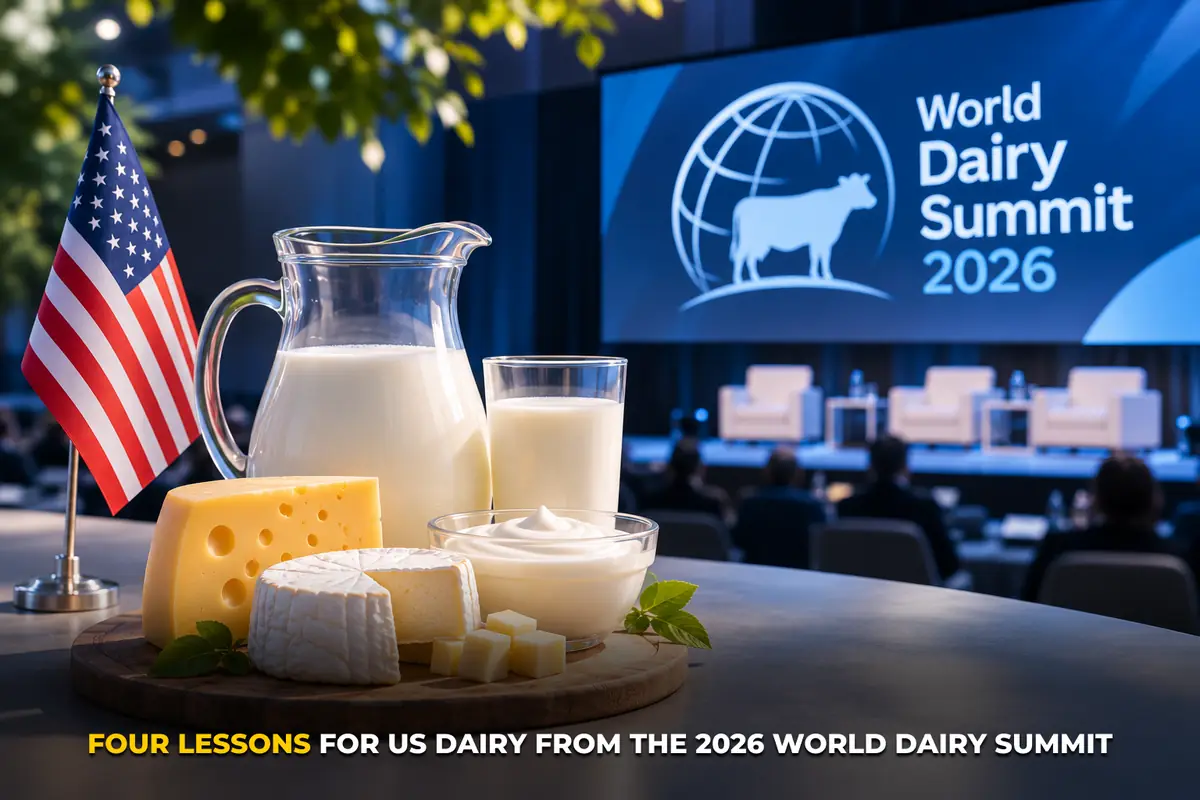
From affordability and market diversification to ultra-processed foods, Becky Rasdall Vargas and Sam Alcaine of the International Dairy Foods Association have shared lessons from conversations with dairy leaders around the world at the 2026 World Dairy Summit in Auckland, New Zealand, the International Dairy Foods Association (IDFA) reports.
Key points:
- the challenges facing US dairy are global, but so are the opportunities;
- affordability is equally pressing in Canada, Europe, Asia and other regions;
- New Zealand’s experience shows that markets must be diversified before a key market shifts or closes;
- the debate on ultra-processed foods is creating unexpected unity across the global dairy sector.
1. Learning + resilience = growth
Resilience came up in nearly every conversation with New Zealand dairy leaders. The country’s dairy industry did not become an economic powerhouse by accident: constantly faced with changing export markets, economic pressures and the need to compete globally, it adapted, confronted barriers and pursued reforms that opened new opportunities for growth.
That lesson resonates for US dairy today, which faces rising costs, policy uncertainty and shifting global markets. But history shows that periods of disruption can also create opportunities to rethink how to compete and where future growth could lie.
2. Affordability is universal
In the US, especially after the 2026 midterms, affordability can feel like a uniquely domestic issue after years of inflation, supply-chain pressures and policy uncertainty. But conversations at the summit made clear that dairy leaders from Canada, Europe, Asia and elsewhere face the same pressures: managing higher input costs while keeping nutritious dairy foods accessible to consumers.
That shared challenge is also an opportunity. Dairy delivers a powerful combination of nutrition, versatility and value. As consumers worldwide scrutinise every dollar, the industry can make a stronger case for dairy not simply as an affordable choice but as an exceptional nutritional value.
3. Market diversification is the game
New Zealand offers a powerful lesson in market diversification. When the United Kingdom joined the European Economic Community in 1973, New Zealand had to rethink its heavy dependence on one of its most important export markets. The dairy sector responded by aggressively pursuing new customers and markets.
That focus remains central to New Zealand’s dairy strategy today. The lesson for US dairy is clear: waiting until a major market shifts or closes is too late to begin diversifying.
That is the thinking behind IDFA’s Project Diversify: identifying promising markets earlier, giving US dairy companies better tools to assess opportunities and helping the industry build durable demand across a broader range of global markets. Diversification is not a short-term response to today’s trade uncertainty but a long-term growth strategy.
4. UPFs are creating unexpected unity
For all the issues that divide global dairy markets, from trade and tariffs to competition and pricing, one is creating remarkable alignment: the emerging policy debate over ultra-processed foods.
Governments and health authorities around the world are considering how processing should factor into nutrition policy. For dairy, the stakes are high: policies focused primarily on processing rather than nutritional value risk discouraging consumption of nutrient-dense dairy products at a time when many consumers already fall short of recommended intake.
What stood out in Auckland was how broadly that concern is shared. Dairy leaders across markets recognise the importance of bringing sound science and nutrition back to the centre of the conversation. The sector may compete globally, but it shares an interest in ensuring consumers have access to nutritious dairy foods and that policy recognises their nutritional value.
In one summit session, Fonterra CEO Richard Allen remarked that he had never met a farmer who didn’t want to leave the farm better than they found it, a principle that holds across the global dairy sector.
«We want to leave consumers better off, with greater access to nutrient-dense foods, more resilient food systems and greater food security. The conversations in Auckland were a reminder that while the challenges facing dairy are significant, so are the opportunities. Learning from one another, remaining resilient and continuing to adapt will help ensure dairy continues to thrive», the authors conclude.
Source: IDFA