
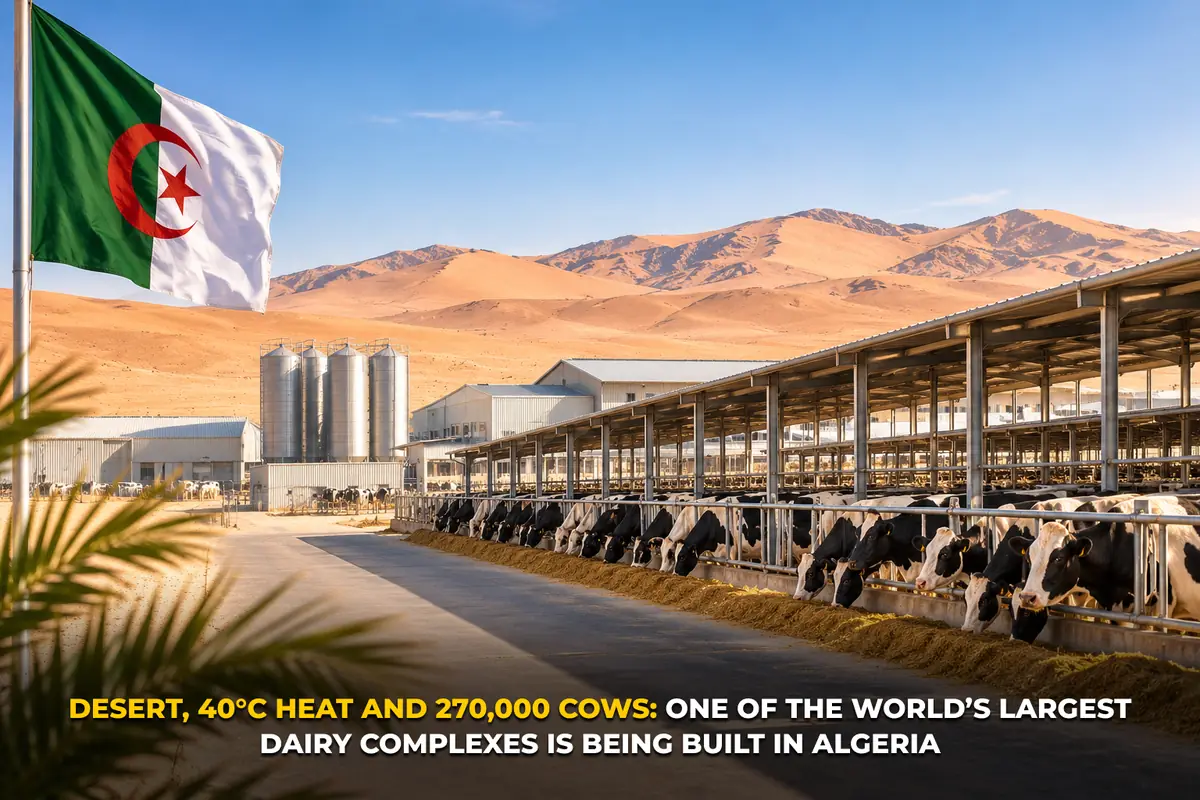
One of the world’s largest dairy complexes is being built in Algeria’s Adrar province. The project will cover about 117,000 ha and combine cattle farming with milk powder production. Its scale is enormous, and building it in the Sahara poses very different challenges from a typical dairy region, top agrar Polska reports.
Key points:
- the agro-industrial complex is worth USD 3.5 billion and covers about 117,000 ha;
- the project is being developed by Qatari dairy company Baladna and Algeria’s National Investment Fund;
- the herd is set to grow gradually to 270,000 cows, and output to 100,000 tonnes of milk powder a year;
- production is scheduled to start at the end of 2027.
Dairy cows, feed crops and a milk powder plant, all in a desert area where temperatures exceed 40°C for much of the year: a huge USD 3.5 billion agro-industrial complex is taking shape in Algeria’s Adrar province.
The project will cover about 117,000 ha and is being developed jointly by Qatari dairy company Baladna and Algeria’s National Investment Fund.
Eventually 270,000 cows
This will not be an ordinary farm. The investor aims to combine grain and forage crops, cow housing, milk production and processing in a single system. The herd is set to grow gradually to 270,000 cows.
In April 2026, Baladna signed second-phase contracts worth more than USD 635 million. The company also announced the import of 30,000 high-yielding Holstein cows from the United States on 109 flights. According to Algerian state media, deliveries were due to start in November 2026 and last about ten months.
Production to start at the end of 2027
At full capacity, the complex will produce up to 100,000 tonnes of milk powder a year, enough to cover about half of Algeria’s demand. The country aims to cut costly imports and make its milk supply independent of global market conditions.
Production is scheduled to start at the end of 2027. The project is no longer just on paper: feed crop cultivation has begun on site, and the barley harvest started in May.
In the Sahara, water and energy will be key
The biggest challenge remains the climate. In Adrar, temperatures exceed 40°C on more than 130 days a year, so growing feed for hundreds of thousands of cows will require constant irrigation.
Fifty generators of up to 330 kVA have been delivered to power centre-pivot irrigation systems, prepared for round-the-clock operation. Without a continuous supply of water and energy, feed production, cooling of buildings and keeping such a large herd will be impossible.
Access to water remains the biggest question mark. The first contracts cover well drilling and irrigation systems, but available reports do not yet show how intensive groundwater use will affect the region’s resources.
There are also questions about the welfare of high-yielding cows in extreme heat. The project’s success will depend not only on its scale but above all on reliable cooling, irrigation and power. In the Sahara, even a brief failure could quickly threaten the animals and the entire operation.
Source: top agrar Polska