
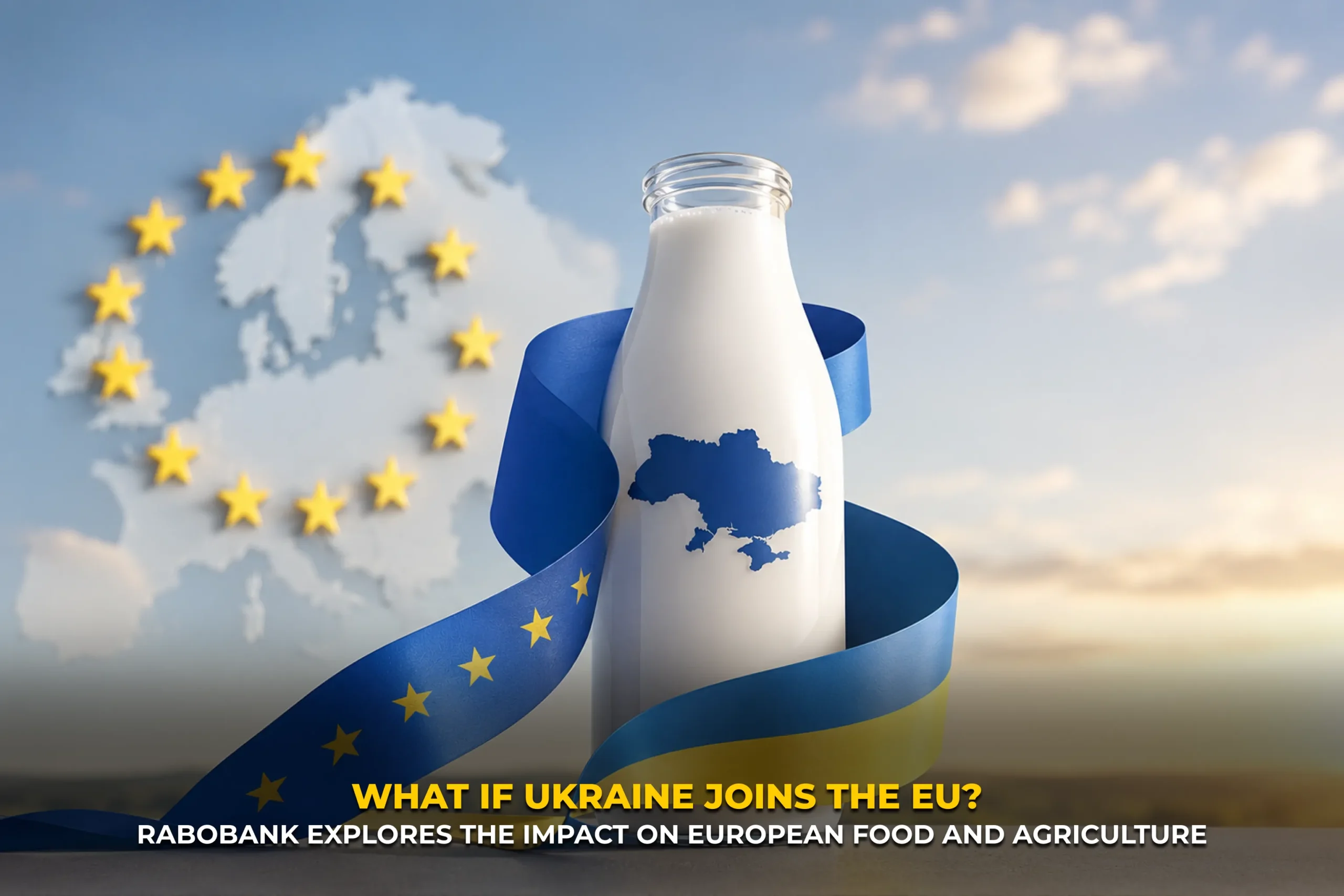
Ukraine’s EU accession would fold a huge farm sector into the bloc, bringing both openings and risks for European food and agriculture, according to a RaboResearch scenario study by analysts Barend Bekamp and Maartje Wijffelaars, Rabobank reports. Even with war damage, Ukraine would add a major production base in grains, oilseeds and poultry while remaining less competitive in higher value-added goods.
A 2027 accession date looks unlikely
Ukraine’s path toward EU membership predates the full-scale invasion: a 2014 Association Agreement with a Deep and Comprehensive Free Trade Area (DCFTA), then candidate status in 2022. Peace-plan proposals floated since last November point to 2027, but the analysts see that as improbable. Membership cannot be imposed or fixed to a timeline: it hinges on the Copenhagen criteria, the EU’s absorption capacity and unanimous approval by all member states — a process that has historically taken from a few years to over a decade. To speed things up, the European Commission is weighing a two-tier membership with reduced rights, though a fast-tracked, incomplete accession faces strong resistance.
The war has badly damaged Ukraine’s farm sector
Comparing three-year averages before and after 2022, output fell sharply for major crops — corn −20%, wheat −22%, barley −33%, sunflower −15% — and in livestock, with milk −19%, beef −28%, pork −8% and poultry −5%, while soybeans, rapeseed and sugar beet rose. Frontline oblasts, mostly cropping regions, took the heaviest direct damage, including mined land (over 160,000 ha in Kharkiv alone). Ukraine lost a quarter of its grain storage capacity, and officials cited by Reuters estimate around 400 port facilities were hit, with reconstruction near EUR 0.5 billion. Even so, exports proved resilient: after the early blockade, the July 2022 Black Sea Grain Initiative (EU, UN and Turkey) reopened ports and volumes recovered.
Accession would boost EU output — with risks and opportunities
Ukraine would become the EU’s largest member state by farmland, adding 41 million hectares (about +25% of EU agricultural area), yet lifting agricultural value added by only 4%, as it produces mainly lower-value commodity crops on its fertile chornozem soils. The study points to three outcomes: a stronger EU surplus in grains, sugar and poultry (pressuring farm prices but cutting feed costs for livestock and benefiting traders and processors); a reduced EU deficit in oilseeds, where Ukraine is already Europe’s main supplier of sunflower oil and meal; and limited change in dairy, pork and beef. Before joining, Ukraine must also meet EU standards on food safety, animal and plant health, labelling, environment and animal welfare — requiring heavy investment that could benefit European technology and knowledge providers.
A bigger EU population, but limited early economic upside
Accession would enlarge the EU’s population and consumer base from about 450 million to nearly 490 million (+8%), making Ukraine the fifth-largest member, just ahead of Poland. The near-term economic effect would be modest, however: Ukraine’s GDP per capita is EUR 4,983 against an EU average of EUR 40,038, so accession would raise EU GDP by just 1% while GDP per capita would actually fall by 7%. Long-run growth should benefit, but convergence would be slow and back-loaded, hinging on the pace of reconstruction — which in turn needs peace, credible security guarantees and major international financing.
The current CAP model can’t accommodate Ukraine
The Common Agricultural Policy (CAP), worth roughly EUR 55 billion a year and heavily weighted toward per-hectare direct payments, would be strained by a ~25% larger farm area. Three options exist: raising the budget (an estimated EUR 7.6–13.4 billion a year, seen as unlikely); tightening eligibility (hitting less subsidy-dependent Western European farmers hardest); or cutting per-hectare payments (hitting the Baltics and Eastern Europe hardest). Transitional arrangements are the likely stopgap. Beyond CAP, Ukraine would also draw substantial cohesion funds: estimates suggest it would qualify for about 10–16% (EUR 126–186 billion) of the current seven-year budget, with Bruegel projecting the largest percentage losses for Italy, Malta, Portugal, Spain, Finland and Hungary. The EU budget would likely need to grow by 10–25%.
Stronger food autonomy, but soy is hard to replace
A key EU vulnerability is its reliance on imported oilseeds and meals for feed: home-grown soy covers only about 15% of use, with the rest from Brazil, the US and Argentina. Ukraine could partly ease this. Yet, in a hypothetical scenario, replacing all Brazilian and US soybean imports (12.3 million tonnes in 2025, excluding meal) with Ukrainian output at 2.5 t/ha would need roughly 4.9 million hectares — over 10% of Ukraine’s farmland — plus subsidies, tariffs (in tension with the Mercosur and July 2025 EU–US trade deals) and agronomic support. Soy also brings agronomic benefits as a nitrogen-fixing crop, but its high protein and lysine content make it hard to replace with sunflower or rapeseed meal, especially in pig and poultry feed.
Balancing risks and opportunities
Today’s volatile geopolitics and the EU’s commitment to Ukraine have made Brussels more open to a fast-tracked, full or «light» membership, though resistance from several member states makes 2027 unlikely. EU arable farmers could face price pressure on grains and sugar and tighter CAP funding, while livestock benefits from cheaper feed and grain and oilseed traders from higher volumes; the poultry effect depends on how far lower output prices are offset by cheaper feed. Reconstruction investment could open doors for European suppliers of technology, farm inputs and knowledge. Overall, accession should strengthen EU food autonomy — but swapping South American soy for Ukrainian production is no easy switch, and these effects will be weighed against defence, critical minerals and geopolitics.
The full report, «What if Ukraine joins the EU? An exploration of the impact on European food and agriculture», is available to download on the Rabobank website.
Source: Rabobank