

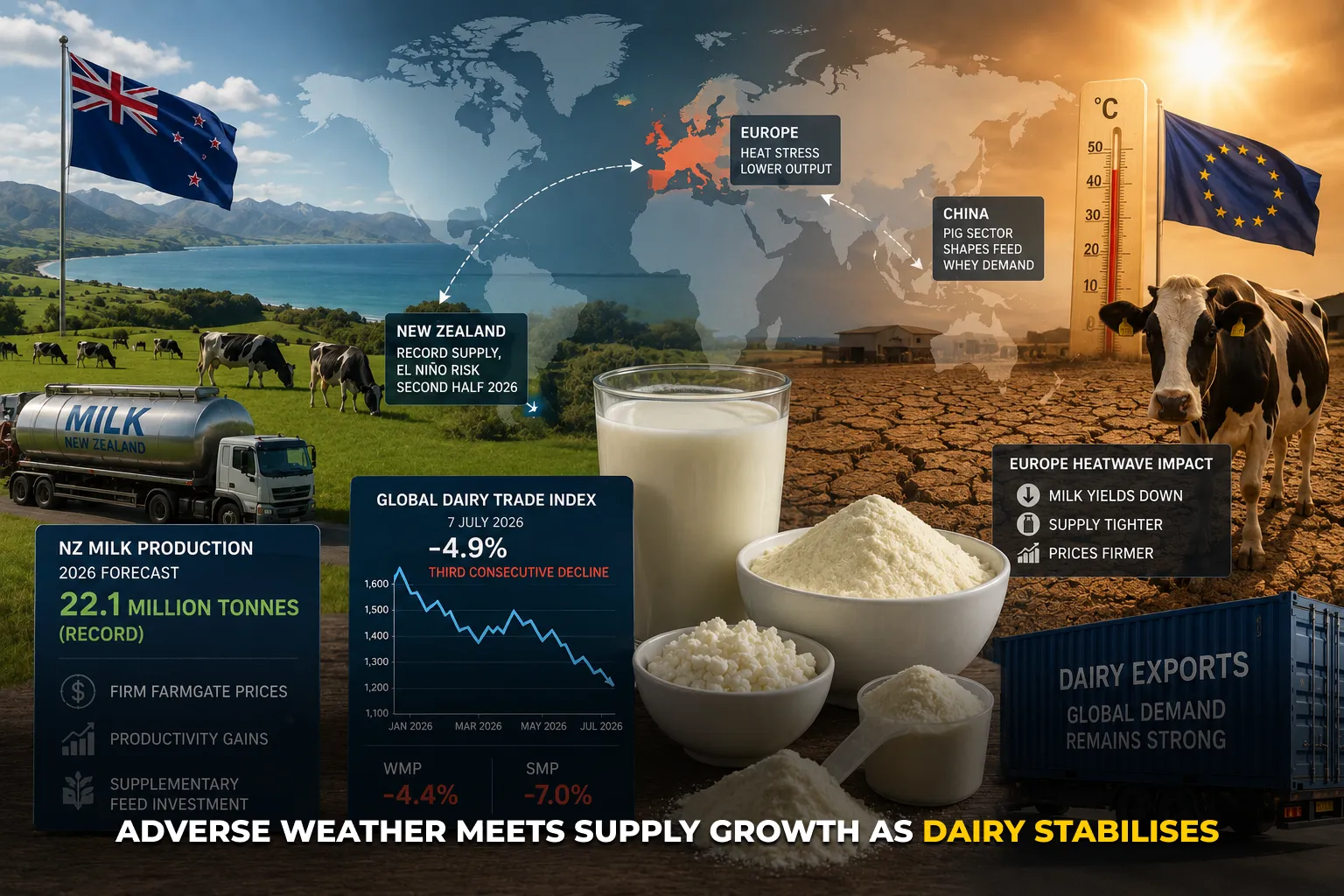
Record milk supply continues in New Zealand, but markets must now price in weather: heat is denting European output, El Niño risks are building for the second half, protein-ingredient markets stay tight on strong whey demand, and China’s pig sector shapes appetite for feed-whey, Czapp reports.
Supply growth meets emerging weather risks
The global dairy market reached mid-2026 caught between abundant milk and mounting weather risk, with New Zealand the main focus for traders. The US Department of Agriculture (USDA) forecasts New Zealand output at a record 22.1 million tonnes in 2026, underpinned by firm farmgate prices, productivity gains and investment in supplementary feed. Processors report unusually strong early-season availability — milk is even being shipped from the South Island to the North Island for processing.
Forecasters are increasingly focused on the risk of El Niño later in 2026. New Zealand’s National Institute of Water and Atmospheric Research (NIWA) puts the probability of El Niño conditions in July–September at 95%, and Fonterra has flagged it as the season’s main supply-side uncertainty. Still, high prices and healthy feed stocks mean any hit to output may surface more slowly than in past drought cycles. A relatively weak New Zealand dollar against the US dollar is supporting farmgate returns and export competitiveness despite softer commodity prices.
European heatwave supports prices
While Oceania heads into a potentially strong season, Europe faces the reverse. Record heat across Western and Central Europe in June and July put cows under heat stress, cutting yields and disrupting seasonal patterns. Copernicus said June 2026 was the hottest June on record in Western Europe, while USDA Dairy Market News warned that prolonged heat and drought were clouding summer supply.
The UK’s Agriculture and Horticulture Development Board (AHDB) estimates heat has already cut British milk output by roughly 18.5 million litres, tipping the market from surplus into short-term deficit, with similar strains reported across mainland Europe. That has helped halt an extended slide in European commodity prices, with cream, butter and skim milk powder (SMP) firming as buyers reassess summer volumes. Upside may be capped, though: if high prices persist into the third quarter, more competitively priced New Zealand product could reach Europe, aided by expanding dairy quotas under recent free trade deals.
Protein markets remain exceptionally tight
The standout move in ingredients has been persistent tightness in protein. Participants report growing scarcity of milk protein concentrate (MPC70), with some New Zealand processors trimming output in favour of higher-return streams. Demand for whey proteins stays exceptionally strong: rapid growth in high-protein and sports nutrition, plus GLP-1 weight-loss-linked demand, keeps whey protein concentrate (WPC) and whey protein isolate (WPI) values elevated.
That competition for liquid whey is squeezing the downgraded products traditionally used in calf and piglet milk replacers. As processors steer more whey toward food-grade ingredients, animal-nutrition makers are hunting for alternative protein and may eventually have to bid against far pricier human-nutrition markets. The trend is also lifting lactose and whey-complex values; although Global Dairy Trade (GDT) prices have softened lately, lactose remains well above year-earlier levels.
China remains a key variable
China’s livestock sector is watched closely for its pull on whey demand. Pig prices stayed under pressure through much of the first half of 2026 as domestic pork supply outran demand — AHDB reports average prices around 27% below year-earlier levels by mid-June. Prices recovered somewhat in early July after government intervention, but Beijing is encouraging cuts to breeding-sow numbers to rebalance the market.
For dairy, this has a secondary effect: sweet whey powder and whey permeate are major pig-feed components, so a sustained herd reduction could modestly soften feed-whey demand and partly offset upward pressure from food-grade whey protein. The effect is likely limited, however, given continued growth in human-nutrition demand.
Prices under pressure despite firm fundamentals
Despite regional supply worries, global commodity markets eased in June and July. The Global Dairy Trade index fell 4.9% at its 7 July event — a third consecutive decline — as auction volumes jumped and buyers priced in stronger output from major exporters; whole milk powder (WMP) dropped 4.4%, and SMP fell 7%. Accordingly, Fonterra cut its opening 2026/27 milk price forecast from NZD 9.75 to NZD 9.25 per kilogram of milk solids (kgMS), citing softer demand and strong global supply. Even so, the co-op still expects a strong start to the New Zealand season, reinforcing the view that weather — rather than supply availability — may be the dominant driver in the second half of 2026.
Source: Czapp