
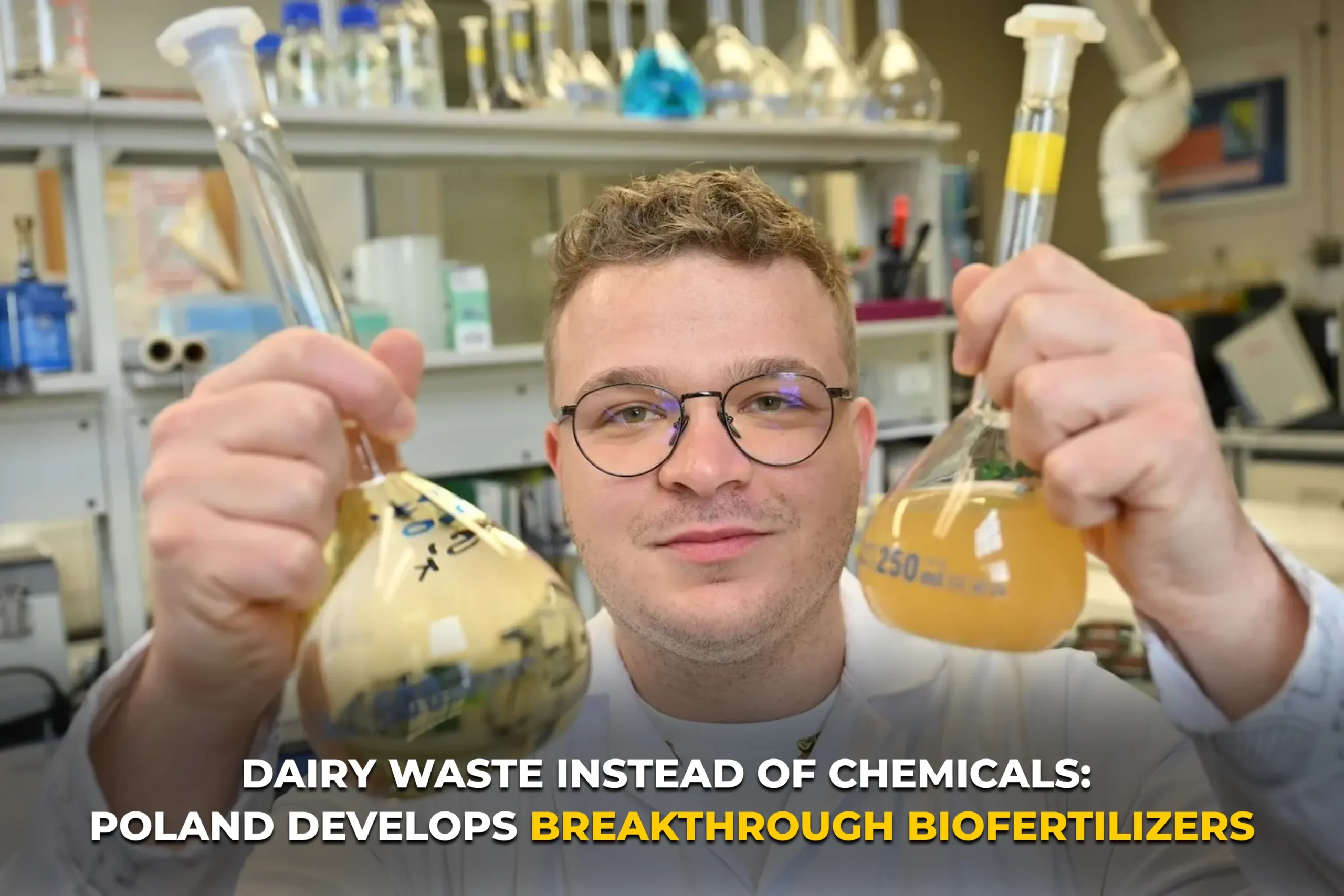
Researchers at Wrocław University of Science and Technology (PWr) are turning dairy-industry waste into biofertilizers, recovering nitrogen and other plant nutrients to create amino-acid-rich products that boost crops’ resilience to climate stress, EcoEkonomia reports.
As sustainable farming grows, biomass-based fertilizers are gaining ground as an alternative to mineral products, improving soil fertility and supporting natural soil processes over time.
Their base is usually organic matter such as manure or guano, or natural residues like plant matter, compost and straw — but, it turns out, dairy-industry waste can be used too.
A first-of-its-kind idea
Chemistry researchers at PWr are working on exactly that, in partnership with a dairy company producing skim and powdered milk. Making those products generates, before pasteurisation, a highly concentrated, protein-rich stream.
«It is sometimes used for animal feed, but it can instead be a source of nitrogen, phosphorus and other elements highly valuable in crop growing, so we decided to use this waste differently — creating an innovative organo-mineral fertilizer and biostimulant. No one had tried to use it this way before», says Rafał Taf says Rafal Taf of the Wrocław University of Science and Technology.
The hardest step, he notes, is characterising the waste’s composition and checking for heavy metals — which, fortunately, dairy waste lacks — so nutrients end up in plant-available forms free of unwanted components such as fats.
«Classic fertilizer production relies mainly on chemical processes. We use those too, but also add enzymatic processes to extract as many free amino acids and short peptides as possible, because these significantly affect plant growth», the doctoral candidate explains.
Recent research confirms that supplying free amino acids helps plants cope with climate stress — important during extremes such as prolonged drought, heatwaves or periodic soil salinity.
Zero-waste technology
«Our method allows 100% use of the waste generated — nothing is wasted — and the finished fertilizer comes as granules or a liquid biostimulant», says Taf, adding that the process needs a binder (such as bentonite, lignite or leonardite) to form granules, and that variable waste composition sometimes requires mineral supplementation.
Designed for cereals such as wheat, maize and barley, the biofertilizer has passed lab tests — from germination trials to long-term pot experiments — and field trials on wheat will soon begin with the Wrocław branch of the Institute of Soil Science and Plant Cultivation (IUNG-PIB) in Puławy.
«It has huge implementation potential — for the dairy sector, which avoids possible waste-disposal costs, and for farmers, since producing the biofertilizer could ultimately be cheaper than chemical fertilizers», Taf stresses.
International cooperation
The work is part of the European HORIZON Landfeed project, in which researchers from Spain, Italy, France, Greece and Poland use various food wastes — including animal residues, olive-press waste and sewage-treatment sludge. PWr focuses solely on dairy waste, with Prof. Chojnacka leading the overall project, which runs until 2028 and is funded with nearly €8 million.
Source: EcoEkonomia