

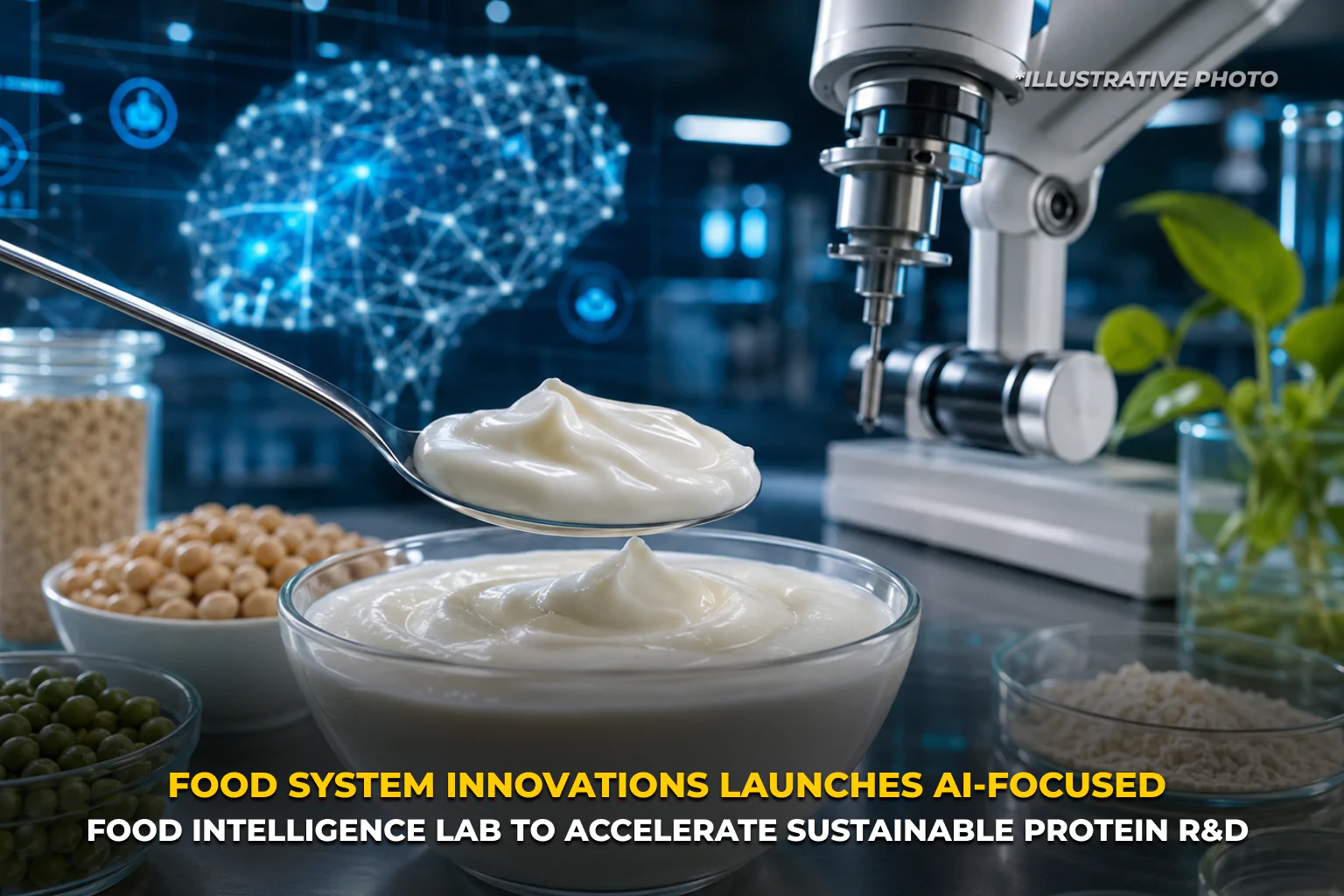
Food System Innovations (FSI) has launched the Food Intelligence Lab — a new interdisciplinary initiative designed to build the AI infrastructure needed to accelerate R&D in the sustainable protein sector.
As FoodBev Media reports, backed by a $2 million grant from the Bezos Earth Fund, the lab has already demonstrated its potential: an AI system improved the sensory performance of a plant-based Greek yogurt by 29% in just 10 formulation iterations over five days.
The lab will develop open-source datasets, machine learning models and benchmarking tools aimed at reducing product development timelines and improving the sensory performance of plant-based and other sustainable protein products — launched against a backdrop of persistent consumer adoption challenges in the alternative protein sector, driven in part by ongoing concerns about taste and texture.
“AI is already transforming fields like drug discovery and materials science, but the food industry still lacks the shared infrastructure needed to fully unlock AI’s potential in this space. We are building tools that will help food scientists iterate faster and create truly exceptional sustainable protein products,” said Anna Thomas, Director of Machine Learning at the Food Intelligence Lab and computer scientist at Stanford University.
Unlike sectors such as pharmaceuticals, where large public datasets have accelerated AI development, food product development remains constrained by fragmented data, proprietary research and expensive experimental cycles.
The Food Intelligence Lab aims to close this gap by building large-scale open datasets that pair sensory evaluations with instrumental measurements such as texture profile analysis, pH and shear testing — forming the basis for AI models capable of predicting consumer-relevant attributes including taste and texture before products undergo physical testing.
FSI highlighted an early collaboration with Proxy Foods AI, in which the teams developed an optimisation system known as Expert-Guided Bayesian Optimisation (EGBO).
The AI system improved the sensory performance of a plant-based Greek yogurt by 29% in just 10 formulation iterations over five days. The optimised formulation matched an animal-based benchmark on three of four key sensory attributes — consistency, creaminess and tartness — and outperformed a professional food scientist working under the same time constraints.
“Food scientists shouldn’t have to spend months on trial and error to get the right texture, mouthfeel, taste and aftertaste. Partnering with FSI’s Food Intelligence Lab to open-source these tools is a way to accelerate these breakthroughs and ultimately change how we feed the planet for the better,” said Panos Kostopulos, founder and CEO of Proxy Foods AI.
The lab has also introduced TasteBench — an open benchmark and Kaggle competition that evaluates AI models on their ability to predict how closely sustainable protein products resemble animal-derived counterparts. FSI reports that the strongest current AI model performs at approximately the level of an average human sensory expert.
By making its datasets, benchmarks and models openly available, FSI aims to lower barriers for start-ups, academic researchers and established producers, encouraging closer collaboration across the sustainable protein ecosystem. Research from the Food Intelligence Lab, including papers on EGBO and TasteBench, will be presented at the AI for Science Discovery workshop at the International Conference on Machine Learning 2026.
Source: FoodBev Media