

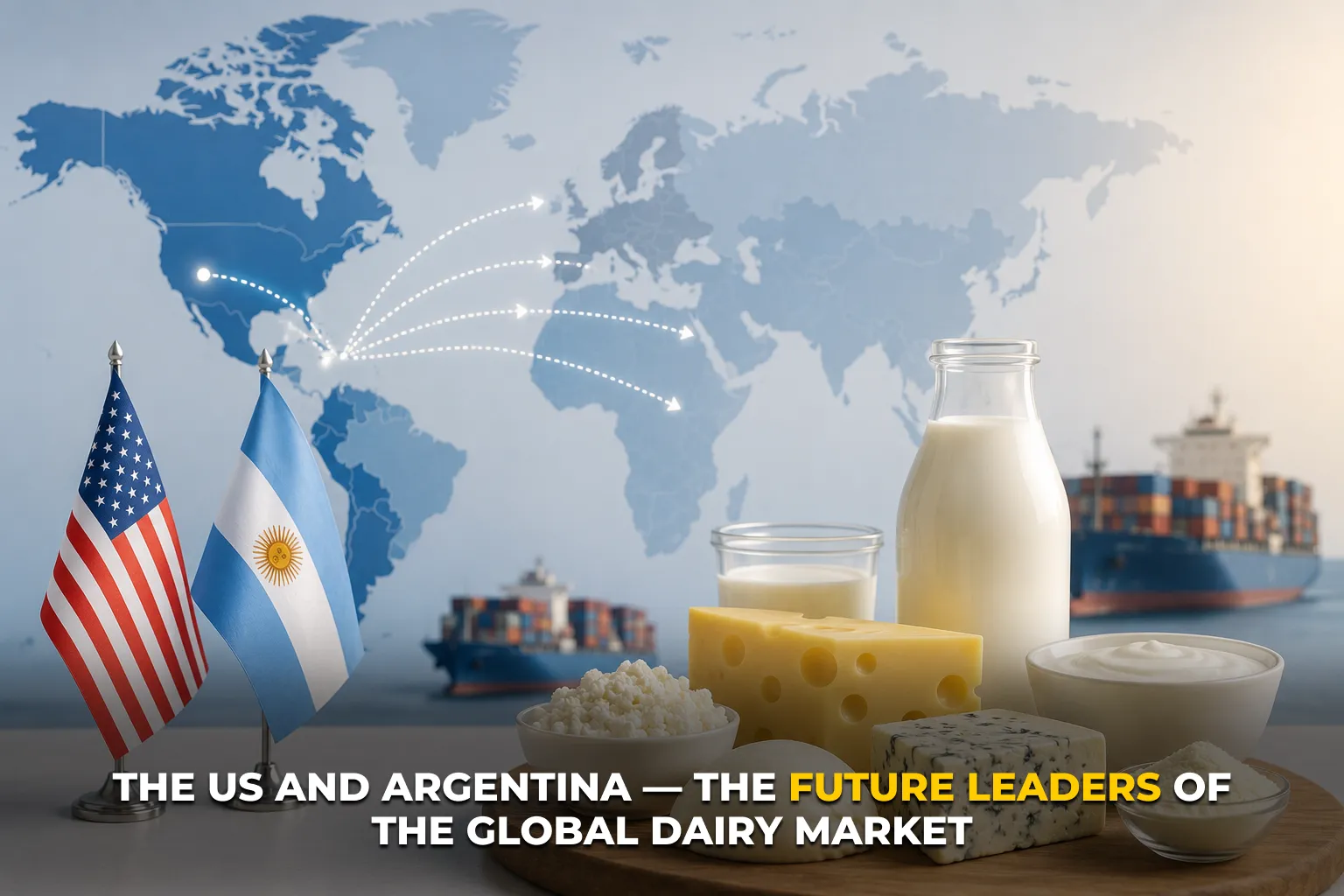
The US and Argentina are “best positioned” to win a bigger slice of global dairy trade as Europe runs into tighter production limits, Just Food reports, citing Rabobank.
In a new report on global dairy production, the bank said the market is entering a phase where export growth will lean less on established leaders like the EU and more on suppliers “able – and willing – to produce more milk”. Tom Booijink, senior dairy specialist at Rabobank, said the “balance of power is shifting”, with a “gradual redistribution of export share away from Europe toward more competitive and less constrained producers in the Americas”.
Trade grows, cheese leads
Global dairy trade rose 11% between 2017 and 2025, from 91.1 billion kg to 101.2 billion kg in liquid milk equivalents (LME), and is still expanding at roughly 2% a year, with cheese the main driver. Global cheese trade hit 8.96 billion kg in 2025 — up 40% on 2017 — as US and Argentine exports both doubled. “The US and Argentina stand out as the only major players both willing and able to significantly up production and address this increasing demand,” the bank said.
Europe’s role “increasingly constrained”
Rabobank expects Europe to stay “important” but sees its future role “increasingly constrained” by tighter regulation, an ageing farmer base and limited room to lift yields further. The EU still supplied 27% of global dairy exports in 2025 — 27.5 billion kg LME — but that is down from close to 30% in 2017. By contrast, the US raised its export share to 13.5% from 11.3%, while Argentina and Uruguay together climbed to 4.3% from 3%.
Argentina rebounds, US offers “predictable growth”
In Argentina, an 8% output drop in 2022–2024 gave way to 10% growth in 2025 and a further 7% rise in the first quarter of 2026, aided by a more business-friendly policy backdrop; much of that extra milk went to Brazil, where import demand has surged. The US offers a more “predictable growth story”, underpinned by a record dairy herd, favourable costs and heavy processing investment — cheese capacity alone grew 6% in 2025.
Demand shifts away from China
On demand, China remains the biggest importer, but softer purchases are steering exporters toward the Middle East, Southeast Asia and Brazil. Rabobank said those markets, alongside expanding cheese and whey demand, will keep reshaping trade flows even if overall growth stays near its long-term trend.
Source: Just Food