
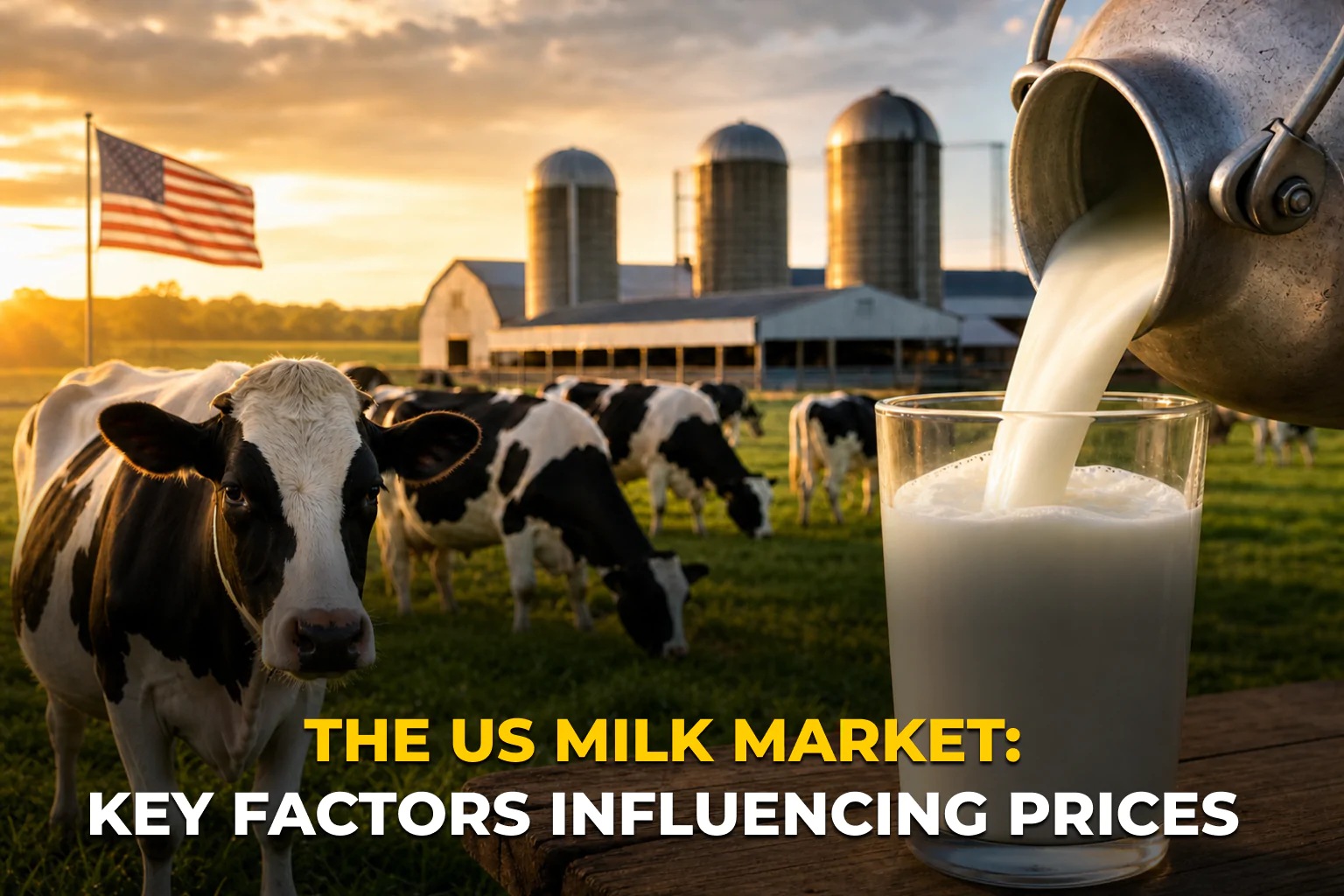
Milk prices in 2026 are showing unexpected resilience despite a sharp rise in supply, as demand for protein and stable exports are creating a new market balance, according to Dairy Herd Management.
As the calendar turned to 2026, the US dairy industry found itself at a difficult crossroads. The sector entered the year with a mixture of cautious optimism and pressure from a global market that was, in effect, oversaturated. The current situation increasingly resembles not a classic ‘boom-bust’ cycle, but a profound structural rebalancing shaped by record production, shifting demand, and geopolitical factors.
The milk tsunami
Milk production in the US rose significantly as early as 2025. By the end of the year, volumes had increased by 2.8%, and in the second half of the year, the growth rate accelerated to almost 4%. This trend continued into early 2026: production rose by 3.4% year-on-year, partly due to a 189,000-cow increase in the herd. Similar trends were observed in Europe, where production also rose by approximately 4% in the second half of 2025.
The milk surplus has begun to impose real physical constraints on the industry. In the US, particularly in California, there have been reports of milk being disposed of due to a lack of processing capacity. This highlights that even with stable prices, logistics and processing remain key bottlenecks in the market.
Despite this, prices have not collapsed — and the key factor has been a shift in the structure of demand. The market is increasingly focusing on protein.
“Consumers want more protein. There has been a convergence of GLP-1s, new Dietary Guidelines, and marketing dollars aimed at developing new products that have accelerated the demand shift. And high-protein dairy products are well-positioned to meet that need,” notes Terrain analyst Ben Laine.
The protein turnaround: why prices remain stable
The growing demand for high-protein products—yoghurts, ultra-filtered milk and concentrates—has radically altered price dynamics within the industry. Whey, previously regarded as a by-product, has become one of the key drivers of the market. At the same time, the reallocation of milk towards protein ingredients has reduced surpluses of skimmed milk, leading to a rise in the price of milk powder.
However, this balance is uneven. Whilst protein-based ingredients are showing growth, the butter and cheese segments remain under pressure, creating a fragmented market and increasing the risks of volatility.
“The support for milk prices right now is being driven by high whey and nonfat dry milk values as opposed to cheese and butter. Since that’s a reversal from the norm, the market might spook easily at any unexpected signals from the data over the next couple of months,” adds Laine.
The lifeline of exports and the shadow of the USMCA
Exports play a key role in balancing the market. In 2025, US dairy exports rose by 3.8%, reaching a value of $9.51 billion. A significant proportion of the produce, particularly cheese, is exported to foreign markets, which helps to absorb surpluses.
“Over the last two years, the majority of the new cheese made in the U.S. has gone into the global market as international demand surged. The international demand is also helping pull U.S. milk overseas,” notes William Loux of USDEC.
At the same time, the industry is closely monitoring the review of the USMCA trade agreement, as over 40% of exports are destined for Mexico and Canada. Access to these markets remains crucial for sustaining prices.
The outlook for 2026 remains moderately positive, but with a high degree of uncertainty. Average prices for Class III milk are expected to be around $17 per centner, and for Class IV milk around $19.5. A gradual decline is possible in 2027.
“Markets continue to move and have surpassed those forecast levels, but with the risk of more volatility. I’d view that as an opportunity to take some risk off the table rather than banking on prices continuing to rise,” concludes Laine.
Thus, 2026 is shaping a new reality for the dairy market: even with a supply surplus, prices may remain stable thanks to a shift in demand patterns and strong exports. At the same time, this balance remains fragile, and volatility will be a key factor in the coming period.
Source: Dairy Herd Management