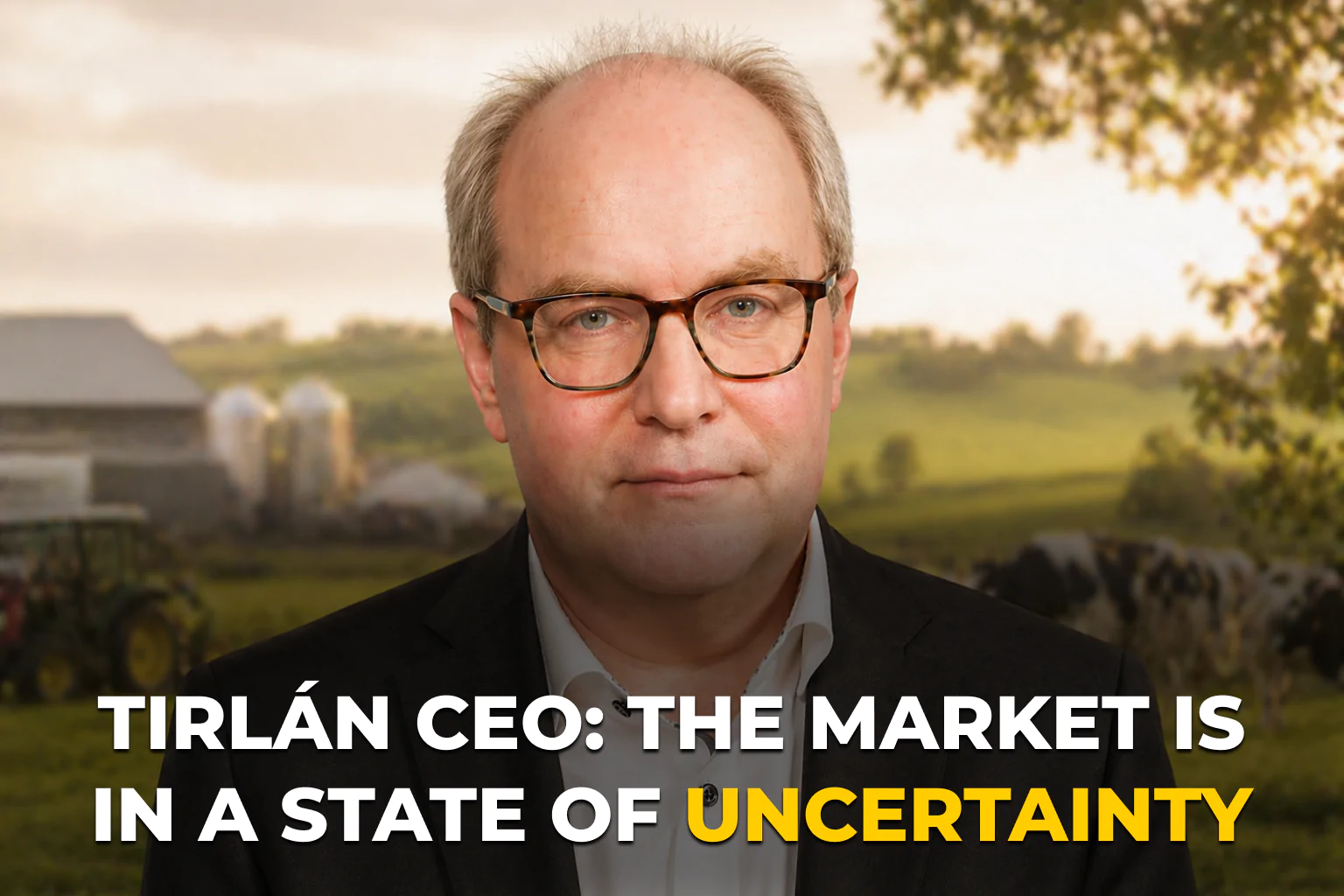
Global milk markets are experiencing high volatility, making it difficult to forecast prices and putting pressure on producers. According to Agriland, Tirlán is warning that farmers face a difficult period ahead.
High volatility in the dairy sector
Seán Molloy, the company’s CEO, stated that the current situation on international markets is unprecedented in terms of volatility.
“I’m 20 years in this business now. I’ve never seen such uncertainty and volatility in international markets that we’re witnessing now,” he said
According to him, following a positive 2025, the outlook for 2026 looks considerably less optimistic for both the cooperative and milk suppliers.
Milk prices do not cover costs
Molloy emphasised that, in some cases, milk prices do not cover the full cost of production, which creates difficult conditions for farmers.
“We are in a very challenged environment now insofar as that the milk price we’re paying, in some cases, isn’t covering the full cost of production. That’s a very difficult place for farmers to be,” CEO added.
He also noted that it is currently “very difficult” to forecast milk prices more than two to three months in advance.
Different trends across dairy product segments
Despite the general uncertainty, demand for dairy products remains relatively stable. At the same time, there are significant differences between individual categories.
“Protein is strong, which is very encouraging for folks like ourselves who invested in that space. But butterfat remains under challenge, and, in fact, it has declined in price over the last number of weeks,” Molloy said
According to Molloy, cheese prices have fallen significantly compared with last year:
“We are talking about a drop of around €700 per tonne.”
The growth in global milk production
According to the CEO, a correction in supply is needed to stabilise the market. However, this is not currently happening.
“If you look at the four or five largest exporting countries, they increased milk production by 4–5% in the first quarter of this year.”
This continues to put pressure on global dairy prices.
Tirlán’s pricing policy
The company has set the price of milk at 37.08 euro cents per litre for March and plans to maintain this price in April and May “barring unforeseen circumstances”.
Molloy explained that the price had been set above market levels to provide some stability for farmers:
“We came out last week and we wanted to present confidence to our farmers and give them some sense of stability.”
New entrants and industry prospects
According to the company’s estimates, 2026 will be a challenging year for new market entrants due to high production costs and investment requirements.
At the same time, Tirlán is rolling out its Generational Renewal Programme, which offers a bonus of 2 euro cents per litre to new participants for the first three years. It is expected that 52 new producers will join the programme this year.
Molloy noted that despite short-term difficulties, the long-term outlook for the dairy sector remains positive:
“This is going to be a challenging start. Having said that, and we have to stand back from it, the medium- to long-term outlook for dairying is really positive. This is a good business,” he said.
*Company profile:
Tirlán (known as Glanbia Co-operative Society Limited from 1999 until 2022) is an Irish dairy co-operative based in Kilkenny, Ireland. Its catchment area mainly covers the South-East and Midland regions of Ireland. Tirlán processes an annual volume of 3.2 billion litres of milk and handles 190,000 tonnes of green grain.
As of 2024 it has 2,300 employees and revenues of €2.53 billion. Tirlán is divided into three main business divisions: Agribusiness (retail stores and farm services), Consumer (consumer brands) and Ingredients (value added solutions).
The company rebranded as Tirlán following a corporate merger in 2022, in which ownership returned to its farmer-members. Its predecessor Glanbia plc will retain and continue to operate under the Glanbia name as an entirely separate entity. Tirlán remained the largest shareholder in Glanbia plc, with a 31.9% shareholding.Source: Agriland