
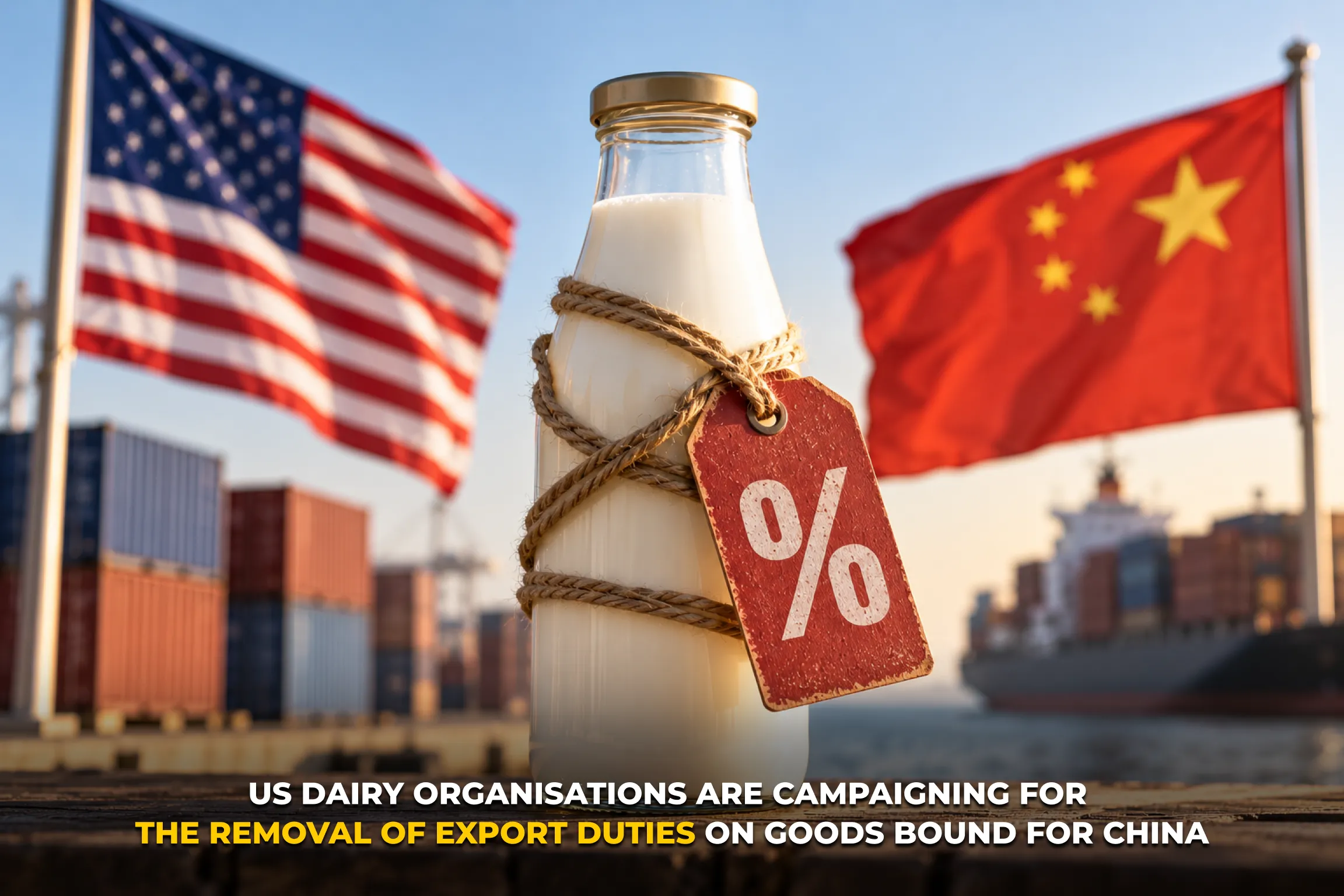
American dairy organizations push for full tariff elimination as international competitors expand their share of the Chinese market
Retaliatory tariffs are weakening US dairy exports to China while international competitors expand market share and industry leaders urge that the duties be eliminated, eDairy News reports.
Key points:
- the tariff truce has been extended through January 2027, and contested Section 301 maritime shipping levies are suspended;
- Chinese retaliatory duties remain fully active on key dairy categories, adding a financial surcharge to US shipments;
- New Zealand and Australia hold free trade agreements with China, and European processors are expanding in infant nutrition ingredients and whey powders;
- export channels absorb about 18% of total US milk production;
- trade representatives urge negotiators to grant full tariff exemptions.
Truce and the Board of Trade
Trade organizations representing American dairy producers have welcomed the operationalization of the bilateral Board of Trade between Washington and Beijing, while stressing that punitive retaliatory duties continue to suppress commercial export competitiveness.
The announcement follows a negotiated extension of the broader bilateral tariff truce through January 2027, which temporarily freezes further escalation and suspends contested Section 301 maritime shipping levies. But the retaliatory import duties imposed by Chinese customs remain fully active on key dairy categories, adding an immediate financial surcharge to American shipments entering mainland ports.
National leadership said that although negotiating tariff cuts under the new body is positive diplomatic momentum, US producers face an ongoing structural disadvantage in China for as long as the duties stay. Trade representatives are therefore urging negotiators to enact full tariff exemptions to restore parity for American exporters.
Plant-level impact and logistics
At plant level, tariff friction complicates throughput and bulk cargo logistics at major processing facilities in the Upper Midwest and the western dairy belt.
US dairy plants turn millions of pounds (hundreds to thousands of tonnes) of raw milk a day into specialised export ingredients, notably high-protein whey concentrates, permeates used in livestock feed and technical-grade lactose. Cooperatives and private manufacturers must coordinate packaging schedules, container freight bookings and customs classifications to minimise storage demurrage at departure terminals.
When retaliatory duties distort destination pricing, exporters often face container diversions or delayed offloading at major Asian ports, and plants must recalibrate spray-drying runs and storage allocation so that product specifications fit alternative destinations without sacrificing efficiency.
Competitors gain ground
The persistent tariffs have also changed competitive dynamics in China’s dairy import market, letting foreign suppliers take share once held by American cooperatives.
New Zealand and Australia operate under comprehensive bilateral free trade agreements with Beijing that give duty-free or preferential entry for bulk powders, anhydrous milk fat and natural cheese, while European processors have used commercial stability to expand in infant nutrition ingredients and high-grade demineralised whey powders.
Chinese buyers, dealing with domestic macroeconomic pressure and rising domestic fluid milk output, increasingly favour supply corridors free from tariff uncertainty. Trade economists note that every month the duties remain lets rival dairy basins lock in long-term supply contracts with Chinese food manufacturers, making lost volume very hard to win back.
Balance sheets and trade finance
On corporate balance sheets, trade friction with China absorbs liquidity and complicates trade finance.
Exports subject to retaliatory tariffs need larger working-capital commitments to cover extended payment cycles, fluctuating currency hedging costs and contingent tariff deposits at customs clearance, and banks and agricultural lenders must price in heightened counterparty risk when extending revolving credit for shipments to non-reciprocal markets.
The bilateral Board of Trade offers a route to stabilise cash flows, provided tariff reduction lists are implemented quickly. Freeing balance sheets from the tariff drag would release capital for plant modernisation, automated packaging lines and the decarbonisation technology needed to stay cost-competitive globally.
Impact on farms
Permanent tariff relief, the article concludes, is essential to protect farmgate milk prices and producer margins in rural communities.
Because export channels absorb about 18% of total domestic milk production, disruption in key markets such as China directly pressures component pricing under Federal Milk Marketing Orders and cooperative advance cheques. Weak export demand for whey proteins and dry milk solids pushes surplus component volume back into domestic manufacturing pools, depressing class prices and revenue for family-owned herds.
A predictable tariff schedule would let cooperatives negotiate multi-year supply contracts with firm farmgate payout floors against feed price volatility, and removing the remaining barriers would let American producers compete on commercial merit and sustain viable farms in future.
Source: eDairy News