
After many distribution centres and warehouses were destroyed, Ukrainian retailers are revising supplier terms. Ultimately, consumers may cover future losses through higher prices.
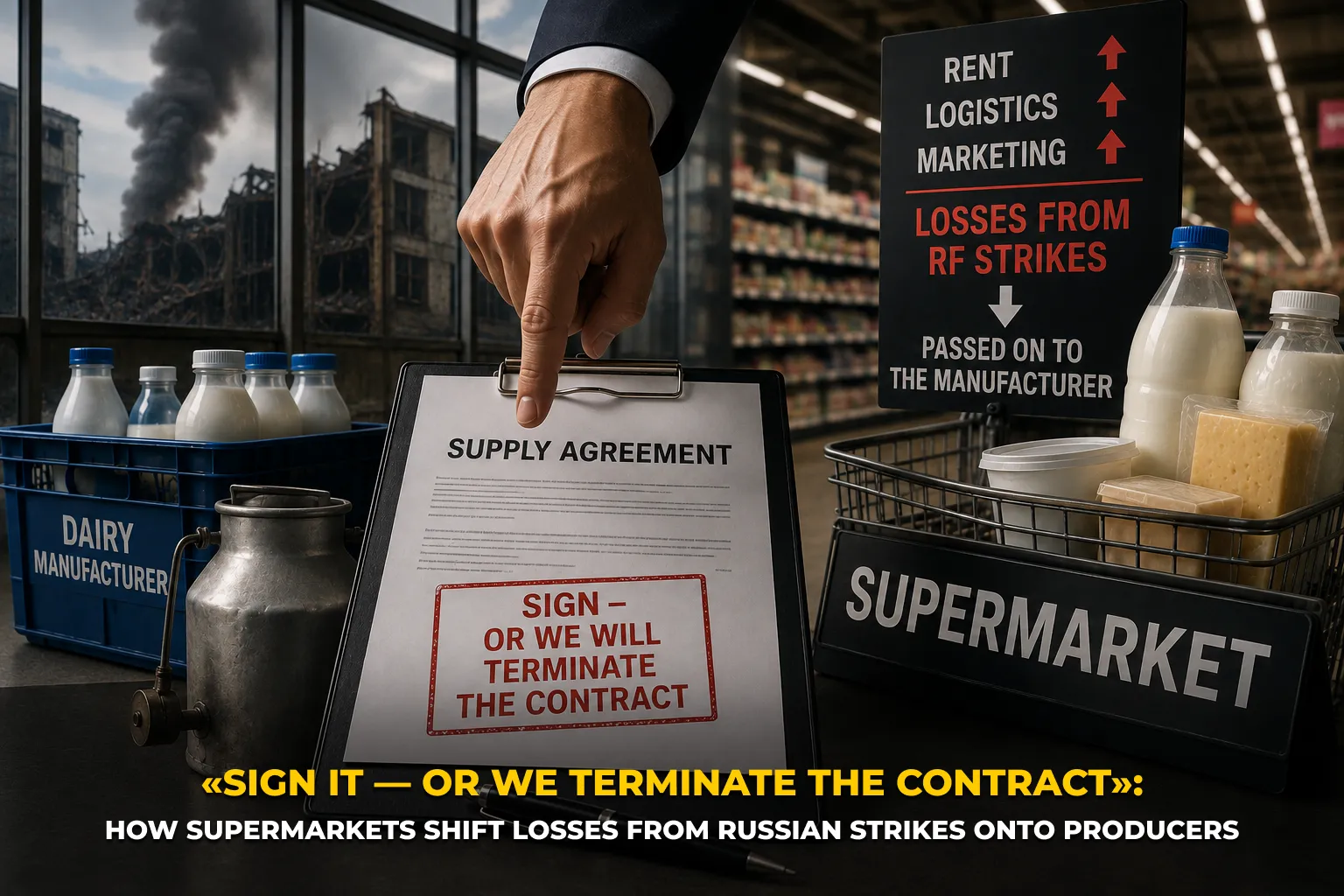
Ukraine’s largest supermarket chains have sent producers letters proposing a «risk-sharing mechanism» after russian strikes on distribution centres (DCs) and warehouses in early August, Ekonomichna Pravda reports.
Among the producers resisting these terms is the dairy industry, whose position is voiced by Arsen Didur, executive director of the Union of Dairy Enterprises of Ukraine (UDEU). Under the mechanism, if already-delivered goods are destroyed or damaged, producers would not receive half of their value — and Ukraine’s largest chain wants suppliers to bear all the risk from russian strikes.
Meetings in the government and at the President’s Office produced no result, and producers fear that once one company agrees, the chains will use it as leverage over the rest — with consumers ultimately feeling the effect of new strikes in their wallets.
How it worked before
Under current contracts, producers deliver goods to chains’ regional DCs or warehouses, and ownership legally passes to the retailer on delivery.
Payment is deferred — producers are paid 30–50 days after delivery, or sooner at a 3–5% discount. So at the moment of a strike, a producer has already paid for raw materials, made and delivered the goods, but not yet been paid.
After signing the «supplementary agreement», the chain could avoid paying more than 50% — or even the full value — of products it accepted and stored at its own warehouse.
What the chains want to change
On 3 June, a russian strike destroyed an ATB DC near Dnipro (37,500 sq m of goods burned). Since the start of 2026, attacks have destroyed three large ATB warehouse complexes.
On 5 August, russia hit five grocery-retail DCs in the Kyiv region in one night, halting a 50,000-sq-m Novus hub and four Fozzy Group centres serving Silpo and Fora.
Days later, ATB, Novus, Silpo and Fora emailed producers asking them to sign supplementary agreements quickly. Novus, Silpo and Fora demand «50/50» liability — the chain simply withholds half the deferred payment if goods are destroyed. ATB set the toughest terms: citing the 24 February 2022 martial-law decree, it wants ownership of destroyed goods deemed not to have passed to the retailer — leaving 100% of losses with the producer.
«If you don’t sign, we stop working with you», one producer complained.
Chains had already offered 50% compensation before the August strikes, says Didur, now they want to make it mandatory for all.
Attempts to negotiate, what the retail side says
Producers turned to industry associations, but two attempts by the UDEU and the Poultry Union brought no result.
At a mid-August meeting, «supermarket representatives said they did not want to debate with the industry and would speak only with individual producers one-on-one».
The UDEU advised members not to sign, as the liability does not match the transfer of ownership. A second attempt at the President’s Office (with deputy head Oleksii Soboliev and ministers Taras Vysotskyi and Oleksandr Kravchenko) saw producers propose legislative changes and compensation for goods destroyed at DCs.
So far, no producer has agreed. Of the chains, only ATB replied, calling the situation critical and the agreement «a subject of negotiation, not an ultimatum» — «a search for a balanced model of sharing extraordinary risks».
Both sides agree on one thing: war risks cannot rest solely on the chain–producer relationship, and state support and insurance mechanisms are needed — exactly what the Union of Dairy Enterprises has asked of the state.
Source: Ekonomichna Pravda