
How dairy processors improve efficiency with membrane concentration.
Milk concentration requires removing large volumes of water while maintaining product quality, throughput and stability. Membrane systems can cut the water removed by evaporation or drying, but the energy benefit depends on where membranes are used and how the whole process is designed, Dairy Foods reports.
Integrating membranes with thermal processing
APV’s Pranav Shah says processors increasingly adopt integrated architectures where membrane filtration and thermal technologies work together.
Reverse osmosis (RO) enables concentration and separation at lower energy and a smaller footprint than evaporators, while preserving proteins, flavours and nutrients. The biggest energy-reduction opportunities remain in heating, cooling, evaporation and thermal processing — via regenerative heat exchange, vapour recompression and recovery, and heat integration — and upstream membrane concentration lowers volumes entering evaporation and drying.
«The most effective results come from designing the plant as one fully integrated system rather than optimizing individual equipment in isolation», Shah says, adding that combining membrane concentration, heat recovery, vapour reuse, optimised CIP (clean in place) and automation compounds efficiency gains.
Staging UF, NF and RO — and managing fouling
GEA’s Shanti Bhushan says processors use several membrane steps in sequence: ultrafiltration (UF) first to retain proteins while passing water, lactose and soluble minerals, then RO or nanofiltration (NF) to raise solids before evaporation or drying — sometimes eliminating the evaporator, sometimes reducing its load.
For skim and whole milk, RO is among the most energy-efficient preconcentration options as it removes water without a phase change. As solids rise, processors must manage viscosity, osmotic pressure, scaling, transmembrane pressure (TMP) and crossflow.
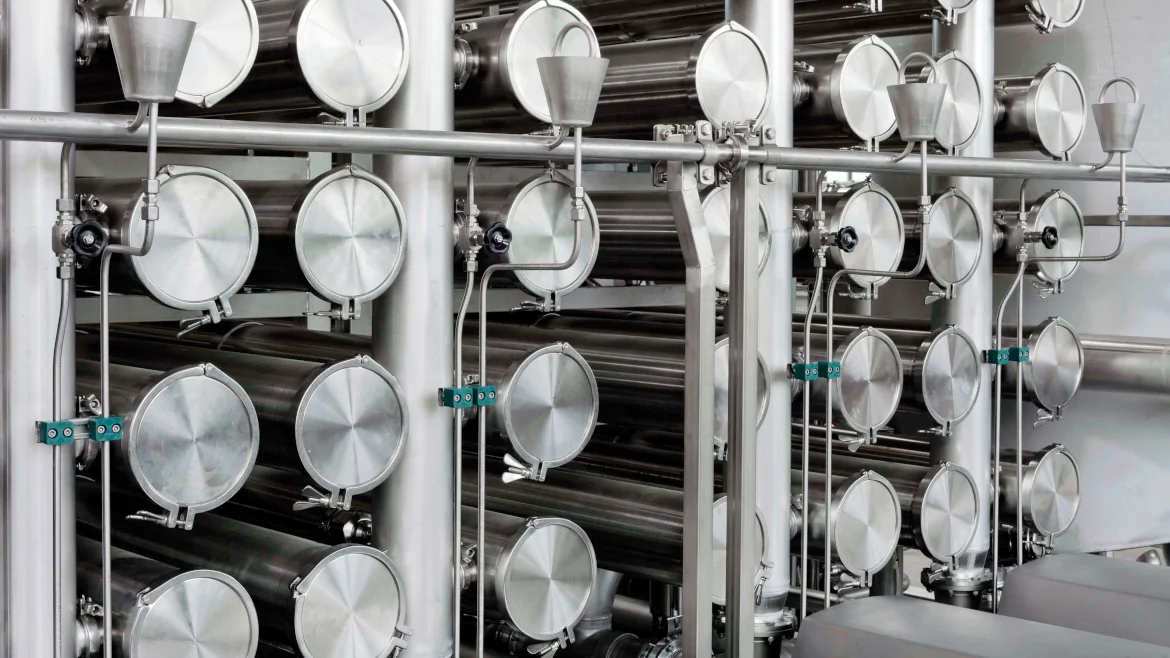
ZwitterCo’s Jon Goodman calls fouling — material building up on the membrane — one of the biggest challenges, cutting permeate flow and raising energy costs; developers pursue greater hydrophilicity, fouling resistance and new chemistries (e.g. zwitterionic) to lower total cost of ownership.
DuPont’s Jie Song, Ph.D., says newer elements (e.g. FilmTec Hypershell XP RO-8038) process more volume in the same footprint using less energy, many upgradable within existing systems.
Overall, removing as much water as possible before evaporation and drying, matched stage-by-stage and integrated with heat recovery, gives the best energy outcome.
Source: Dairy Foods