
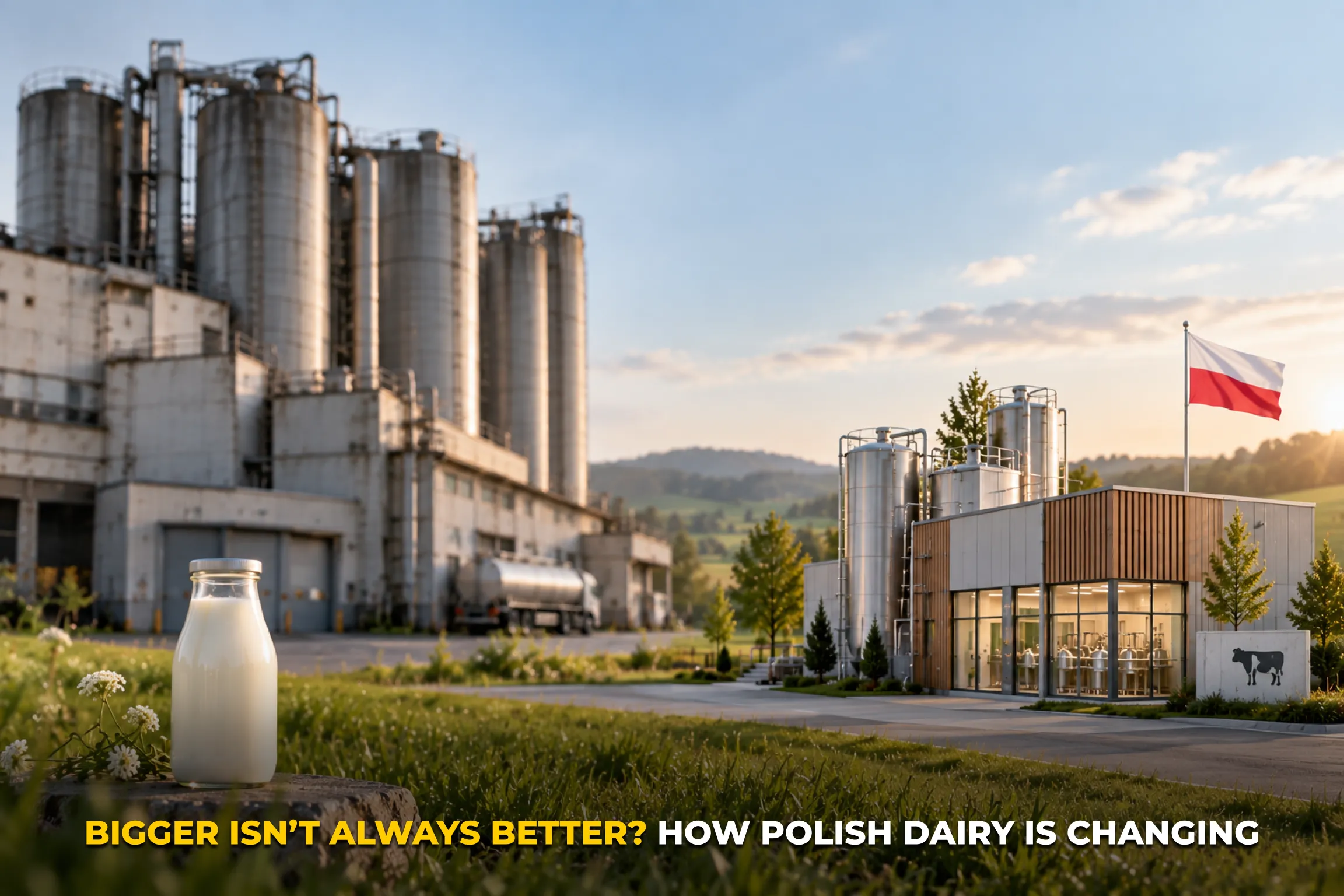
The dairy sector cannot build its future on scale alone. According to Maciej Tomaszewski, president of Hochland Polska, the coming years will place ever more weight on profitability, high-value-added products and a deliberately built export strategy.
At the 23rd International Dairy Community Forum in Białystok, Hochland Polska president Maciej Tomaszewski spoke about how Polish dairy is changing — and about the areas where competing companies should cooperate, top agrar reports.
Everyone must have their own strategy
A key panel theme was the strategy of Polish dairy to 2035. Tomaszewski stressed that an industry-wide strategy should not be set against individual companies’ plans.
«I cannot imagine there is any player that would not have its own strategy», he said.
Hochland still works to five-year strategies, he noted — a horizon that allows both investment planning and reaction to market change — yet there are areas where individual firms should act together, without giving up competition.
«We are all competitors, and that will not change», he underlined.
Joint action for the whole sector
Tomaszewski flagged four areas needing broader sector cooperation.
First, legislation and regulation, both national and EU-level — here he also pointed to energy and food security and business resilience.
Second, promoting dairy, including encouraging young people to take over farms and develop milk production.
Third, promoting dairy products to consumers — clearly communicating their value and countering disinformation.
The fourth pillar is export. Cooperation is needed where joint action benefits the whole sector, he said, while competition between firms is preserved.
«Bigger isn’t always better»
One of his most important theses concerned scale.
For years, higher output and expansion were the natural way to strengthen a market position; in the coming decade, size alone may no longer be enough. «It won’t necessarily be that those who grow bigger will be better than those who choose more wisely», he said.
Tomaszewski did not dispute the value of scale but argued that further expansion should be more targeted and pursued in specific directions — a point that matters for milk producers too, since raising volume alone does not decide the whole chain’s profitability.
Profitability over scale alone
One important direction, he argued, should be raising the share of high-value-added products.
«I think we should shift the emphasis slightly toward profitability — that is, products with high added value», he said, pointing to functional and branded products, though building one’s own brands takes time and investment.
For milk producers, this means that not only output and raw-material volume matter, but also its quality and how processing uses it.
Export must be more than selling surpluses
Export is a key growth direction for Polish dairy, but it should not be treated merely as a way to offload surpluses.
«Export cannot be treated on the basis of: we export surpluses», he stressed.
Companies should deliberately choose the geographies where they want to build positions over years — a long-term presence in specific markets, not just a current hunt for buyers. For producers, export growth widens the options for placing domestic output; it does not automatically raise milk prices, but can reduce the sector’s dependence on the home market.

Automation as the answer to demographic change
Another element of the industry’s future is operational efficiency, automation and robotics — driven partly by demographic change and labour-availability problems.
«Demographics are not processes that reverse even within a few years», he noted.
Technology therefore matters more and more for competitiveness, and milk farms face similar challenges as they seek to cut labour input and improve efficiency.
Competition and cooperation must go together
The vision does not mean giving up competition between dairies. Firms will keep competing but can cooperate where the whole sector’s interest aligns — above all on regulation, promoting dairy, consumer communication and export.
What does it mean for milk producers?
Tomaszewski’s remarks suggest the sector’s future need not rest on scale alone; profitability, added value, efficiency and the ability to build lasting positions in foreign markets will matter more.
For dairy farms, this means above all a need to keep raising efficiency and caring for raw-material quality, while a strong, competitive processing sector — able to place domestic output at home and abroad — remains essential.
His core message reduces to one idea: in future, a dairy position may be decided not by who is biggest, but by who best chooses their direction of development.
Author of the article: Krzysztof Zacharuk, source: top agrar