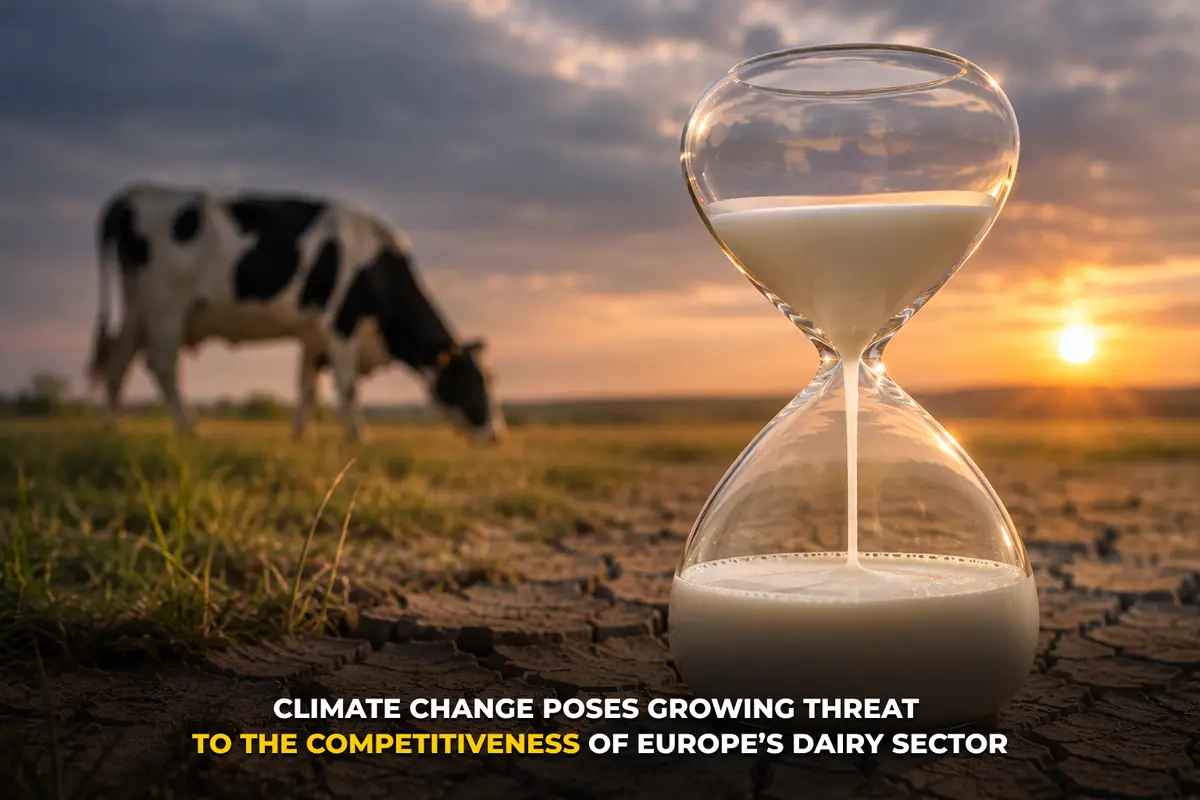
European dairy production is coming under increasing pressure as climate change and rising heat stress in cows threaten milk yields and competitiveness, according to Rabobank, DairyReporter reports.
Key points:
- annual heat-related milk losses in Europe could rise from around 4.5 million tonnes today to around 12.5 million tonnes by 2050;
- current losses equal 2.8% of EU raw milk output and could reach around 7.5% in future;
- higher-yielding cows are more vulnerable to heat stress;
- farmers need to strengthen cooling, feeding and herd management, while processors need to support on-farm investment.
Losses could almost triple
In its paper «Europe’s dairy comfort zone is moving», Rabobank estimates that under a global warming scenario, annual heat-related milk losses across Europe could rise from around 4.5 million tonnes in today’s climate to around 12.5 million tonnes by 2050.
EU farms produced 159 million tonnes of raw milk in 2025. Current heat-related losses are equivalent to 2.8% of output, while future losses could be around 7.5%.
A major challenge is that higher-yielding cows are more vulnerable to heat stress, while certain breeds tolerate heat and humidity better, so the impact will differ across Europe’s dairy regions.
Traditionally «cool» regions under pressure too
Rabobank said rising temperatures and changing rainfall patterns are unlikely to displace dairy production from Europe but may affect its competitiveness.
Europe’s leading dairy regions, including Ireland, the Netherlands, northern France, Germany, Poland and Denmark, have historically had limited exposure to heat stress. But they will face growing pressure on cow welfare, milk yields and the reliability of milk supply.
The major production centres in northern Italy, southern Germany, France and Spain face a marked increase in potential milk losses, which could require costly adaptation in an industry already under pressure from high EU production costs.
Adaptation could limit the impact
However, Rabobank said climate adaptation could limit the impact. Farmers need to strengthen cooling, feeding and herd-management strategies, while processors need to support on-farm investment and build flexibility into sourcing, infrastructure and operations.
Rabobank pointed to farmers in Israel and Saudi Arabia who have adapted and increased production in hotter environments. Processors can also encourage climate-resilient farming through technical assistance, knowledge sharing, financial incentives and more flexible sourcing and processing.
«The biggest impact of heat stress is not just lower milk production per cow. As extreme heat becomes more frequent, milk supply to dairy processors will also become less predictable. That could lead to underutilised processing capacity and higher costs, turning climate change into a competitiveness issue for the European dairy industry», said Tom Booijink, Senior Dairy Specialist Europe & Africa at Rabobank.
«In Greece, dairy farmers have already adapted by shifting milk production away from the hottest summer months to reduce heat stress on their cows. As temperatures rise, we are gradually seeing this pattern extend further north in Europe», he added.
«Parmigiano Reggiano can only be produced in a specific area of northern Italy. So if heat stress increasingly affects milk production there, you cannot simply move production to a cooler part of Europe».
Source: DairyReporter